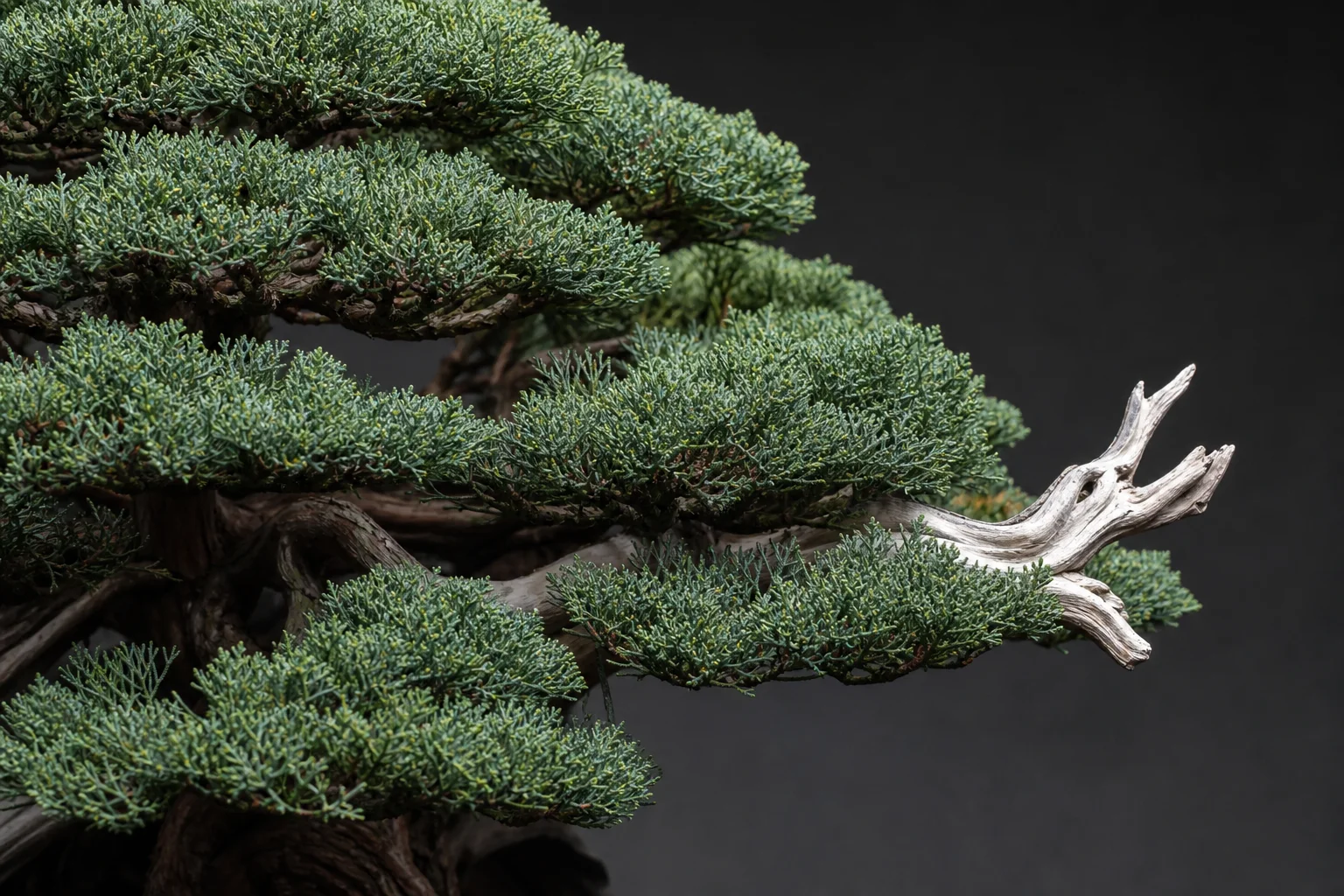
Chinese juniper (Itoigawa) bonsai care
Juniperus chinensisThe connoisseur's juniper. Finer foliage, more dramatic deadwood potential, and the species behind most world-class juniper bonsai.
Water
Every 2 days
check daily in summerLiquid feed
Every 14 days
growing seasonSolid feed
Every 28 days
slow releaseRotate
Every 30 days
even canopy growthWhere Juniperus procumbens is the species most beginners start with, Juniperus chinensis is the species most experienced growers end up with. The Itoigawa cultivar in particular — selected from wild trees on a specific mountainside in Niigata Prefecture, Japan — produces an unusually fine scale foliage in a rich blue-green, and the species' wood carves into deadwood features (jin and shari) more dramatically than almost any other bonsai genus.
This is the juniper behind most of the famous Japanese masterpieces. It's not difficult in any individual aspect but it rewards experience: timing of pinching and wiring, the patience for deadwood to weather naturally, the eye for asymmetric design. New growers should probably start with procumbens and graduate to chinensis after a couple of years.
The two main forms you'll encounter are Itoigawa (fine blue-green foliage, the standard for refined work) and Kishu (slightly coarser, brighter green, more vigorous). Both are excellent.
Native across China, Korea, Japan, Mongolia, and into the Russian Far East. Adapted to mountain conditions — exposed rocky slopes, poor lean soils, harsh winters, full sun. The Itoigawa form was selected from mountain trees in the Niigata region of Japan, where dramatic deadwood-rich specimens grow naturally on the cliffs around the Itoigawa river.
Seasonal calendar
Timing is for South East England. Select your region above to see adjusted guidance.
- Heavy structural wiring on dormant trees
- Deadwood carving
- Continue styling work
- Plan repotting
- Watch for root activity
- Final winter wiring
- Repot when root tips visible
- Move into full sun position
- Begin pinching strongest growth
- Start light liquid feeding
- Continue pinching in waves
- Second slow-release feed
- Maintain dry/wet watering cycle
- Continue pinching
- Wiring window opens late month
- Take cuttings if propagating
- Stop feeding
- Prime month for styling work
- Continue wiring
- Reduce watering frequency
- Heavy structural work and deadwood carving
- Position for winter
- Continue wiring on dormant trees
- Minimal watering
Watering
Water when the surface of the substrate has dried — typically every 2–3 days in summer, every 4–7 days in spring and autumn, every 7–14 days in winter. Chinese junipers tolerate dryness better than wetness; the most common cause of death is overwatering.
Water thoroughly when you water — until it runs from the drainage holes — then let the substrate dry between waterings. This wet-dry cycling is what juniper roots want.
Tap water is fine. Foliage handles overhead watering well in most conditions but avoid wetting it heavily in still, humid evenings.
Feeding
Light feeding. Half-strength liquid feed every two weeks from May through August. Slow-release organic pellets in spring (April) and early summer (June). Stop feeding by early September.
Heavy feeding produces coarse, juvenile-style needle foliage instead of the fine scale foliage that's the species' main aesthetic asset. Some growers feed mature show-quality trees only with organic pellets and avoid liquid feed entirely.
Soil & Repotting
Very free-draining. Junipers tolerate poor substrates better than rich ones.
50% pumice, 30% akadama, 20% lava in 2–6mm grade. For trees in development or recovery, more pumice (60–70%) helps establish strong roots. Pure pumice works for collected material in recovery boxes. Avoid organic-rich potting mixes.
Repot every 3–5 years on established trees. The window is late March to early May — wait for visible root activity (new white root tips at drainage holes, or new shoot extension above). Chinese junipers tolerate root work poorly. Remove no more than a quarter of the root mass on healthy trees. Don't bare-root. Preserve the mycorrhizal fungi — they're partly responsible for the species' health.
Keep freshly repotted trees out of strong sun and wind for at least three weeks afterwards. Water carefully — slightly drier than usual — until you see new shoot extension confirming the roots are working.
Pruning
Junipers are pinched, not cut. Pinch out soft growing tips with clean fingertips through the growing season — May through August. Don't use scissors on scale foliage; cut tips brown immediately and stay brown for months.
Pinch in waves rather than all at once. Work through the tree over four to six weeks, pinching the strongest growth first and leaving weaker areas alone so they catch up. This is how energy balance is maintained.
Major branch removal happens in late winter or early spring before growth begins. Cuts heal slowly — consider leaving stubs to be carved into jin rather than cutting flush.
Heavy structural work is best combined with substantial deadwood. Itoigawa wood carves beautifully and bleached deadwood is a defining feature of refined specimens.
Wiring & Styling
Wire is fundamental to juniper styling. Apply from late summer (August) through to early spring (March). Itoigawa branches are flexible and take wire well — major bends are possible without breaking. Use copper for structural branches, aluminium for finer work.
Wire can stay on for 6–18 months. Check every two months — the bark is reasonably forgiving but wire can still bite in during summer growth flushes. Branches set well and usually hold their position after wire removal.
Be ambitious. Itoigawa rewards dramatic styling — branches bent in tight curves, trunks twisted into spirals, the wood manipulated into shapes that look impossible.
Informal upright, cascade, semi-cascade, windswept, literati, and root-over-rock all work brilliantly. Deadwood is a defining feature of the best Itoigawa bonsai — substantial jin and shari read as natural mountain weathering and dramatically extend the design possibilities.
Formal upright and broom styles don't suit the species. Most refined Chinese junipers emphasise asymmetric, dynamic compositions where deadwood and living veins create visual tension.
Winter care
Properly hardy in the UK. Down to -10°C with no protection. Below that, shelter from wind. The species evolved on exposed mountains and shrugs off cold; the bigger UK winter concern is damp, not freezing.
Position pots with morning sun rather than afternoon sun in winter — sudden warming followed by hard freezes is harder on roots than steady cold.
Never bring indoors. Junipers cannot live indoors.
Propagation
Cuttings (semi-hardwood, August–September) — moderate success rate, the standard route. Air layering is possible but slow. From seed produces juvenile needle foliage for many years and is rarely used for bonsai. Most quality Itoigawa material in the UK is imported from Japan or grown by specialist UK nurseries from cuttings of established mother trees.
Common problems
Generally healthy when grown outdoors correctly. Most problems trace back to overwatering, poor airflow, or attempting techniques the tree isn't strong enough for.
Phytophthora root rot
Symptoms: Whole branches or whole tree collapse; foliage greys uniformly; soil smells sour.
Cause: Saturated substrate, often combined with cold.
Solution: Usually fatal once symptoms appear. Prevention via free-draining substrate and careful watering. Emergency repot into bone-dry pumice can occasionally save a tree caught very early.
Spider mites
Symptoms: Foliage greys and looks dusty; fine webbing visible if you tap a branch over white paper.
Cause: Hot dry weather, still air, sheltered position.
Solution: Thoroughly hose foliage including underside, repeat every 3 days for 2 weeks. Improve air circulation. Neem if severe.
Juniper rust (Gymnosporangium)
Symptoms: Bright orange jelly-like galls on branches in wet spring weather.
Cause: Fungal disease with alternate host (usually hawthorn or apple).
Solution: Remove galls promptly. Bin (not compost). Move away from any nearby Rosaceae if possible. Copper fungicide as a preventative in early spring if recurring.
Reversion to juvenile foliage
Symptoms: Tree produces longer, sharper needle-like foliage instead of fine scale foliage.
Cause: Stress response — overwatering, hard pruning, repotting shock, or vigorous growth on young material.
Solution: Reduce stress factors. Maintain consistent care. Juvenile foliage will gradually convert back to scale foliage as the tree settles, usually over one to two seasons.
Loss of interior foliage
Symptoms: Outer pads thicken while inner foliage browns and dies.
Cause: Light blocked by dense outer growth.
Solution: Thin outer pads selectively in summer to let light reach the interior.
Yellowing during summer
Symptoms: Foliage turns yellowish overall, sometimes with bronze tint.
Cause: Stress — usually root issues from overwatering or nutrient deficiency.
Solution: First check the substrate moisture. If wet, ease back on watering and improve drainage. If substrate is fine, light feeding may help.
Popular cultivars
The refined cultivar. Fine blue-green scale foliage, exceptional ramification potential. The choice for show-quality work.
Slightly brighter green and more vigorous than Itoigawa. Excellent for development; many growers prefer it for the first decade of work.
Umbrella term in Japan for cultivated forms of J. chinensis. Most bonsai-grade chinensis sold in the UK is some form of shimpaku.
A different variety of J. chinensis with a more prostrate growth habit. Useful for cascade work.
Track your Chinese juniper (Itoigawa) with Kentai.
Collection tracking, care logs and photo history are free — no card, no time limit.
More care guides
Other Juniperus guides: Juniper procumbens 'Nana'
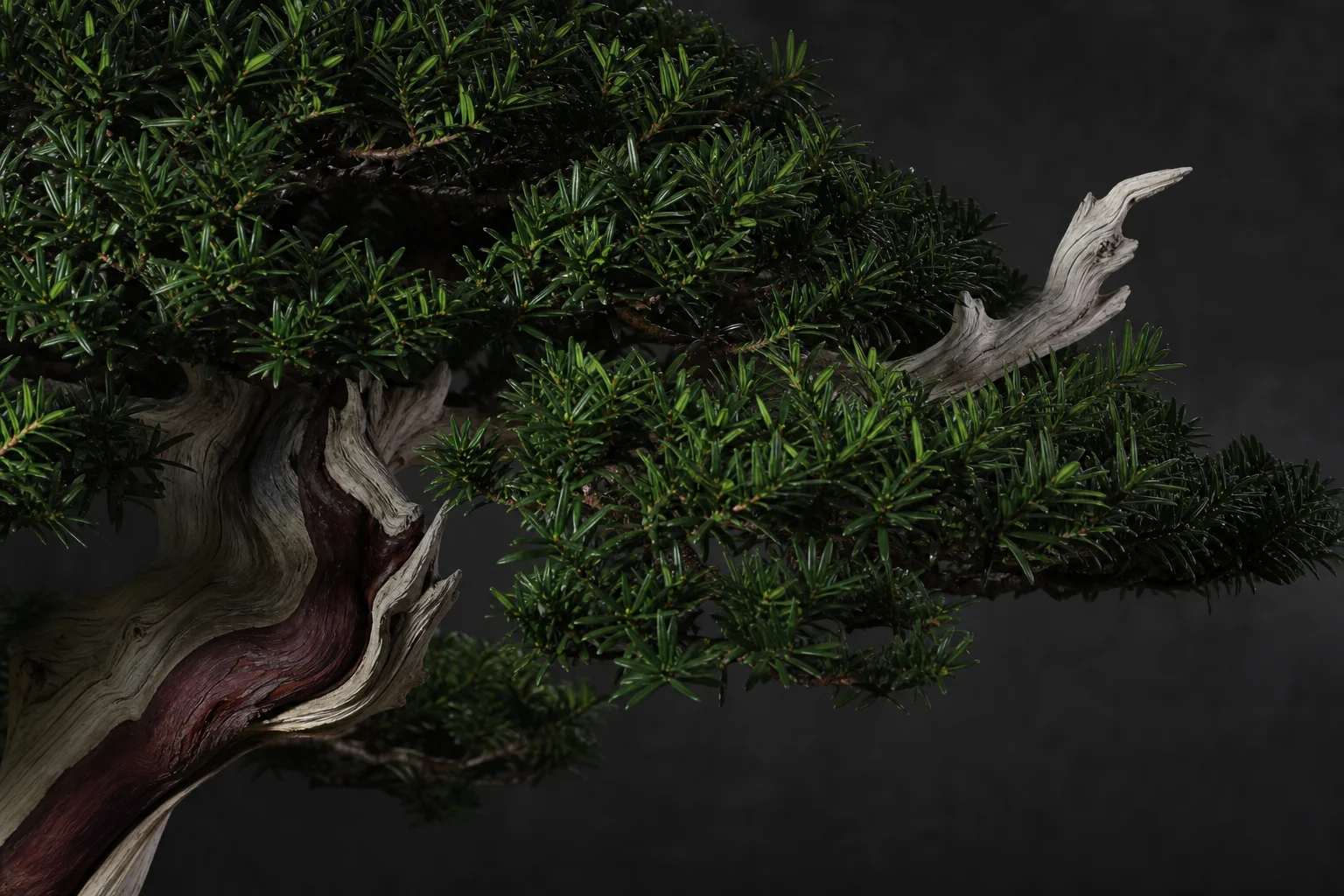
English yew
Taxus baccataThe oldest living things in Britain. Dark green needles on the youngest twigs, deep red heartwood for deadwood, and a capacity for back-budding that no other conifer matches.
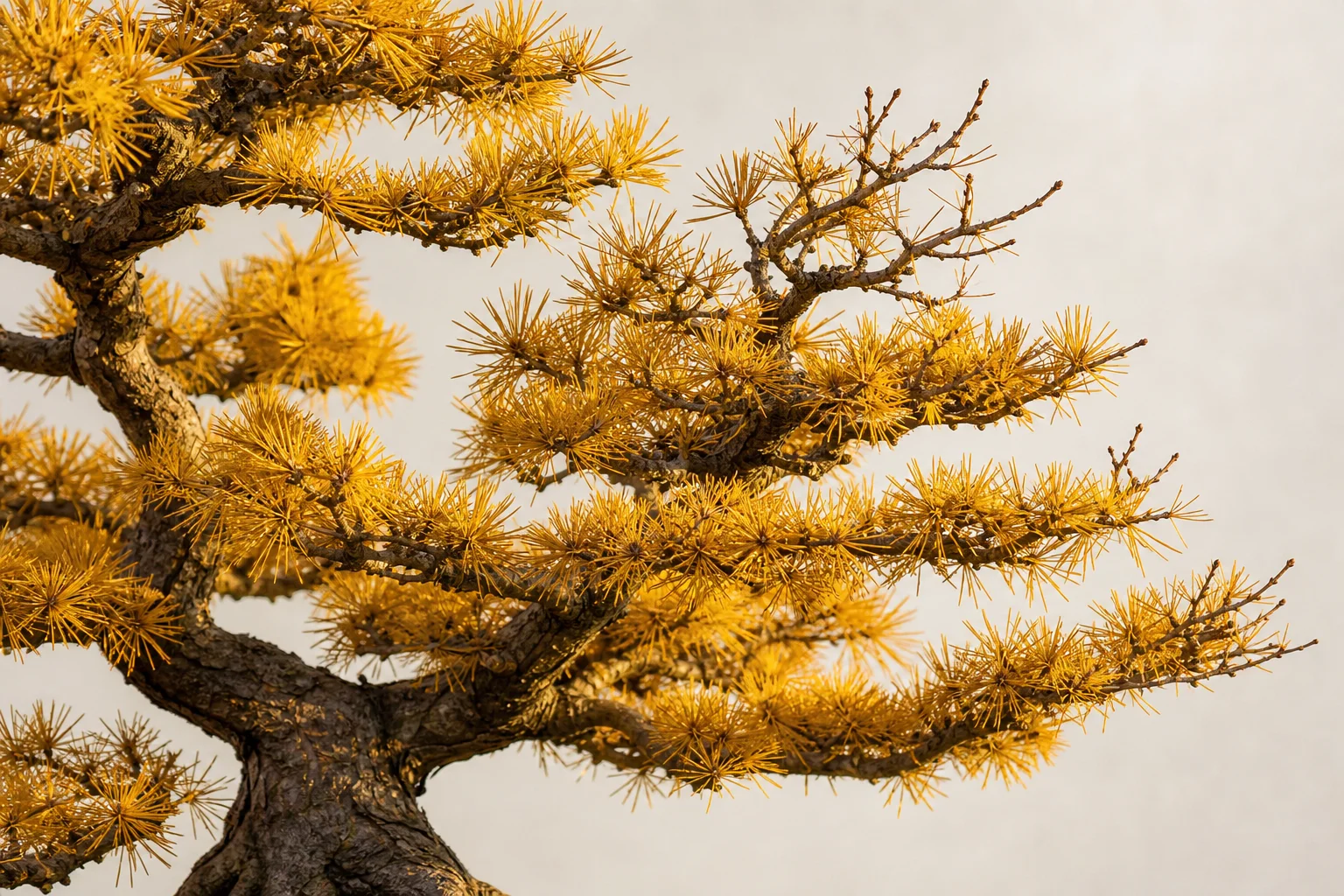
European larch
Larix deciduaThe deciduous conifer. Soft acid-green needles in spring, gold in autumn, bare in winter — and one of the toughest bonsai species in the UK.
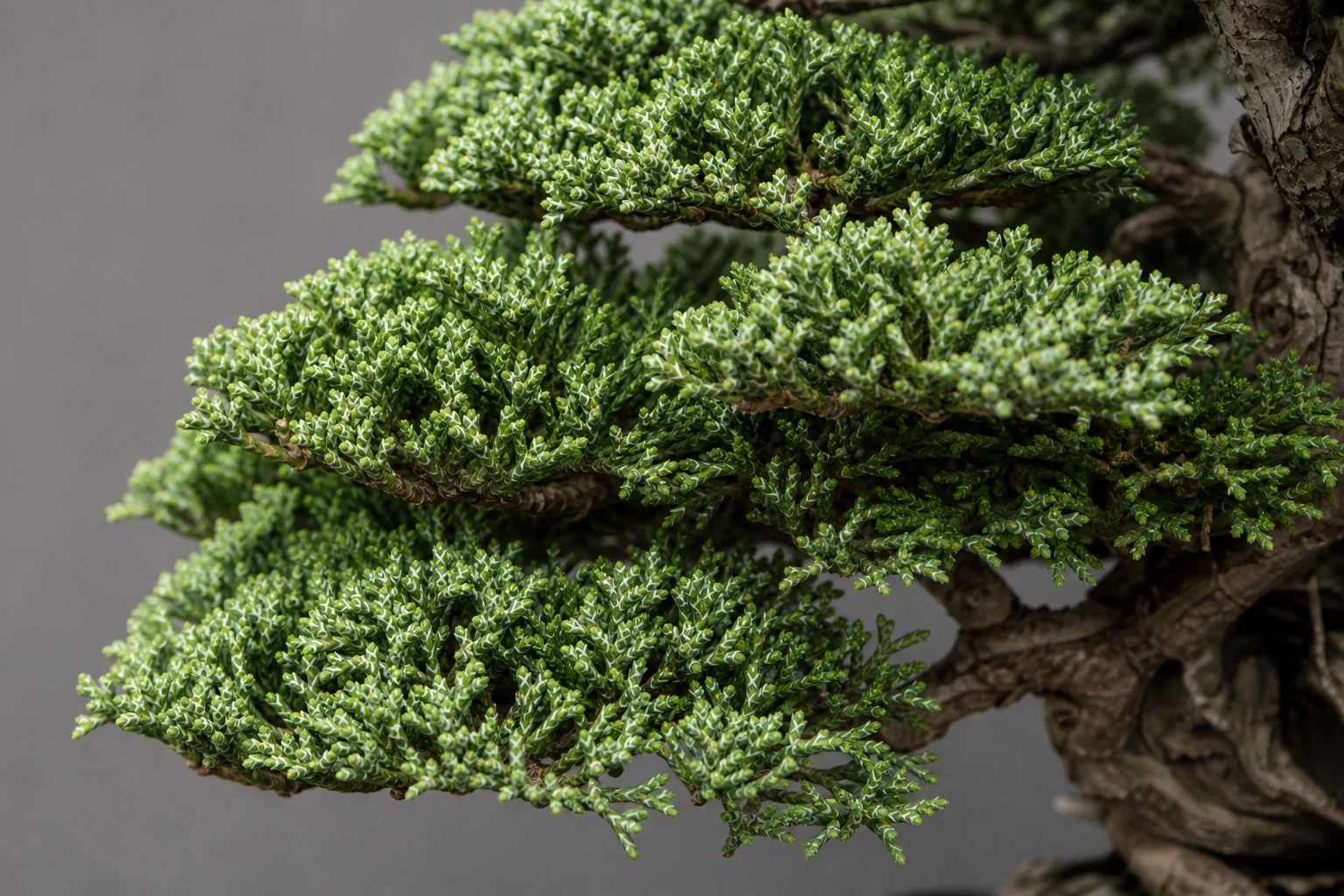
Hinoki cypress
Chamaecyparis obtusaDistinctive scale-like foliage with white markings on the underside, refined ramification potential, and a tradition stretching back through Japanese temple culture. The conifer for growers who find pines and junipers too familiar.