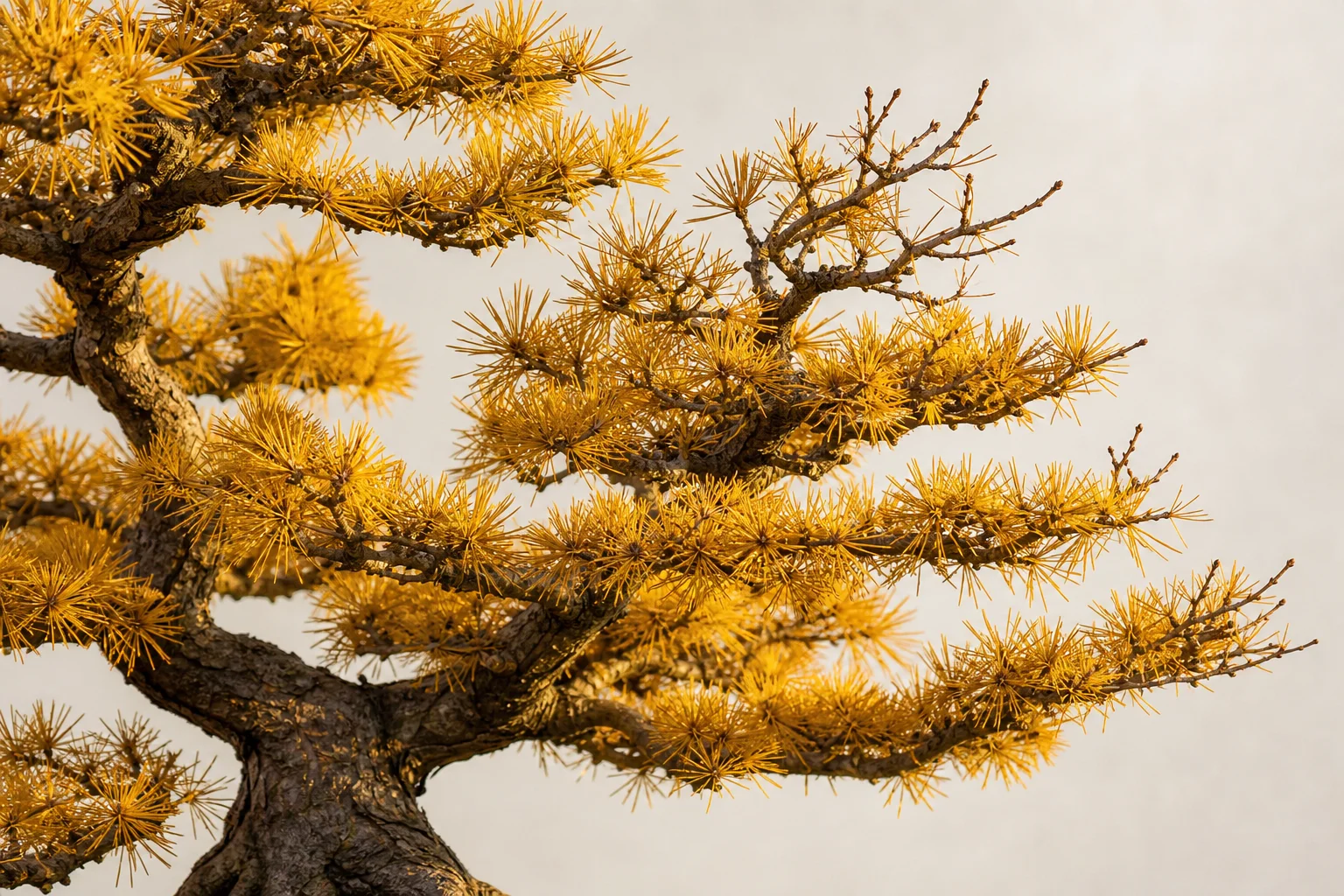
European larch bonsai care
Larix deciduaThe deciduous conifer. Soft acid-green needles in spring, gold in autumn, bare in winter — and one of the toughest bonsai species in the UK.
Water
Every 1 day
check daily in summerLiquid feed
Every 7 days
growing seasonSolid feed
Every 28 days
slow releaseRotate
Every 21 days
even canopy growthLarch is the bonsai species that breaks people out of the conifer-vs-deciduous mental model. It's a needle-bearing conifer that drops its needles every autumn, leaves a clean silhouette through winter, and pushes fresh acid-green needles in spring with all the visual impact of a deciduous flush. Mature larch bonsai in winter — bare, with their straight strong trunks and fine twiggy ramification — read as elegantly as a winter Japanese maple.
The species is also one of the most rewarding for UK growers. It's hardy beyond anything the British climate produces, it grows fast (one of the fastest UK conifers), it back-buds reliably, it tolerates hard pruning, and substantial collected material is widely available — Larix decidua is planted commercially across upland Britain for timber, and forestry thinning operations regularly produce decades-old trees with good trunk character.
For someone who wants a conifer but is intimidated by pine pruning, larch is the easier alternative. It's also one of the few conifers that handles repotting and root work without the recovery patience that pines demand.
Native to the mountains of central and eastern Europe — Alps, Carpathians, Sudetes. Widely planted across upland Britain for timber, and naturalised in many Scottish and Welsh forests. Larix kaempferi (Japanese larch) and the hybrid Larix × marschlinsii (Dunkeld larch) are also commonly grown in the UK and make equally good bonsai with near-identical care.
Seasonal calendar
Timing is for South East England. Select your region above to see adjusted guidance.
- Repot if convenient — window is open
- Structural pruning while fully dormant
- Main repotting window
- Continue structural work
- Complete repotting before buds break
- Watch for early bud swell
Larch wakes early — don't miss the repot window.
- New needles emerge
- Begin daily watering
- First slow-release feed
- Candle pinching on strong shoots
- Start weekly liquid feed
- Continue light pinching
- Watch for sawfly larvae
- Twice-daily watering in heat
- Avoid heavy pruning
- Reduce feeding end of month
- Wiring window opens
- Stop feeding
- Needles begin gold transition
- Peak gold autumn colour
- Wiring window prime time
- Needle drop complete
- Heavy structural and styling work
- Continue winter work on bare trees
- Minimal watering
Watering
Daily through the growing season. Larch is thirstier than most conifers — closer to a maple than a pine in water demand. The soft summer needles transpire heavily and a pot allowed to dry will scorch needles at the tips, after which they brown and don't recover that year.
In winter (after needle drop) watering reduces dramatically — the tree is genuinely dormant and the bare branches transpire minimally. Check every 5–10 days through winter and water only when the substrate has dried.
Tap water of any hardness is fine. Larch tolerates UK water without complaint.
Feeding
Weekly liquid feed from when new needles emerge in April through to mid-August. Slow-release organic pellets in spring and early summer. Stop feeding by end of August — the species needs time to harden growth before autumn dormancy.
Larch responds well to consistent feeding without producing the coarse foliage that overfeeding causes in pines. A well-fed larch produces longer needles but the deciduous habit means each year's needles are temporary anyway — coarse spring growth still drops in autumn.
Soil & Repotting
Free-draining and slightly acidic. Larch is unfussy about substrate compared to pines.
50% akadama, 30% pumice, 20% lava in 2–6mm grade. For trees in development or collected material in recovery, more pumice (60%) helps with root establishment. Avoid organic-heavy potting mixes.
Repot every 2–3 years for young trees, every 3–5 for established specimens. The window is earlier than for most species — late January through mid-March, before buds swell. Larch wakes up early, often pushing new growth by mid-March even in northern regions, so the repotting window can close before you expect.
Larch tolerates root work better than most conifers. Up to a third of the root mass can be removed on healthy trees. Don't bare-root — mycorrhizal fungi are important to the species' vigour, particularly on collected material.
Collected wild material (typically from forestry plantations) potted up in late winter usually recovers strongly through the first growing season. Use coarse pumice-based substrate in deep wooden boxes for the first 2–3 years.
Pruning
Larch pruning is between pine and deciduous in technique. The species back-buds reliably on old wood — better than any pine — but the seasonal pattern of work is more conifer-like.
Spring (April): New needles emerge from buds. Let them extend.
Candle pinching (May): Pinch back the strong new shoots when they're 2–3cm long, before needles fully extend. Pinch back to a couple of needle bundles. Strong shoots can be reduced harder than weak ones — this is how energy is balanced. Unlike pine candle work, larch can be partially pinched continuously through May and into early June rather than in a single timed operation.
Summer: Light pinching of strong extending shoots can continue. Avoid heavy work in July and August.
Structural pruning (winter, November–February): Major cuts on dormant trees. Larch heals slowly but reliably; seal large wounds.
Larch will back-bud freely from bare wood given a season of strong growth, which means hard cutbacks recover well. This is the conifer to learn structural pruning on.
Wiring & Styling
Wire from autumn (October–November) through to early spring, on dormant trees. Larch branches are flexible and take wire well. Use copper for structural work, aluminium for finer branches. Check every two months — larch thickens fast in summer and wire can mark.
Bark is relatively forgiving but young smooth bark marks faster than older fissured wood.
Informal upright is the most common style and what most collected forestry material naturally suggests. Twin-trunk and forest plantings are particularly fine — a forest planting of larch in winter, with bare branches against a contrasting background, is one of the most photographed bonsai compositions in the UK and Europe.
The species also suits literati (bunjin) styling on suitable material — a tall slender trunk with foliage clustered near the top references the way larch grows on exposed upland sites. Cascade and semi-cascade are uncommon but possible. Avoid formal upright and broom styles; they don't suit the species' natural form.
Deadwood is acceptable but less dramatic than on Scots pine or juniper. Larch deadwood weathers to a warm grey rather than the silver of pine and the white of juniper.
Winter care
Fully hardy across the UK with no protection needed. Larch tolerates -25°C in the wild and handles British winters without complaint. The bare winter silhouette is a major aesthetic feature — don't try to keep needles on the tree past autumn.
Pots in exposed positions benefit from shelter from prevailing wind in late winter to protect swelling buds. Otherwise no special protection needed.
Never bring indoors. The species absolutely requires cold dormancy.
Propagation
From seed (autumn-sown, cold-stratified) — straightforward and produces variable seedlings useful for development. Cuttings rarely succeed on Larix decidua specifically (Larix kaempferi roots more easily). Air layering is possible but slow. The most rewarding sources of larch bonsai material in the UK are collected forestry trees (with permission) and nursery-grown young material developed over 10–15 years.
Common problems
Generally healthy. Larch is among the most trouble-free conifers in UK cultivation.
Larch canker (Lachnellula willkommii)
Symptoms: Sunken cankers on branches and trunk, sometimes with resin bleeding. Bark dies in patches.
Cause: Fungal disease, more common on stressed trees.
Solution: Remove affected branches well below visible damage. Disinfect tools between cuts. Keep tree vigorous with consistent feeding and watering. Severely affected trees may not recover.
Larch sawfly
Symptoms: Caterpillar-like larvae feeding on needles in early summer, sometimes defoliating sections.
Cause: Common pest of larch across Europe.
Solution: Hand-pick where possible. Bacillus thuringiensis spray if severe. Trees usually recover from defoliation but lose a season of vigour.
Adelgids
Symptoms: White woolly patches on branches and needle bases.
Cause: Sap-sucking insect specific to conifers.
Solution: Wash off with strong water jet. Neem if persistent. Inspect annually in spring.
Needle scorch
Symptoms: Brown crispy needle tips in summer.
Cause: Pot allowed to dry combined with hot sun or wind.
Solution: Water more attentively. Move out of strongest afternoon sun in heatwaves. Scorched needles will not recover but the tree will. Affected needles drop in autumn as normal.
Slow back-budding after collection
Symptoms: Recently collected forestry tree pushes weakly in the first year or two.
Cause: Normal — collected trees need to rebuild fine roots and recover before resuming vigorous growth.
Solution: Patience. Don't repot or prune in year one. Feed lightly. Strong growth typically returns by year three.
Failure to drop needles in autumn
Symptoms: Tree retains some brown needles through winter rather than dropping them cleanly.
Cause: Occasionally normal in mild autumns, sometimes a sign of nutrient or root issues.
Solution: Usually cosmetic. Hand-strip remaining needles in February before new growth. If the tree shows other signs of stress, check root health at next repot.
Popular cultivars
European larch, native to alpine Europe and widely planted in UK forestry. Most quality larch bonsai material is this species, collected from plantations.
Japanese larch, also widely planted in UK. Slightly different needle colour (more blue-green) and slightly later autumn drop. Equally good for bonsai.
Hybrid of European and Japanese, developed at Dunkeld in Perthshire. Hardier than either parent and widely used in UK forestry. Excellent for bonsai.
Weeping cultivar of European larch. Occasionally used for cascade styling.
Track your European larch with Kentai.
Collection tracking, care logs and photo history are free — no card, no time limit.
More care guides
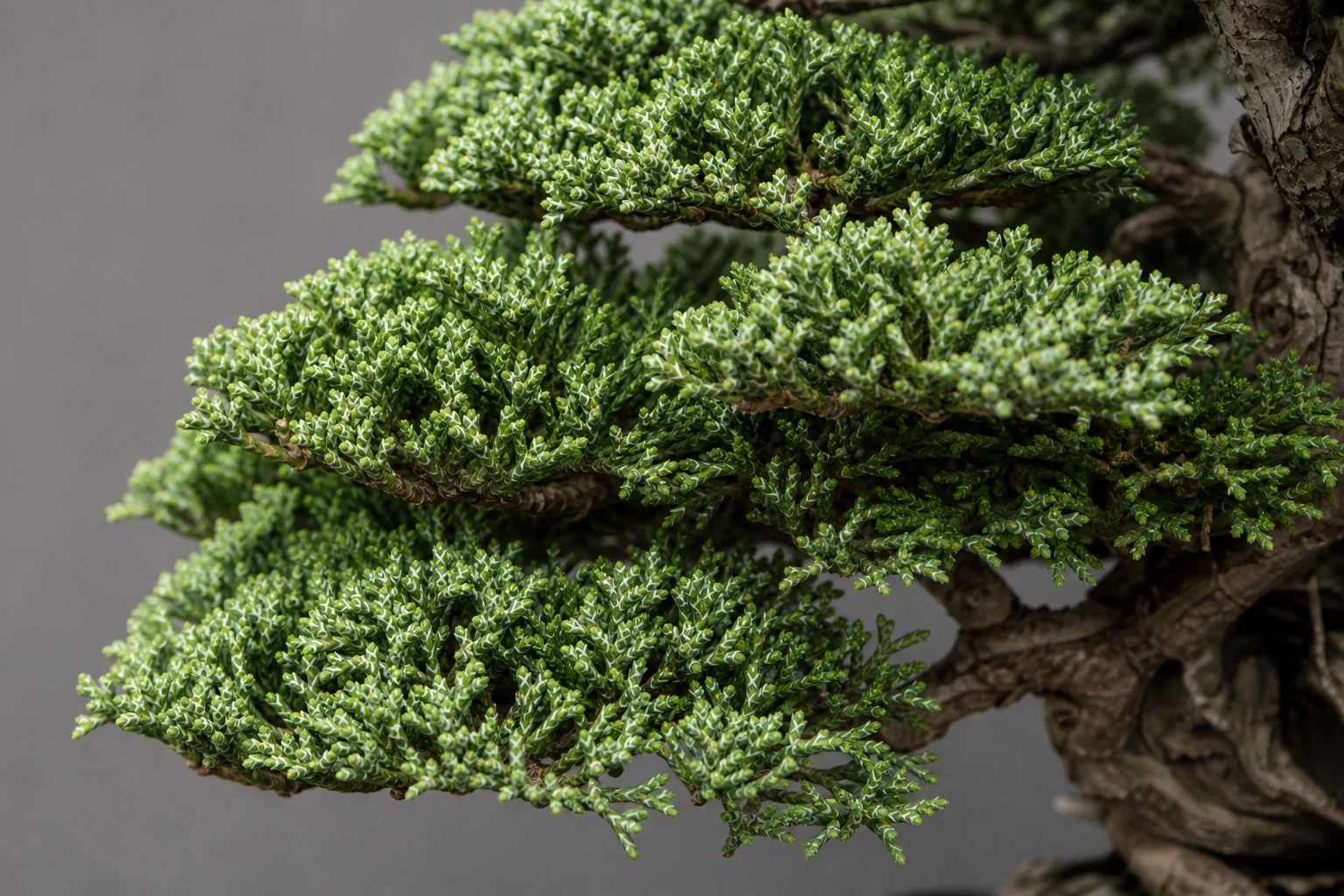
Hinoki cypress
Chamaecyparis obtusaDistinctive scale-like foliage with white markings on the underside, refined ramification potential, and a tradition stretching back through Japanese temple culture. The conifer for growers who find pines and junipers too familiar.
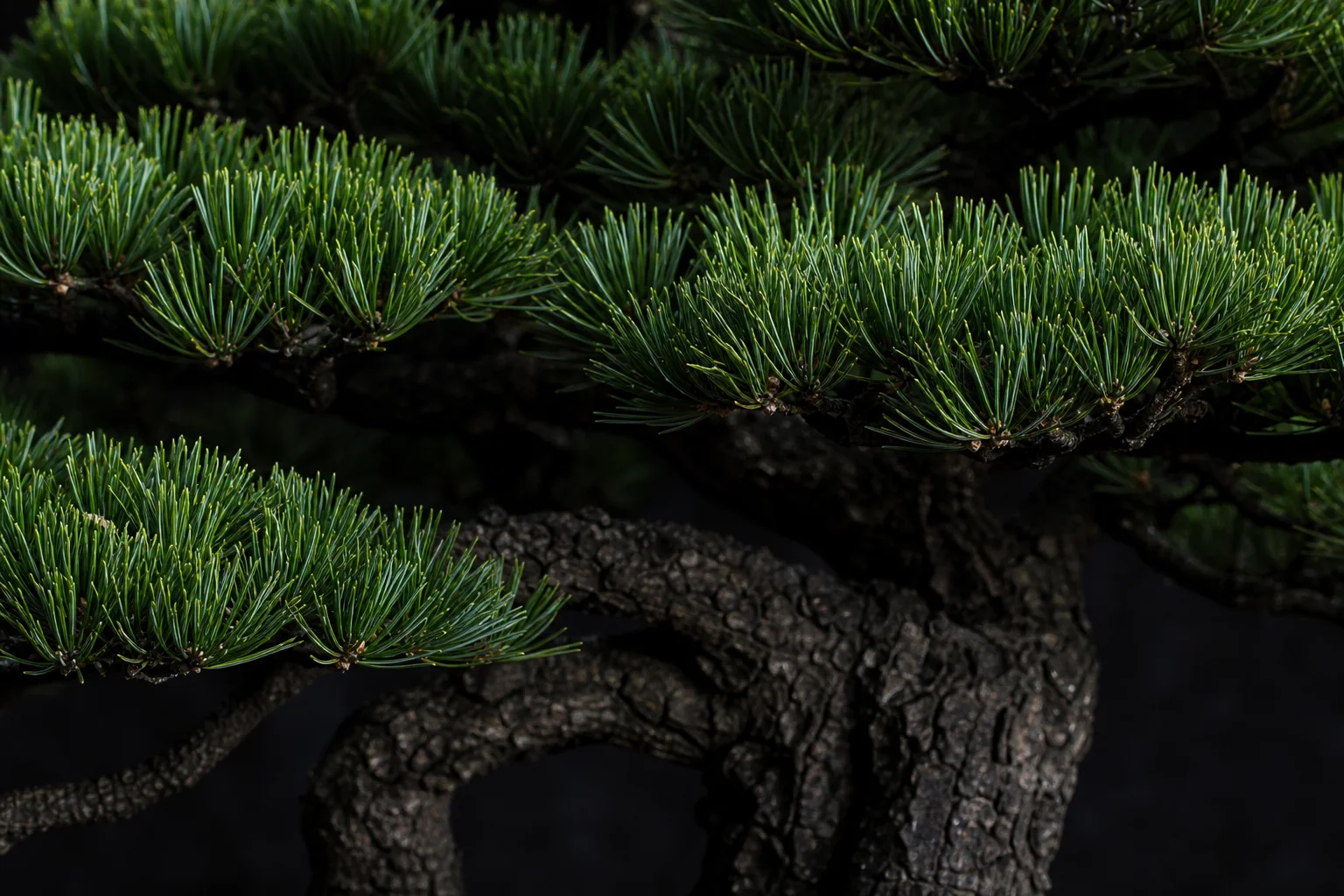
Japanese black pine
Pinus thunbergiiThe flagship bonsai pine — dark fissured bark, two-flush technique, and a steeper learning curve than any other common species.
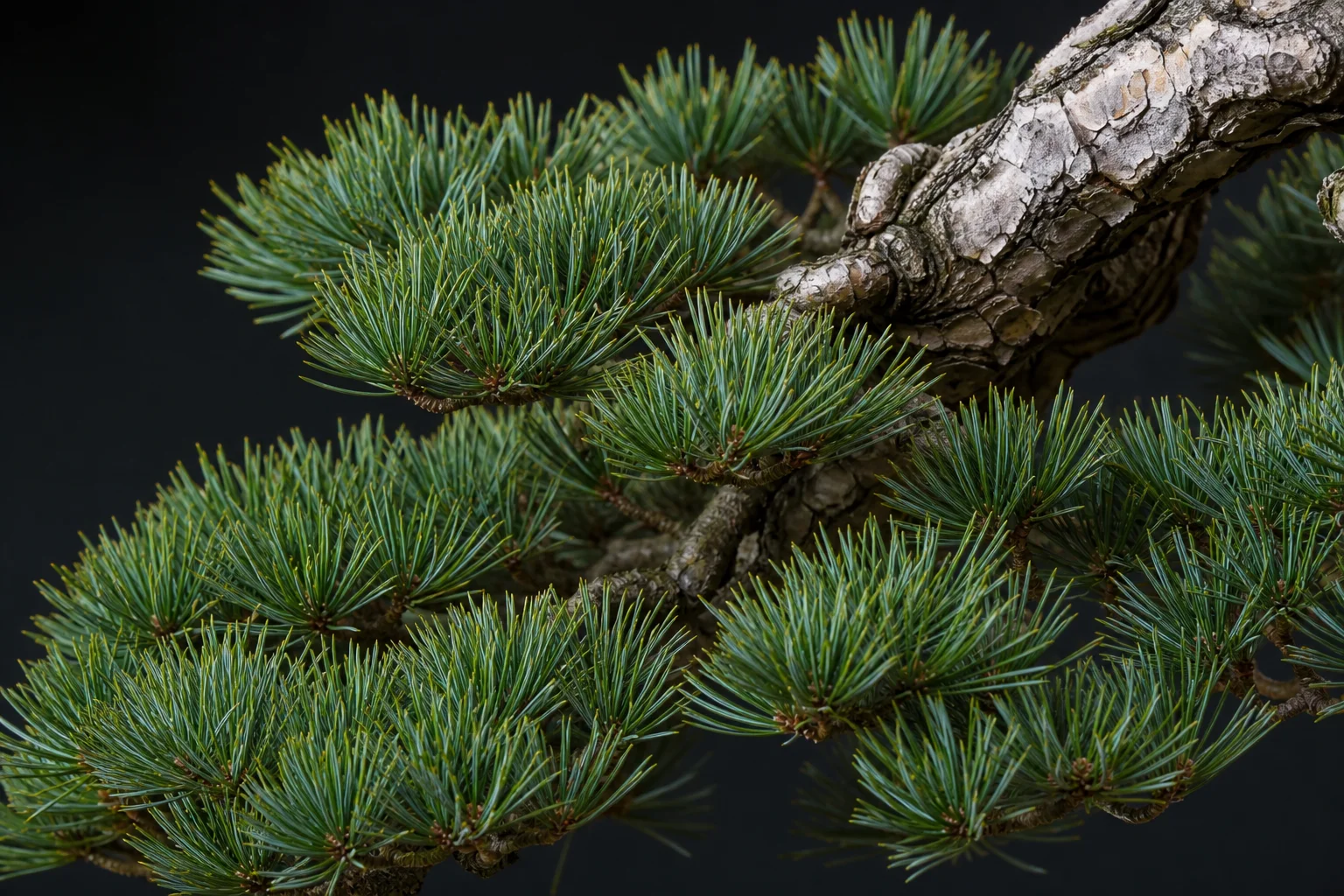
Japanese white pine
Pinus parvifloraThe other classic Japanese pine. Five blue-green needles per bundle, single-flush growth, and a refined elegance that no other pine quite matches.