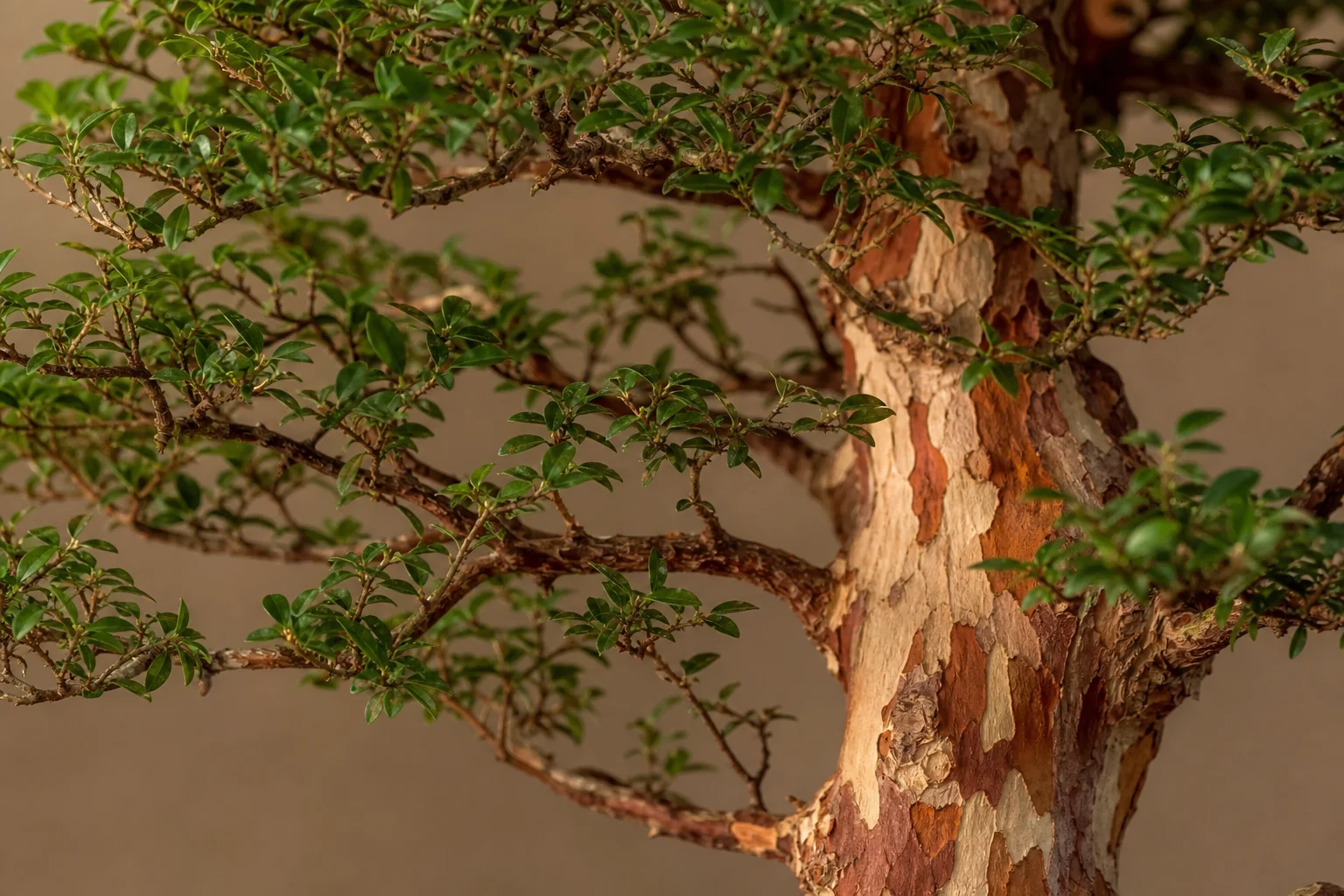
Chinese sweet plum bonsai care
Sageretia theezansThe other indoor bonsai. Distinctive peeling bark, tiny leaves, and a more refined character than the mass-market ficus.
Water
Every 2 days
check daily in summerLiquid feed
Every 14 days
growing seasonSolid feed
Every 28 days
slow releaseRotate
Every 14 days
even canopy growthChinese sweet plum is the indoor bonsai that experienced growers reach for when ficus feels too coarse. The leaves are smaller and more delicate, the bark develops a distinctive flaking pattern in patches of beige, cream, and rust that reads as ancient much faster than ficus, and the overall character is more refined and traditional. If you've grown ficus successfully and want an indoor tree with more aesthetic depth, this is the species.
The trade-off is that sageretia is slightly more demanding than ficus. It's more sensitive to underwatering (leaf drop comes faster), less tolerant of low light, and less forgiving of temperature changes. It's also less commonly available in the UK — most ficus are sold at every garden centre, but you'll often need a specialist supplier for sageretia.
For UK growers without outdoor space who want a real bonsai, this is the second species to consider after ficus. For growers with outdoor space who want a flowering indoor tree to bring inside during winter, it's a stronger candidate than most.
Native to subtropical Asia — southern China, Korea, India, and into Vietnam. Grows naturally as a sprawling thorny shrub on hillsides and woodland margins. Long cultivated as bonsai in China; the species' Chinese aesthetic predates much of the Japanese bonsai tradition.
Seasonal calendar
Timing is for South East England. Select your region above to see adjusted guidance.
- Monitor watering in heated rooms
- Light feeding monthly
- Watch for spider mites in dry air
- Maintain humidity
- Increase light if possible
- Begin spring feeding cycle
- Repotting window opens
- Full feeding resumes
- Move outdoors mid-month if planned
- Main pruning and styling
Acclimatise gradually to outdoor conditions over 2 weeks.
- Vigorous growth period
- Frequent pinching
- Maximum growth
- Wiring window
- Continue pinching
- Take cuttings from prunings
- Begin reducing feeding
- Plan move back indoors mid-month
- Indoor by month-end
- Acclimatise gradually
- Reduce watering as growth slows
- Maintain humidity
- Monthly light feeding
- Watch for heating-related stress
Watering
Water when the surface of the substrate has dried — typically every 2–3 days indoors, more often in summer or near bright windows. Sageretia is more sensitive to drying than ficus; even a single missed watering causes significant leaf drop, and the tree may take weeks to recover.
When you water, water thoroughly until it runs from the drainage holes. Drain any standing water from the saucer afterwards.
The species likes consistent moisture but will rot if kept saturated. Free-draining substrate and attentive watering is the right combination.
Feeding
Year-round feeding, but reduced in winter. Liquid feed every two weeks from April through October at half strength; monthly through winter at quarter strength. Slow-release organic pellets in spring and summer.
The species responds well to consistent feeding — both growth rate and ramification benefit from a steady supply. Don't push too hard, though; overfed sageretia produces coarse foliage and long internodes.
Soil & Repotting
Free-draining and slightly moisture-retentive. Tolerant of a wide range of substrates.
50% akadama, 30% pumice, 20% lava is reliable. The species tolerates cheaper bonsai mixes for development material.
Repot every 2–3 years for young trees, every 3–4 for mature specimens. The window is essentially year-round for indoor-grown trees but late spring (April–May) gives the strongest recovery.
The species tolerates aggressive root work — up to half the root mass on healthy trees. Comb roots radially, prune cleanly, settle into fresh substrate. Recovery is good.
Pruning
Sageretia pruning is straightforward. The species back-buds reliably on old wood, tolerates hard cutbacks, and produces fine ramification through consistent pinching.
Through the growing season, let new shoots extend to 6–8 leaves then cut back to 2. Pinch every 2–3 weeks in active growth. Trees in development can be allowed to run longer.
Major structural pruning happens at any time the tree is actively growing — typically May through September. The species is forgiving of timing.
A useful technique: sageretia branches sprout new growth quickly from leaf nodes after pinching, making the species excellent for clip-and-grow refinement without heavy wiring.
Wiring & Styling
Wire after leaves harden in late spring or on bare wood any time. The bark is delicate when young and marks easily — apply loosely and check every two weeks. Mature bark with its characteristic flaking is more forgiving but visible marks remain a concern.
Aluminium for almost all work; copper rarely needed.
Informal upright is the most common style. The species' naturally sprawling habit also suits cascade and semi-cascade. Root-over-rock plantings work beautifully. Forest plantings of multiple young sageretias produce particularly fine compositions.
The species' character favours styles that emphasise refined ramification and the dramatic flaking bark. Don't over-style; let the bark be the feature.
Winter care
Indoor permanently in UK winters. Minimum 5°C — colder than ficus tolerates, but still firmly tropical/subtropical. Keep away from cold windows in winter, draughts from doors, and unheated rooms.
Light: bright indirect to direct light. South-facing window with sheer curtain ideal. The species needs more light than ficus and will lose interior foliage in dim positions.
Humidity: indoor heating dries the air to 30–40% RH; sageretia prefers 50–70%. Humidity tray (pebbles, water) under pot helps. Regular misting in heated rooms.
Many UK growers move sageretia outdoors for summer (June–September) — produces stronger growth and tighter foliage. Acclimatise gradually in both directions to avoid leaf drop from environmental shock.
Propagation
Easy from semi-hardwood cuttings in spring or early summer with rooting hormone — high success rate, the standard route. Air layering works well in late spring. From seed possible but slow and rarely used.
Common problems
Generally healthy when grown correctly. Most problems are environmental — light, humidity, watering consistency — rather than pest or disease.
Leaf drop from underwatering
Symptoms: Sudden loss of leaves within days of a dry period.
Cause: Sageretia is more sensitive to drying than ficus; a single missed watering can trigger significant leaf drop.
Solution: Resume consistent watering. Don't repot. New leaves typically appear within 4–6 weeks. Set a watering routine and stick to it.
Spider mites
Symptoms: Fine stippling on leaves, fine webbing on undersides.
Cause: Dry indoor air, especially in heated winter rooms.
Solution: Raise humidity. Wipe leaves with damp cloth. Neem if persistent. Inspect weekly in winter.
Scale insects
Symptoms: Small brown bumps on stems and leaves, sticky honeydew.
Cause: Common on imported material; can spread between indoor plants.
Solution: Manual removal with alcohol-dipped cotton bud. Systemic insecticide for severe cases. Quarantine new acquisitions for 2 weeks.
Mealybugs
Symptoms: White cottony masses in leaf joints.
Cause: Common indoor pest.
Solution: Wipe off with alcohol. Neem if widespread.
Interior dieback
Symptoms: Inner foliage thins and branches in the canopy interior die back.
Cause: Insufficient light reaching interior; common indoors in low-light positions.
Solution: Move to brighter position. Open up outer canopy to let light in. Back-budding is reasonable but slower than ficus.
Slow recovery after indoor/outdoor moves
Symptoms: Tree drops leaves after being moved between environments.
Cause: Environmental shock — light, humidity, and temperature all change simultaneously.
Solution: Acclimatise gradually over 2 weeks when moving in either direction. Keep in intermediate position (covered porch, shaded windowsill near open window) for the transition period.
Popular cultivars
The standard form. Most sold material is this species. Variable but consistent character.
Same species under an older taxonomic name. You'll see both names used.
Track your Chinese sweet plum with Kentai.
Collection tracking, care logs and photo history are free — no card, no time limit.
More care guides
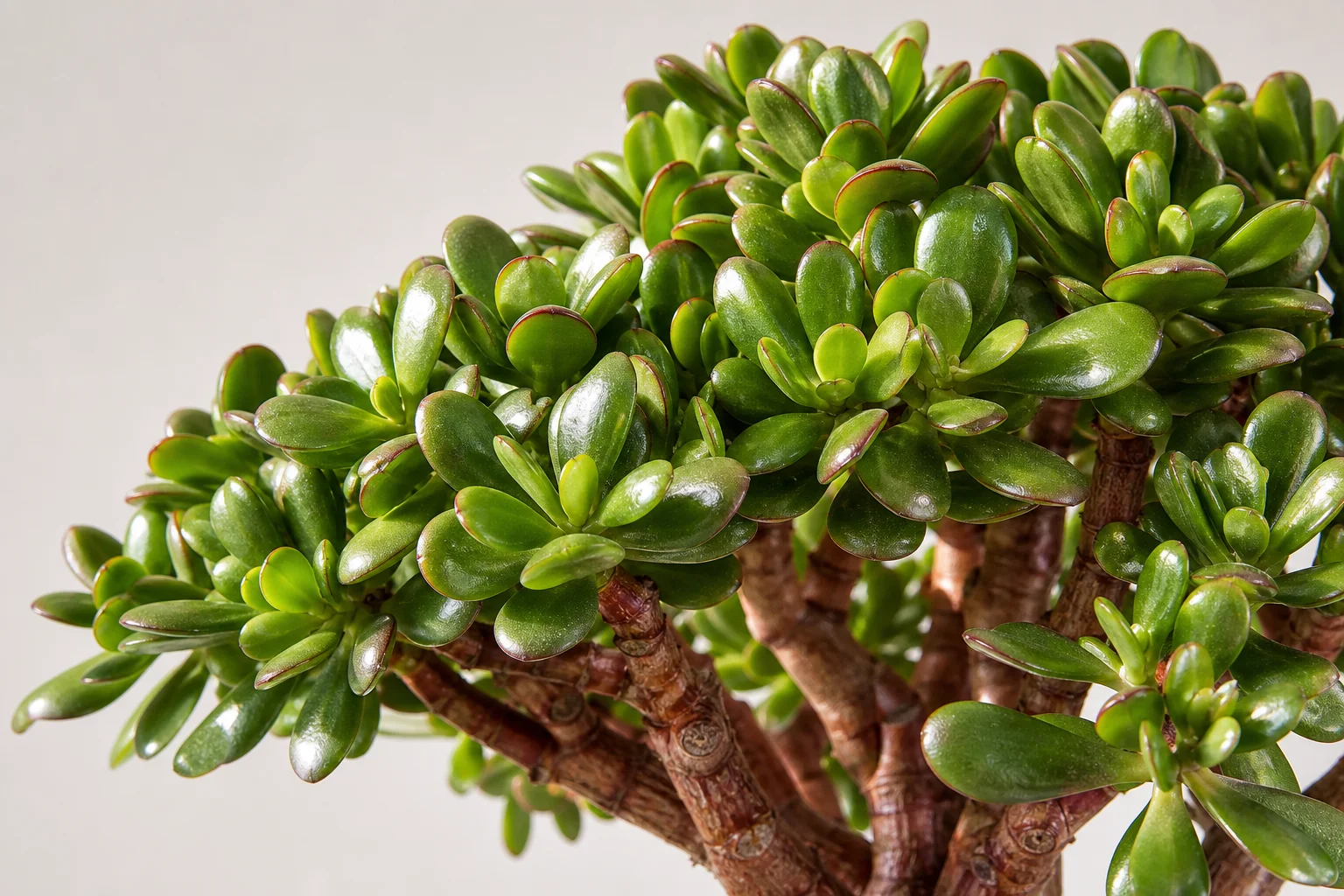
Dwarf jade
Portulacaria afraThe succulent bonsai. Drought-proof, sun-loving, almost impossible to kill, and fundamentally unlike any other species in your collection.
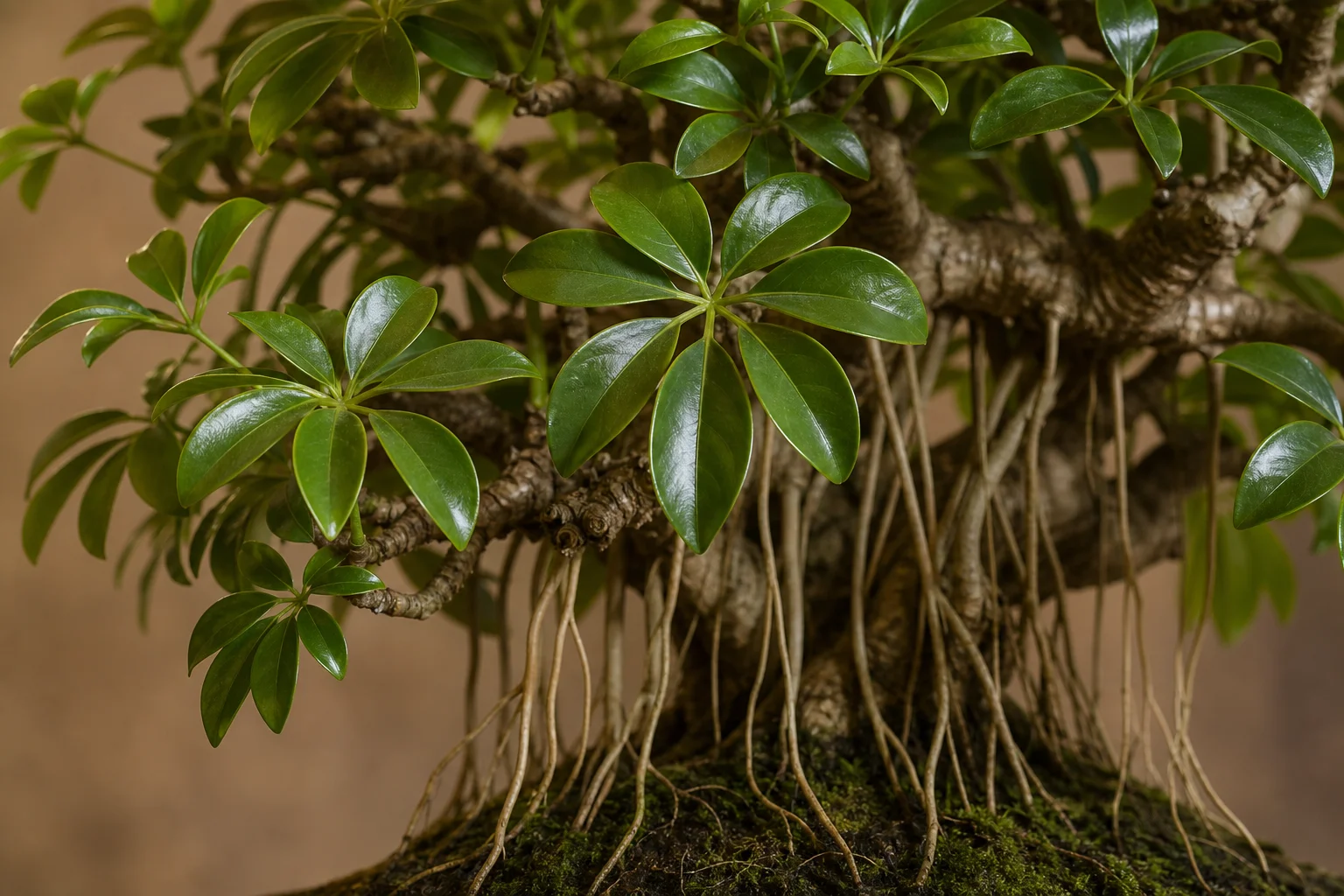
Dwarf umbrella tree
Schefflera arboricolaThe banyan-style indoor bonsai. Aerial roots, compound leaves arranged in umbrella patterns, almost impossible to kill — and one of the few species that genuinely lives up to its "easy indoor bonsai" marketing.
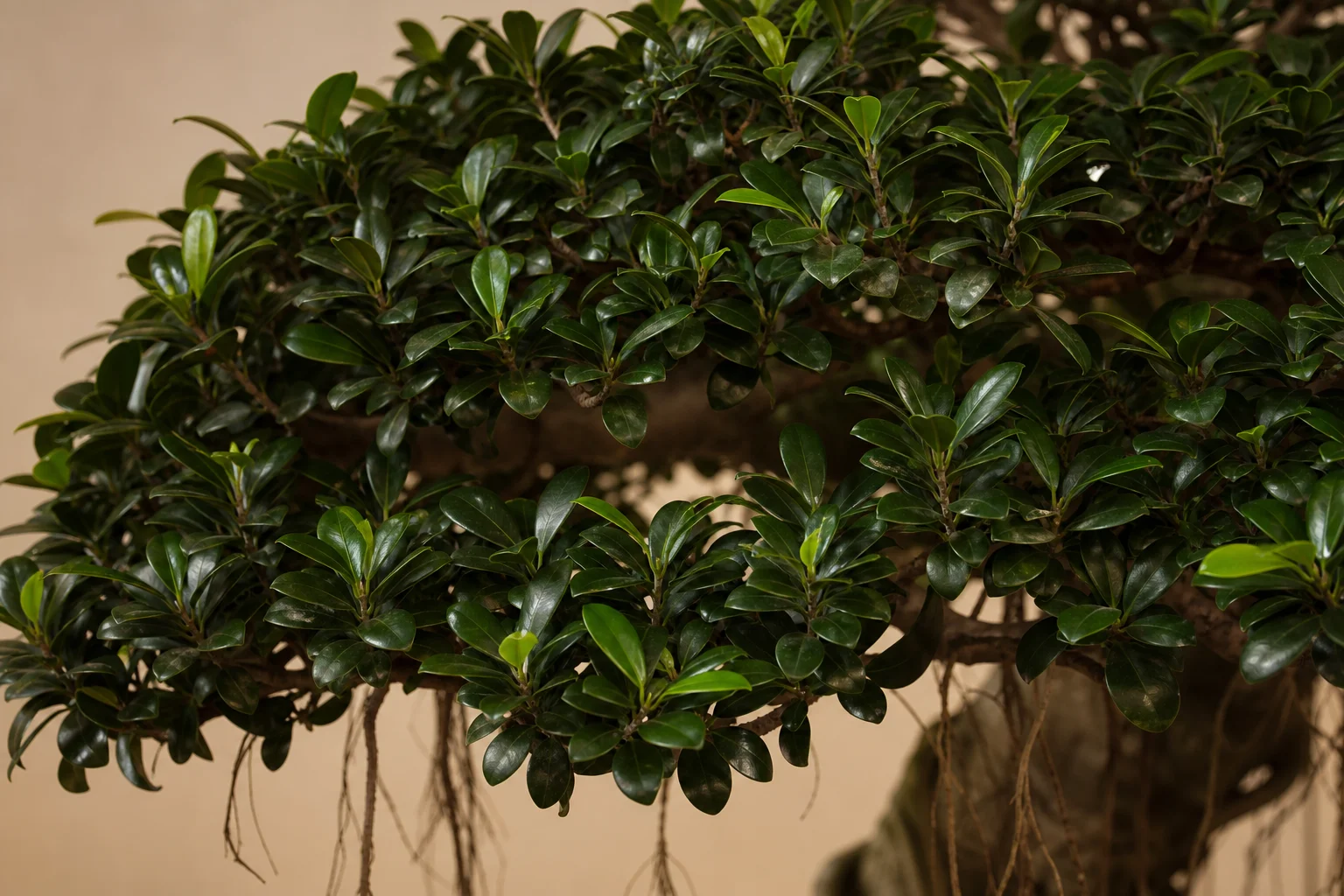
Ficus retusa
Ficus microcarpaThe best indoor bonsai. Tolerant of household conditions, fast-growing, and the only common bonsai species that truly thrives without a winter dormancy.