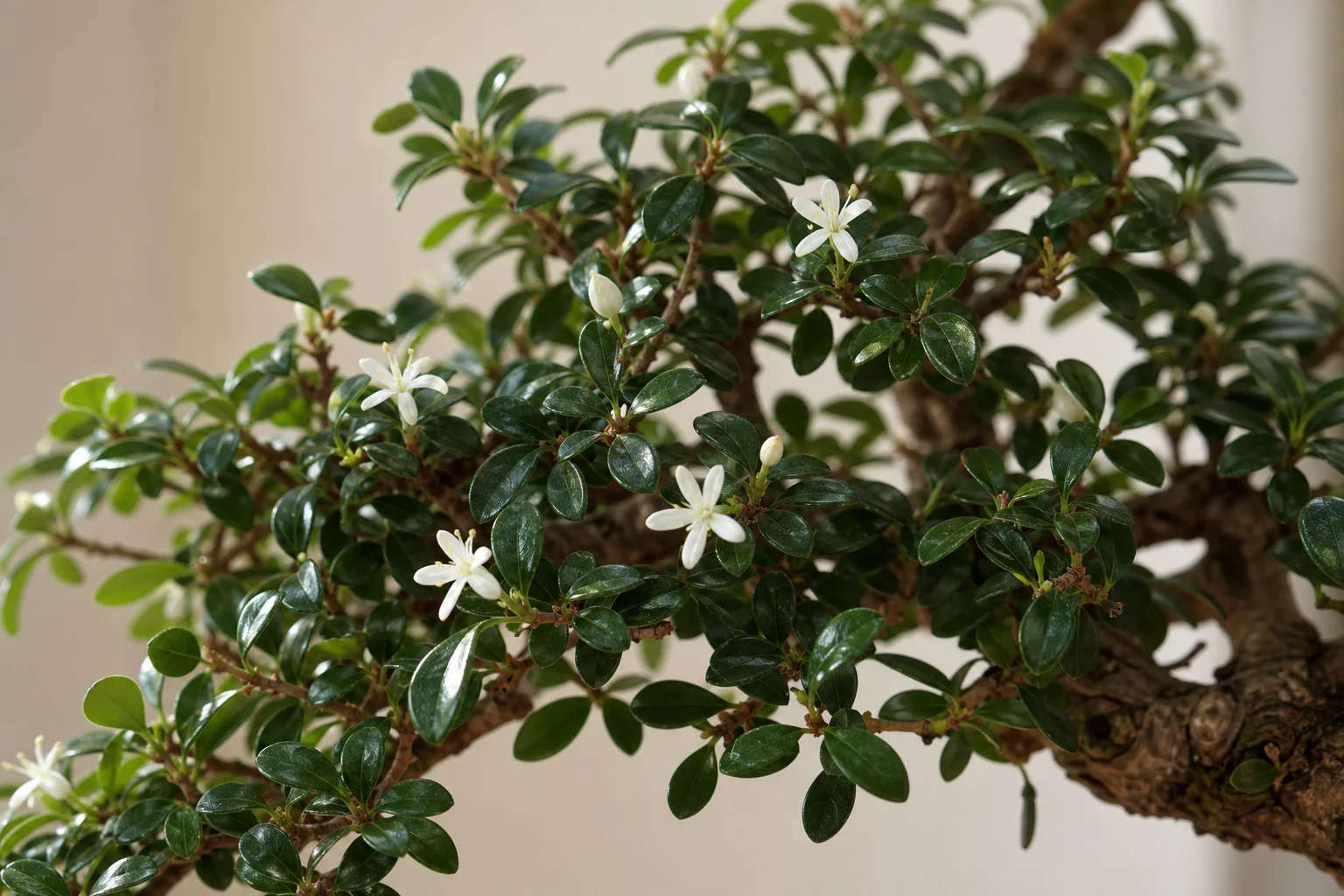
Fukien tea bonsai care
Carmona retusaSmall dark glossy leaves, tiny white flowers year-round, small red berries — the popular indoor bonsai widely sold as starter material despite being one of the more challenging species to maintain.
Water
Every 2 days
check daily in summerLiquid feed
Every 14 days
growing seasonSolid feed
Every 28 days
slow releaseRotate
Every 14 days
even canopy growthFukien tea is the species most often sold to new UK bonsai buyers as "easy indoor bonsai" and most often dies within a few months. This is a problem worth being honest about. The species can be grown well indoors but it's genuinely demanding — far more so than ficus, sageretia, or jade — and the gap between marketing and reality has killed a lot of starter trees.
The actual character of the species: small dark glossy leaves (typically 1–2cm), woody trunk that develops attractive bark, small white flowers that appear sporadically throughout the year, and tiny red berries on flowering plants. The compact habit and ability to develop trunk character relatively quickly make it visually appealing as bonsai. But the species demands consistent bright light, consistent moisture without saturation, consistent warmth, consistent humidity, and immediate response to pest issues — particularly spider mites, which destroy Fukien tea bonsai in heated UK winter rooms with depressing regularity.
For new growers reading this before purchase: consider ficus, jade, or Chinese sweet plum instead. They're genuinely easier and produce satisfying bonsai with far less maintenance burden.
For growers who already have a Fukien tea or who specifically want to try the species: follow the demanding care regime below and be prepared for occasional losses. With attention, the species rewards effort — and the small leaves, flowering display, and bark character produce some of the finest small indoor bonsai available.
A taxonomic note: the species was long called Ehretia microphylla and is sometimes still sold under that name or as Carmona microphylla. Current accepted name is Carmona retusa. All three names refer to the same plant.
Native to southern China (particularly Fujian province, hence 'Fukien'), the Philippines, Taiwan, and Southeast Asia. Cultivated as a small ornamental tree across the region and used in traditional Chinese medicine. As bonsai, the species has been developed in China for centuries and exported widely to Western markets, often as cheap mass-produced specimens that don't survive the journey or the new environment.
Seasonal calendar
Timing is for South East England. Select your region above to see adjusted guidance.
- Maintain humidity in heated rooms
- Monthly light feeding
- Watch closely for spider mites
- Maintain humidity
- Increase light if possible
- Begin slightly heavier feeding
- Repotting window opens
- Resume bi-weekly feeding
- Main pruning and styling
- Watch for first flowers
- Move outdoors mid-month if planned
- Vigorous growth period
Acclimatise gradually to outdoor conditions over 2 weeks.
- Maximum growth phase
- Frequent pinching
- Continue pinching
- Sporadic flowering may continue
- Begin reducing feeding mid-month
- Plan move back indoors
- Indoor by month-end before night temps drop
- Acclimatise gradually
- Reduce watering as growth slows
- Establish winter humidity routine
- Monthly light feeding only
- Maintain humidity in heated rooms
Watering
Water consistently — neither dry nor saturated. The species is more sensitive to both extremes than ficus or jade. Water when the surface starts to dry, typically every 2–3 days indoors. Don't let pots dry completely between waterings; Fukien tea responds to dryness with leaf drop and bud abortion.
In summer if moved outdoors, daily watering. In winter indoors, slightly less but still regular.
Humidity matters more for Fukien tea than for most indoor bonsai. UK heated indoor air in winter (typically 30–40% humidity) is too dry and causes gradual leaf yellowing, leaf drop, and spider mite problems. Use a humidity tray, mist foliage in the morning, or group with other plants. Aim for 50%+ humidity.
Use rainwater or filtered water where possible — the species is moderately sensitive to alkaline conditions over years.
Feeding
Light to moderate feeding. Half-strength liquid feed every two weeks from April through October. Reduce to monthly through winter at quarter strength.
Fukien tea responds well to consistent moderate feeding. Heavy feeding produces vigorous growth but oversized leaves; insufficient feeding produces pale weak growth.
Soil & Repotting
Free-draining but slightly moisture-retentive. The species is unfussy about specific mixes within reasonable parameters.
50% akadama, 30% pumice, 20% lava is reliable. Generic bonsai mixes work. Avoid pure organic potting compost (holds too much water) and very lean mixes (the species likes some moisture retention).
Repot every 2–3 years. The window is essentially year-round indoors but late spring (April–May) is most traditional. Fukien tea tolerates moderate root work — up to a third of the root mass on healthy trees.
After repotting, increase humidity and reduce light slightly for two weeks while roots establish. Don't move a freshly repotted tree to outdoor conditions immediately.
Pruning
Pruning is forgiving. The species back-buds on old wood and tolerates moderate cutbacks.
Through the growing season, let new shoots extend to four or five leaves then cut back to two. Pinch every two to three weeks in active growth.
Structural pruning happens whenever the tree is actively growing — May through September is ideal. Avoid hard pruning in deep winter when light levels and growth are slow.
Defoliation can be used on healthy trees but isn't typically necessary on Fukien tea — the natural leaf size is already appropriate for bonsai scale.
Wiring & Styling
Wire after new growth hardens. The species' bark is moderately delicate. Aluminium for almost all work. Check fortnightly during active growth.
Branches are flexible when young and stiffen with age. Major bends on heavy wood need raffia-wrapping.
Informal upright is the natural fit. The species' habit suits broom-style, clump, and twin-trunk forms. Cascade and semi-cascade are uncommon but possible.
The species' fine leaves and developable bark suit refined twiggy compositions that emphasise structural delicacy. A well-developed Fukien tea reads as quietly elegant in the way refined Sageretia does.
Winter care
Indoor permanently in the UK. Minimum temperature 10°C; happier above 15°C. The species is more cold-sensitive than ficus or sageretia — keep well away from cold windows and draughts.
Light: bright direct light is essential. South-facing window with sheer curtain in summer; full south-facing winter sun without curtain. Supplementary grow lights help maintain growth through dark UK winters.
Humidity management is the most common point of failure in UK indoor cultivation. The species genuinely needs more humidity than most heated UK rooms provide. Without supplementary humidity, Fukien tea bonsai gradually decline through winter despite otherwise reasonable care.
Some growers move Fukien tea outdoors for summer (mid-June to mid-September). This produces stronger growth but requires careful re-acclimation to avoid environmental shock.
Propagation
From semi-hardwood cuttings any time during warm conditions, with rooting hormone — moderate success rate. Air layering possible but slow. From seed possible but rarely used. Most UK Fukien tea material is purchased as mass-produced imports; quality specimens come from specialist bonsai nurseries.
Common problems
Mostly environmental and pest-driven. The species is more disease-resistant than environmentally robust.
Spider mites
Symptoms: Fine stippling on leaves, fine webbing on undersides, eventual leaf yellowing and drop.
Cause: Dry indoor air, especially in heated UK winter rooms. The single most common cause of Fukien tea death in UK collections.
Solution: Prevention is far easier than cure. Maintain humidity at 50%+. Inspect weekly through winter. Wipe foliage with damp cloth fortnightly. Neem oil at first sign. Severe infestations require systemic treatment and humidity correction; trees often don't fully recover from heavy mite damage.
Sudden leaf drop
Symptoms: Substantial leaf loss within days of environmental change.
Cause: Fukien tea is sensitive to changes in temperature, light, watering routine, or humidity.
Solution: Maintain consistent conditions. Don't move the tree dramatically. New leaves typically appear within 4–6 weeks if root system is healthy. Don't repot a stressed tree. Future changes should be gradual.
Scale insects
Symptoms: Small brown bumps on leaves and twigs; sticky honeydew and sooty mould.
Cause: Common indoor pest.
Solution: Manual removal with alcohol-dipped cotton bud. Systemic insecticide if severe. Inspect new acquisitions before adding to collection.
Yellowing leaves throughout canopy
Symptoms: Gradual yellowing across the tree, sometimes with leaf drop.
Cause: Usually inadequate humidity, sometimes insufficient light, occasionally alkaline water issues over years.
Solution: First check humidity — most common cause. Increase via humidity tray, misting, or grouping plants. If humidity is adequate, check light levels and consider rainwater.
Root rot from overwatering
Symptoms: Tree weakens, leaves yellow and drop, eventual collapse; substrate sour-smelling.
Cause: Watering too frequently combined with insufficient drainage.
Solution: Reduce watering. Improve drainage. Emergency repot into dry substrate may save trees caught early. Fukien tea is more sensitive to overwatering than ficus or sageretia.
Failure to develop refined ramification
Symptoms: Long internodes between leaves, sparse branching despite consistent pruning.
Cause: Insufficient light combined with overfeeding.
Solution: Maximise light exposure. Reduce feeding to half-strength. Pinch consistently every 2 weeks. UK indoor light alone is often insufficient — grow lights help substantially.
Popular cultivars
Current accepted name. The standard species used in bonsai.
Older botanical synonym. The same plant. Still appears on plant labels.
Another older botanical synonym, occasionally still used. Same plant.
Track your Fukien tea with Kentai.
Collection tracking, care logs and photo history are free — no card, no time limit.
More care guides
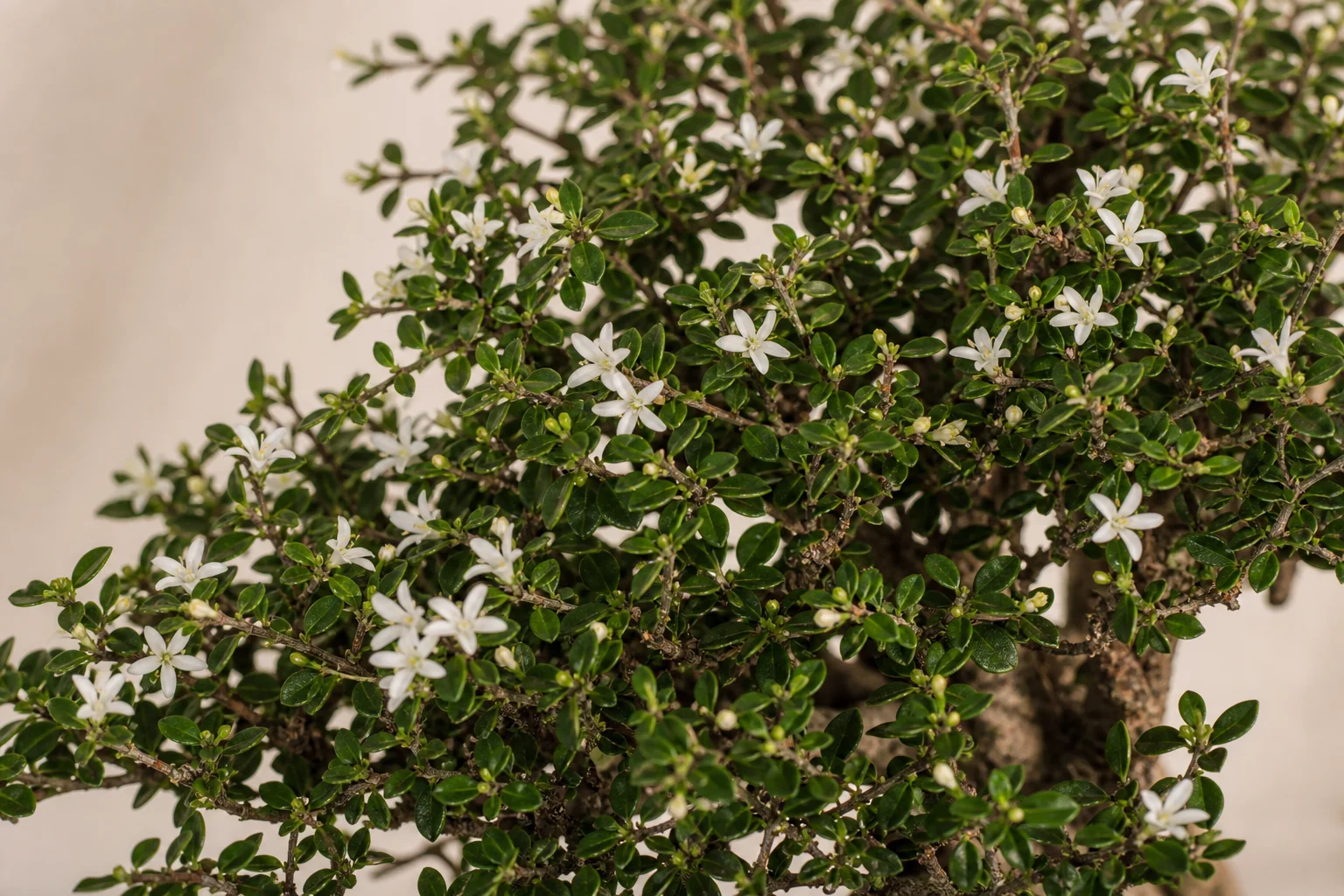
Serissa
Serissa japonicaSmall white star-shaped flowers year-round, tiny dark leaves, refined twiggy habit — and a reputation as the most temperamental indoor bonsai you can buy. The drama queen of the indoor world.
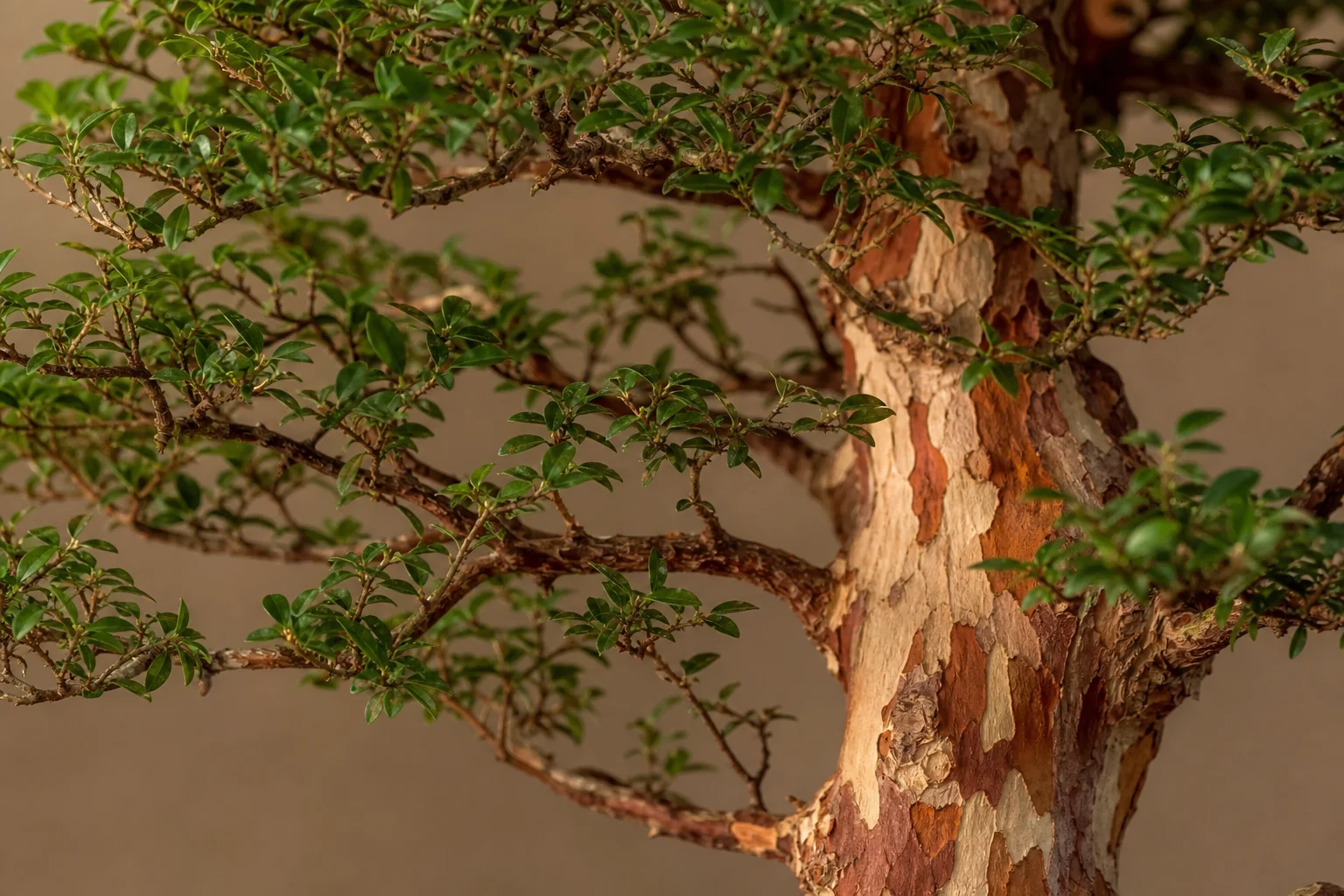
Chinese sweet plum
Sageretia theezansThe other indoor bonsai. Distinctive peeling bark, tiny leaves, and a more refined character than the mass-market ficus.
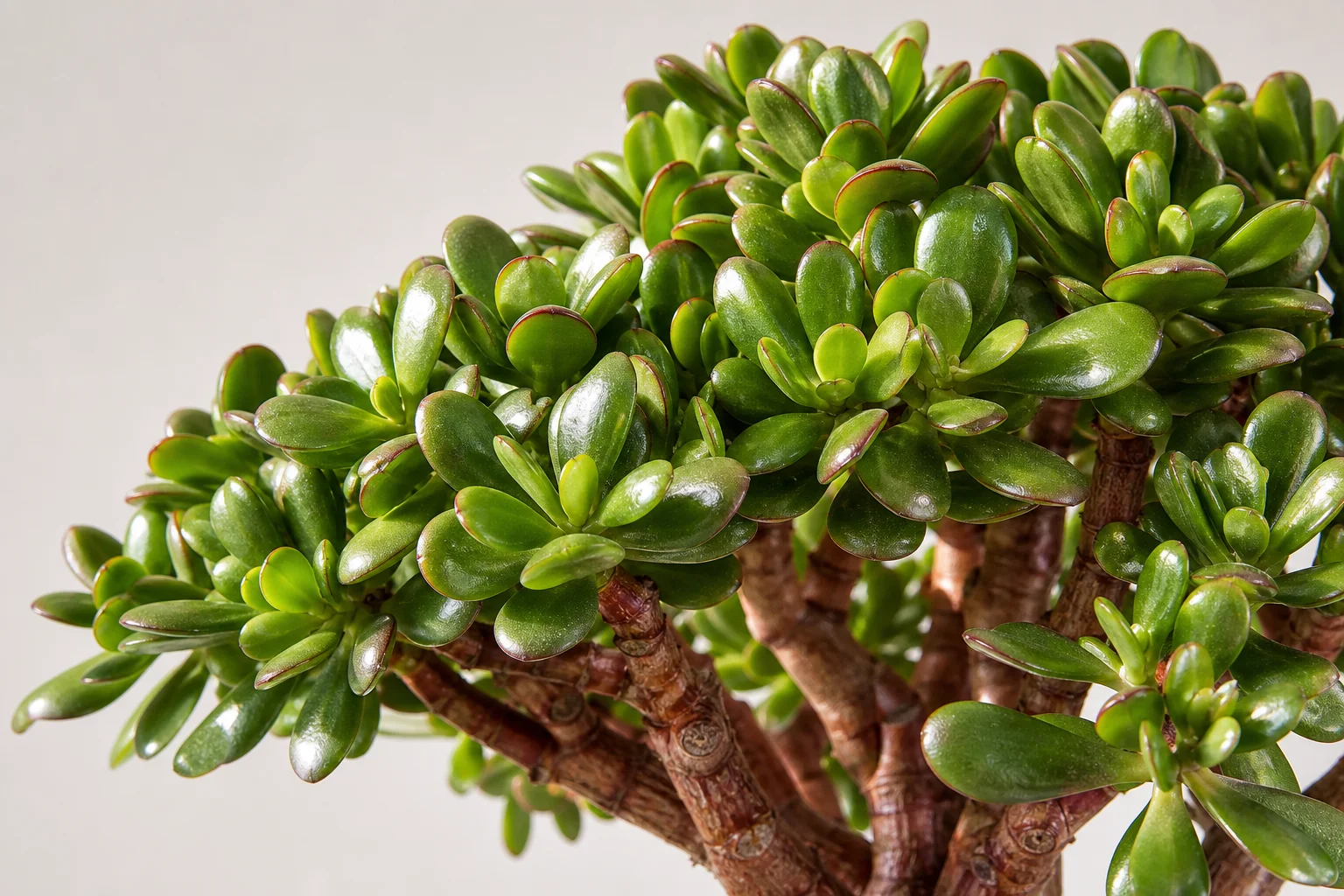
Dwarf jade
Portulacaria afraThe succulent bonsai. Drought-proof, sun-loving, almost impossible to kill, and fundamentally unlike any other species in your collection.