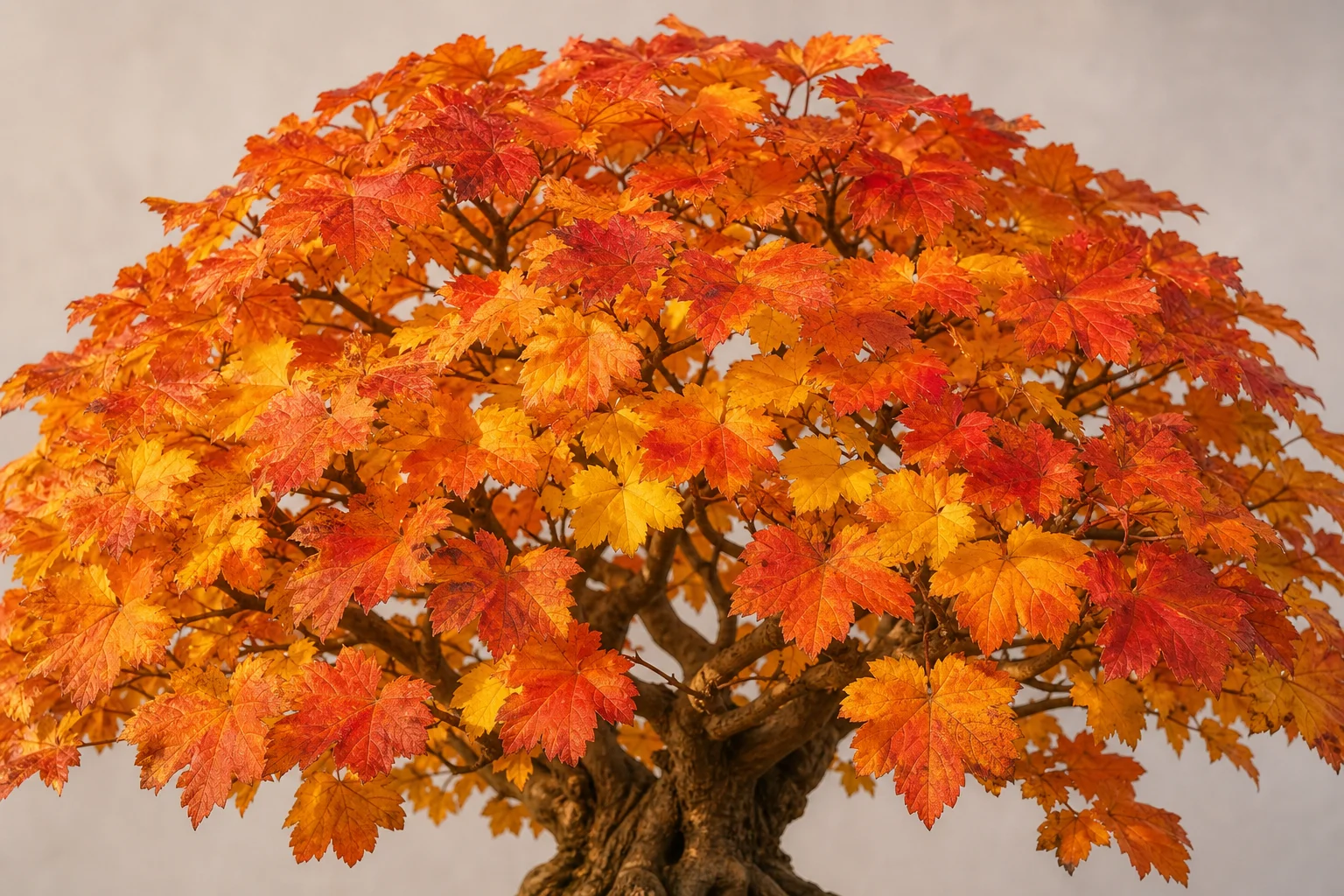
Full-moon maple bonsai care
Acer japonicumThe other Japanese maple. More rounded leaves with shallower lobes than Acer palmatum, similar care, distinct enough to be its own species — and home to two of the most beautiful maple cultivars in bonsai.
Water
Every 1 day
check daily in summerLiquid feed
Every 7 days
growing seasonSolid feed
Every 28 days
slow releaseRotate
Every 14 days
even canopy growthAcer japonicum is the second Japanese maple species and the one most growers don't know exists. The species sits alongside Acer palmatum in the broader "Japanese maple" category but is genuinely distinct — leaves are more rounded with shallower lobes (typically 7–11 lobes versus palmatum's 5–7), the species grows more vigorously, and certain refined cultivars produce some of the most striking maple bonsai available.
Care is essentially identical to Acer palmatum — same watering, feeding, repotting, pruning techniques apply. The substantive differences are in habit and cultivar selection. Where palmatum has hundreds of selected cultivars covering every possible leaf shape, colour, and habit, japonicum has a much smaller cultivar pool but includes two standout selections: 'Aconitifolium' (Maiku-jaku — peacock's tail), with deeply cut filigree-like leaves and exceptional gold-orange-red autumn colour, and 'Vitifolium', with grape-like rounded leaves and brilliant red autumn colour. Both are widely planted in UK gardens and both produce striking bonsai.
For UK growers, the species offers an alternative to palmatum with slightly less competition and slightly different character. The wider leaves of typical A. japonicum are larger than the most refined palmatum cultivars but produce a more "tree-like" appearance — A. japonicum bonsai often read as full trees in miniature rather than refined miniaturisations.
Botanical confusion is worth flagging: Acer japonicum is sometimes confused with Acer pseudosieboldianum (Korean maple) and Acer shirasawanum (Shirasawa's maple, golden full-moon), both of which are related species with similar characteristics. A. shirasawanum 'Aureum' (golden full-moon) is particularly fine as bonsai. All three species can be cared for with the same techniques.
Native to Japan, particularly the cooler regions of northern Honshu and Hokkaido. The species evolved in slightly cooler conditions than A. palmatum and is correspondingly slightly more hardy in cold regions. Long cultivated in Japan but historically less developed as bonsai than palmatum. Major cultivars: 'Aconitifolium' (filigree leaves), 'Vitifolium' (vine-leaf form), 'Green Cascade' (weeping form).
Seasonal calendar
Timing is for South East England. Select your region above to see adjusted guidance.
- Structural pruning while dormant
- Plan year's work
- Begin repotting late month
- Final winter pruning
- Main repotting window
- Protect emerging buds from late frost
- Leaves emerge
- Begin daily watering
- First slow-release feed
- Start half-strength liquid feed
- Begin pinching new shoots
- Wiring window opens
- Defoliate refined trees every 2-3 years late month
- Twice-daily watering in heat
- Continue pinching
- Reduce nitrogen mid-month
- Watch for wire biting
- Stop feeding mid-month
- Reduce watering
- Peak autumn colour — gold/orange/red
- Continue reducing watering
- Leaf drop
- Sweep fallen leaves
- Structural pruning
- Plan winter wiring
Watering
Daily through the growing season. Identical needs to Acer palmatum — twice daily in summer heat, reduced in winter.
In hot summer weather, twice daily for trees in shallow pots. Position with morning sun and afternoon shade is preferred — the species' broader leaves are slightly more sensitive to scorch than palmatum's finer foliage.
Use rainwater where possible.
Feeding
Weekly half-strength liquid feed from late April through to mid-September. Slow-release organic pellets in spring and early summer.
The species responds to feeding similarly to palmatum. Restrained feeding produces better proportioned trees than heavy feeding.
Stop feeding by mid-September.
Soil & Repotting
Free-draining and slightly acidic. Identical requirements to Acer palmatum.
60% akadama, 30% pumice, 10% lava in 2–6mm grade. Rainwater preferred.
Repot every 2–3 years on young trees, every 3–4 on mature specimens. The window is mid-February through to early April. Repot as buds swell.
A. japonicum tolerates moderate root work — up to a third of the root mass on healthy trees. The species recovers slightly faster than refined palmatum cultivars but slower than vigorous deciduous like elms or hornbeams.
Pruning
Standard Japanese maple pruning technique applies. The species back-buds reliably and tolerates moderate cutbacks.
Structural pruning in late winter (February). Through the growing season, allow new shoots to extend to four or five leaves then cut back to two. Pinch every two to three weeks.
The larger leaves of typical A. japonicum mean defoliation produces dramatic leaf-size reduction on the second flush. Use defoliation on healthy refined trees every 2–3 years rather than annually.
For 'Aconitifolium' specifically, the deeply cut leaves don't reduce dramatically with defoliation — the leaf shape rather than size is the cultivar's aesthetic asset. Don't expect defoliation to produce dramatically smaller leaves on this cultivar.
Wiring & Styling
Wire after leaves harden in early summer or on bare branches in winter. Bark is thin — apply loosely and check fortnightly. Aluminium for almost all work.
The species' more vigorous habit compared to refined palmatum cultivars means wire bites in slightly faster — check fortnightly during active growth rather than monthly.
Informal upright is the natural fit. The broader leaf habit suits naturalistic compositions rather than the most refined miniaturised styles. Twin-trunk and clump styles work well. Forest plantings of A. japonicum (particularly 'Aconitifolium' for autumn colour displays) are exceptional.
Cascade and semi-cascade work on the weeping cultivars ('Green Cascade', 'Filigree'). Formal upright and pure broom styles don't suit the species' habit.
Winter care
Hardy across most of the UK with no protection needed in normal winters. Slightly more cold-tolerant than typical palmatum cultivars due to the species' more northern origin.
In exposed northern positions, light shelter in severe winters is sensible while trees are developing. Mature trees tolerate UK winters without complaint.
Never bring indoors.
Propagation
The species is grafted onto Acer palmatum rootstock in most commercial production. From seed possible — produces variable seedlings, not true to cultivar. Air layering works on established branches. UK garden centres widely stock 'Aconitifolium' and 'Vitifolium' as ornamental trees.
Common problems
Generally healthy. Inherits the typical Japanese maple vulnerabilities (verticillium wilt, chlorosis from alkaline conditions) but with slightly better resistance than palmatum on average.
Verticillium wilt
Symptoms: Individual branches die back over weeks; dark streaking in cut wood.
Cause: Soil-borne fungus.
Solution: No cure. Remove affected branches well below visible damage. Disinfect tools between cuts. Slightly less common on A. japonicum than on palmatum but still possible.
Leaf scorch in heat
Symptoms: Brown crispy margins on the broader leaves, particularly mid-summer.
Cause: Excess sun combined with drought.
Solution: Provide afternoon shade. Maintain consistent moisture. Use rainwater. The species's broader leaves are slightly more scorch-prone than palmatum.
Chlorosis from alkaline water
Symptoms: Pale leaves with green veins.
Cause: Hard tap water gradually shifts substrate pH.
Solution: Use rainwater. Repot into fresh substrate.
Larger leaves than palmatum cultivars
Symptoms: Leaves remain larger than refined palmatum bonsai despite refinement work.
Cause: Normal species characteristic — A. japonicum leaves are inherently larger than refined palmatum cultivars like Shishigashira or Kiyohime.
Solution: Accept the slightly larger scale. The species suits larger bonsai compositions where the leaf size is well-proportioned to the trunk. Don't try to grow A. japonicum at the same scale as Kiyohime — the proportions won't work.
Aphids
Symptoms: Curled sticky leaves in spring.
Cause: Standard spring pest pressure.
Solution: Hose off. Neem if persistent.
Confusion with other species
Symptoms: Not a tree problem — uncertainty about which species you're working with.
Cause: A. japonicum, A. shirasawanum, and A. pseudosieboldianum are sometimes confused commercially.
Solution: Care is essentially identical for all three. For identification, examine leaf detail closely (japonicum has fine downy hairs on leaf undersides, shirasawanum is hairless, pseudosieboldianum has 9–11 lobes). For bonsai purposes, identification doesn't change how you grow the tree.
Popular cultivars
The wild full-moon maple. Less commonly used in bonsai than the named cultivars.
Filigree-leaved cultivar with deeply cut leaves and brilliant gold-orange-red autumn colour. The most celebrated A. japonicum cultivar for bonsai. Widely available in UK garden centres.
Vine-leaf cultivar with rounded grape-like leaves and brilliant red autumn colour. Robust and reliable.
Weeping cultivar with cut leaves. Excellent for cascade-style bonsai.
Closely related species with golden-yellow spring foliage. Care identical. Exceptional bonsai material when found.
Korean species sometimes lumped with A. japonicum. Slightly hardier (H7), excellent autumn colour. Suitable for cooler UK regions.
Track your Full-moon maple with Kentai.
Collection tracking, care logs and photo history are free — no card, no time limit.
More care guides
Other Acer guides: Arakawa maple · Deshojo maple · Field maple · Japanese maple · Kiyohime maple · Sango Kaku maple · Shishigashira maple · Trident maple
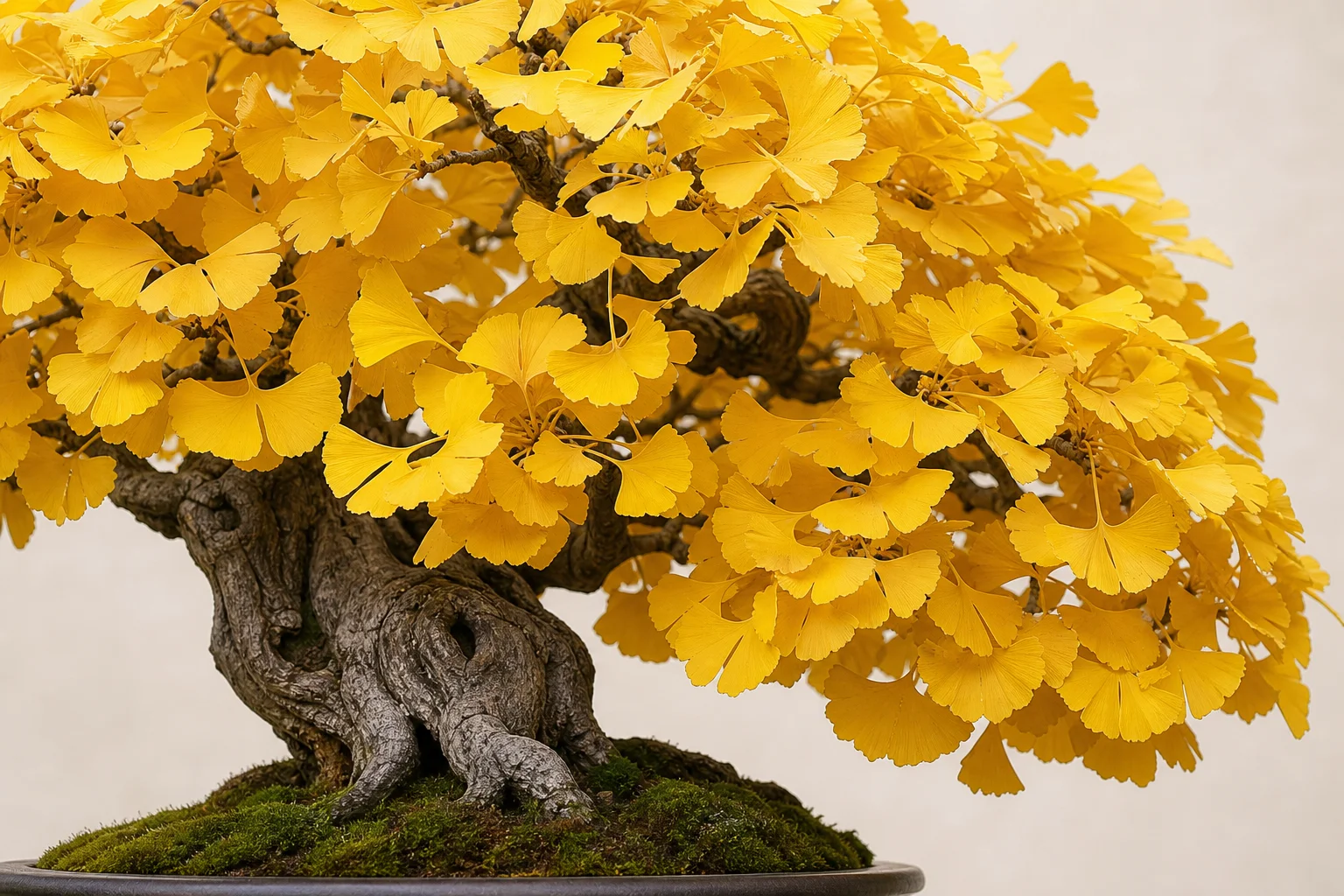
Ginkgo
Ginkgo bilobaThe living fossil. The only surviving species in an entire plant lineage 200 million years old, fan-shaped leaves unlike anything else in horticulture, and brilliant butter-yellow autumn colour. A bonsai with a genuinely unique place in the natural world.
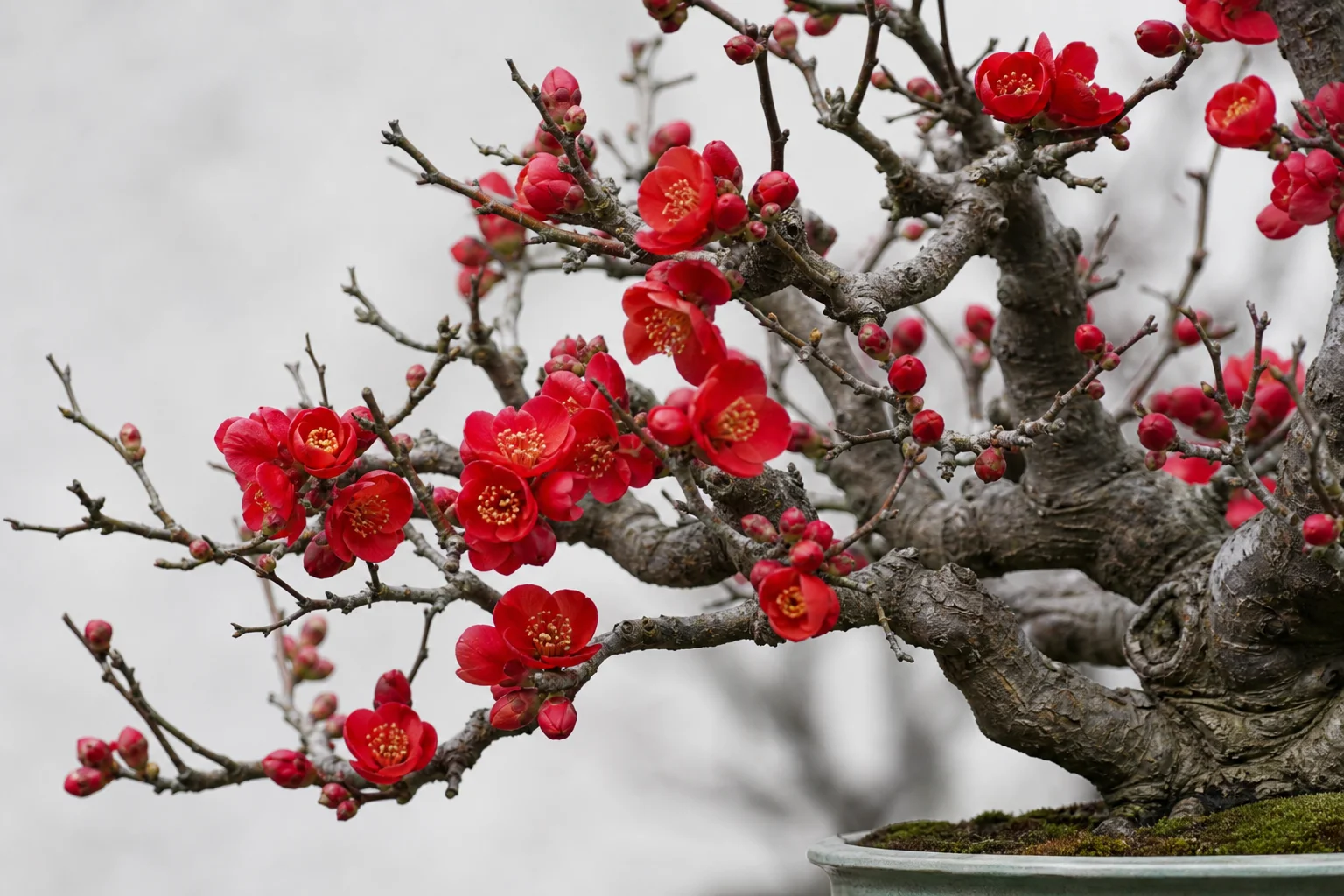
Japanese flowering quince
Chaenomeles japonicaWinter-into-spring flowers in red, orange, pink, or white. The bonsai that blooms when nothing else does.
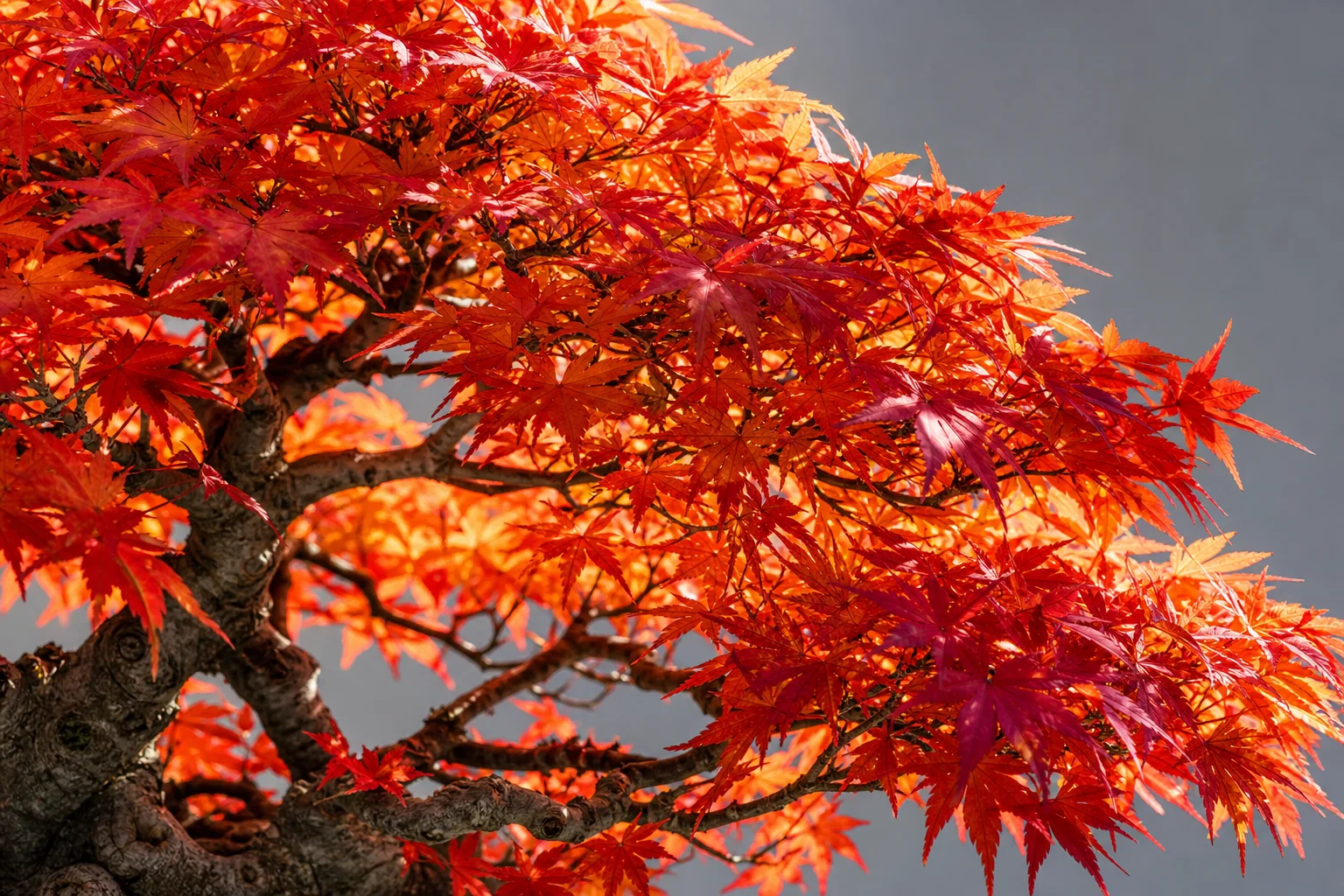
Japanese maple
Acer palmatumThe iconic deciduous bonsai — slender twigs, palmate leaves, and four genuinely different seasons.