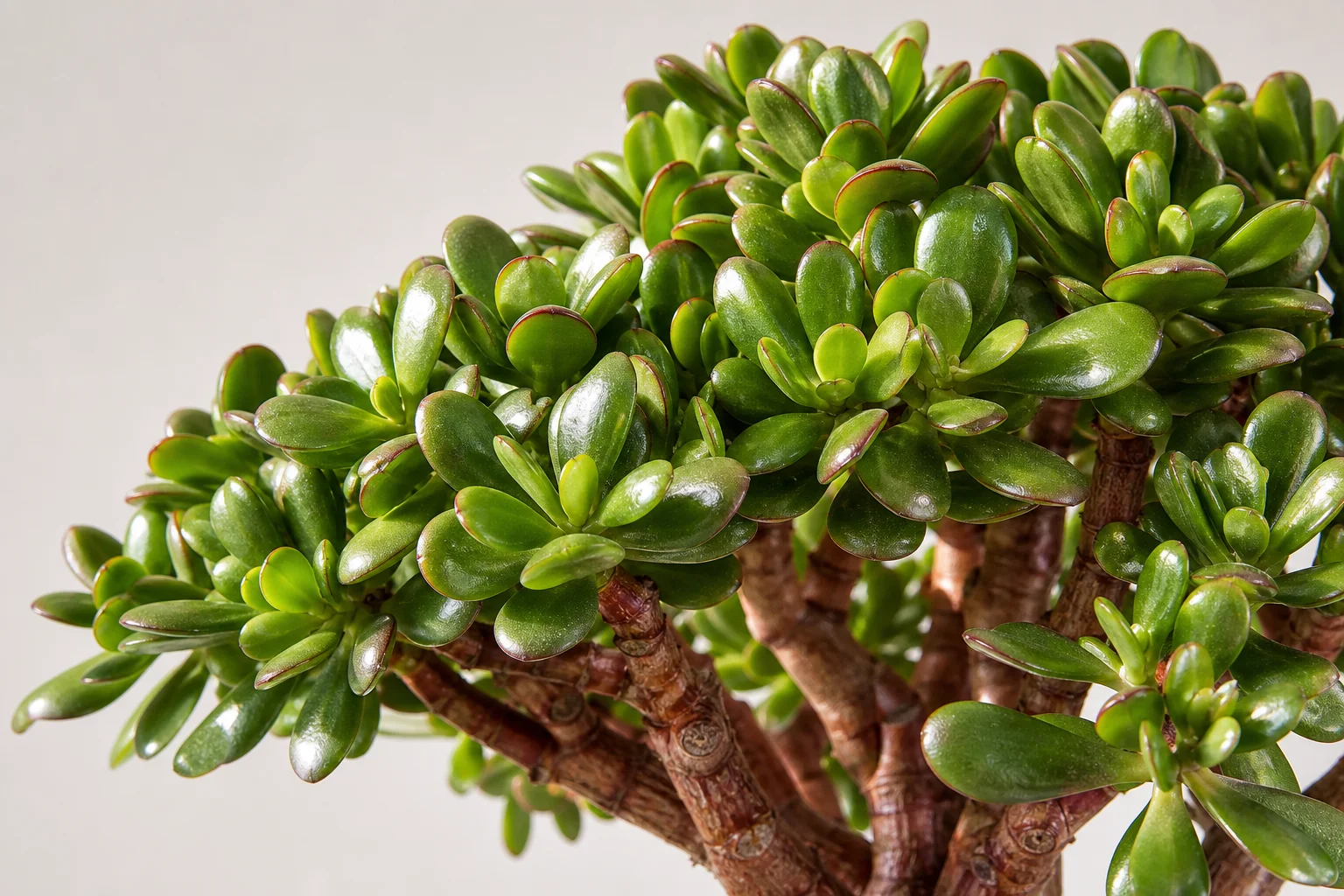
Dwarf jade bonsai care
Portulacaria afraThe succulent bonsai. Drought-proof, sun-loving, almost impossible to kill, and fundamentally unlike any other species in your collection.
Water
Every 10 days
check daily in summerLiquid feed
Every 28 days
growing seasonSolid feed
Every 60 days
slow releaseRotate
Every 28 days
even canopy growthPortulacaria afra is the bonsai for people who travel, for people who forget to water, for people who want an indoor tree that thrives on neglect. It's a succulent — closely related to the jade plant (Crassula ovata) that everyone's grandmother has on a windowsill — and operates on completely different rules from any other bonsai species. It stores water in its stems and leaves, photosynthesises through specialised drought-adapted pathways, tolerates temperatures from frost-marginal to actually-quite-hot, and recovers from periods of complete neglect that would kill any other bonsai.
The trade-off is aesthetic. Jade doesn't have refined ramification in the traditional bonsai sense; the branch structure tends to be chunky rather than fine. The leaves are small and shiny but visually unlike any conventional bonsai. The species reads as bonsai-influenced sculpture more than as miniature tree.
For a beginner who wants an indoor bonsai and a forgiving learning experience, jade is one of the strongest options. For an experienced grower wanting another forgiving species in the collection, it's a useful contrast. For someone whose aesthetic ideal is the classic refined Japanese maple, jade may always feel like a different category of object.
A naming note: the species commonly called jade in bonsai contexts is Portulacaria afra, not Crassula ovata (which is also sometimes called jade plant). Crassula works as bonsai too but is more brittle and less suitable; if a nursery is selling a jade bonsai, it's almost always portulacaria.
Native to South Africa, particularly the eastern Cape — semi-arid scrubland where it forms the dominant vegetation in some areas. Locally called spekboom (bacon tree). Significant ecological importance — large old portulacaria are major carbon-sequestering plants in their native range.
Seasonal calendar
Timing is for South East England. Select your region above to see adjusted guidance.
- Minimal watering — every 3-4 weeks
- Maintain bright position indoors
- Still dormant — light watering only
- Watch for leggy etiolated growth
- Begin slight watering increase
- Move to brightest indoor position
- Begin monthly light feeding
- Active growth resumes
- Move outdoors mid-month after last frost
- Begin pruning and shaping
- Full sun outdoors
- Frequent pruning to shape
- Peak growth
- Take cuttings for forest plantings
- Continue light feeding
- Major structural pruning if needed
- Stop feeding mid-month
- Prepare to move indoors
- Move indoors before first frost
- Reduce watering dramatically
- Watering every 2-3 weeks
- Position in brightest window
- Minimal watering
- Watch for environmental stress
Watering
Water when the substrate is completely dry — typically every 7–14 days in summer, every 2–4 weeks in winter. The species is genuinely drought-adapted and prefers dryness to moisture. Overwatering is the only common way to kill a jade bonsai.
When you water, water thoroughly until it runs from the drainage holes. Drain any standing water. Then wait until the substrate is bone-dry again before the next watering.
Tap water of any hardness is fine. The species evolved on mineral-rich soils.
Feeding
Feed very lightly. Monthly liquid feed at quarter strength from April through September. Stop feeding entirely from October through March.
The species doesn't respond to heavy feeding — overfeeding produces soft etiolated growth rather than the tight compact habit you want. Use cactus or succulent-specific fertilisers (low N, balanced PK) rather than general bonsai feeds.
Soil & Repotting
Very free-draining. Standard bonsai mixes are too moisture-retentive for jade.
60% pumice, 20% cactus/succulent compost, 20% lava in 3–6mm grade. Alternatively, a quality commercial cactus mix with extra perlite for drainage. The goal is a substrate that dries rapidly between waterings.
Repot every 3–4 years on established trees. The window is broad — anytime the tree is actively growing (April through September is ideal). Jade is forgiving of timing.
The species tolerates substantial root work — up to half the root mass on healthy trees. Allow the roots to dry for 24–48 hours after pruning before potting into fresh substrate — this lets cuts callus and reduces rot risk. Don't water for 7–10 days after repotting.
Pruning
Jade pruning is the easiest in bonsai. The species back-buds reliably from any cut point and tolerates timing whenever convenient.
Through the active growing period (spring and summer), let shoots extend to 4–5 leaves then cut back to 2. The species responds to pinching with new growth at the cut, building ramification with consistent technique.
Major structural pruning can happen any time the tree is actively growing. Cuts heal quickly. Don't seal cuts on jade — the species' natural healing involves rapid callus formation, and sealants can interfere.
Cuttings root almost effortlessly — any pruned branch can be left to callus for a day, then potted in dry substrate, and will produce roots within 2–4 weeks. This makes jade ideal for forest plantings and group compositions from a single mother plant.
Wiring & Styling
Wire is rarely used heavily on jade — the species' thick succulent stems resist most wire bending and snap rather than flex when forced. Light wiring on younger growth is possible but check very frequently as the soft tissue marks quickly.
Most jade bonsai is styled through clip-and-grow technique rather than wiring. Position branches by where you let new growth occur and where you cut back to redirect.
Informal upright, broom, and clump styles all work well. The species' chunky branching habit suits styles that emphasise the trunk and major branches rather than refined ramification.
Forest plantings from cuttings of a single mother plant create coherent groves quickly and are a particularly satisfying way to work with the species — start with a few rooted cuttings in spring, and within a year or two you have a forest composition.
Cascade is possible but unusual. Literati is rare. Avoid trying to apply traditional Japanese maple aesthetic ideals to jade; it's a different kind of tree.
Winter care
Indoor in UK winters — the species cannot tolerate frost. Minimum 10°C (some growers push to 5°C briefly, but consistent cold weakens the plant). Bring indoors well before first frost; in southern UK this means mid-October, in northern regions late September.
Most jade growers move plants outdoors for UK summer (mid-May through to mid-September) — full sun produces tight compact growth and small leaves. Indoors year-round produces leggy etiolated growth unless the position is exceptionally bright.
Reduce watering dramatically in winter — the indoor plant is barely growing and overwatering at cool temperatures is the killer. A jade may not need watering at all for 3–4 weeks at a time in a cool conservatory.
Light: as bright as possible. Direct sun is fine. South-facing windowsill in winter, full outdoor sun in summer.
Propagation
From cuttings — essentially free, essentially guaranteed. Cut any branch, let the cut callus for 24–48 hours, push into dry substrate, water lightly after 7 days. Roots within 2–4 weeks. This is the standard propagation method and many jade collections are built from a single original purchase.
From seed possible but rarely used.
Common problems
Generally bulletproof. Most problems are watering-related; pest pressure is low.
Root rot from overwatering
Symptoms: Soft mushy stems near soil level; leaves drop; foul smell from substrate.
Cause: Overwatering, especially in winter or in dense substrate.
Solution: Often fatal once stem rot is visible. Sometimes salvageable by cutting above the rotted area and rooting the top as a cutting — jade roots so easily that this works frequently. Prevention: water only when bone-dry, use very free-draining substrate.
Etiolation (leggy growth)
Symptoms: Internodes lengthen, leaves spread further apart, growth becomes loose and pale.
Cause: Insufficient light, especially indoors in winter.
Solution: Move to brighter position immediately. Affected growth doesn't reverse but new growth in better light will be tight again. Some growers prune off etiolated growth in spring once light improves.
Mealybugs
Symptoms: White cottony masses in leaf axils and on stems.
Cause: Common pest on jade and related succulents.
Solution: Wipe off with alcohol-dipped cotton bud. Neem oil for widespread infestations. Systemic insecticide if persistent. Easy to control with regular inspection.
Sunburn
Symptoms: Pale or brown patches on leaves after sudden exposure to strong sun.
Cause: Moving an indoor jade straight into outdoor summer sun without acclimatisation.
Solution: Affected leaves typically drop but the plant recovers. Future moves: acclimatise gradually over 2 weeks in partial shade before full sun.
Frost damage
Symptoms: Sudden collapse of stems and leaves after exposure to freezing temperatures.
Cause: Jade has no frost tolerance.
Solution: Usually fatal if more than light frost. Salvage what's not damaged as cuttings. Prevention: bring indoors well before any risk of frost; in UK, mid-October at the latest in the south.
Wrinkled leaves
Symptoms: Leaves become soft and wrinkled rather than firm and shiny.
Cause: Underwatering — eventually, even drought-adapted succulents need water.
Solution: Water thoroughly and wait. Leaves recover firmness within 24-48 hours. This is one of the few species that genuinely tells you when it's thirsty.
Popular cultivars
The wild type. Vigorous, green leaves, the standard for bonsai.
Variegated cream-and-green leaves. Less vigorous, more delicate, distinct visual character.
Yellow-leaved form. Striking but slower-growing than the species.
Slow-growing cultivar with corky bark on mature stems. Excellent for refined bonsai work — develops apparent age faster.
Different species sometimes also called jade. Larger leaves, more brittle stems, less suitable for bonsai. If you're buying jade for bonsai, look for portulacaria not crassula.
Track your Dwarf jade with Kentai.
Collection tracking, care logs and photo history are free — no card, no time limit.
More care guides
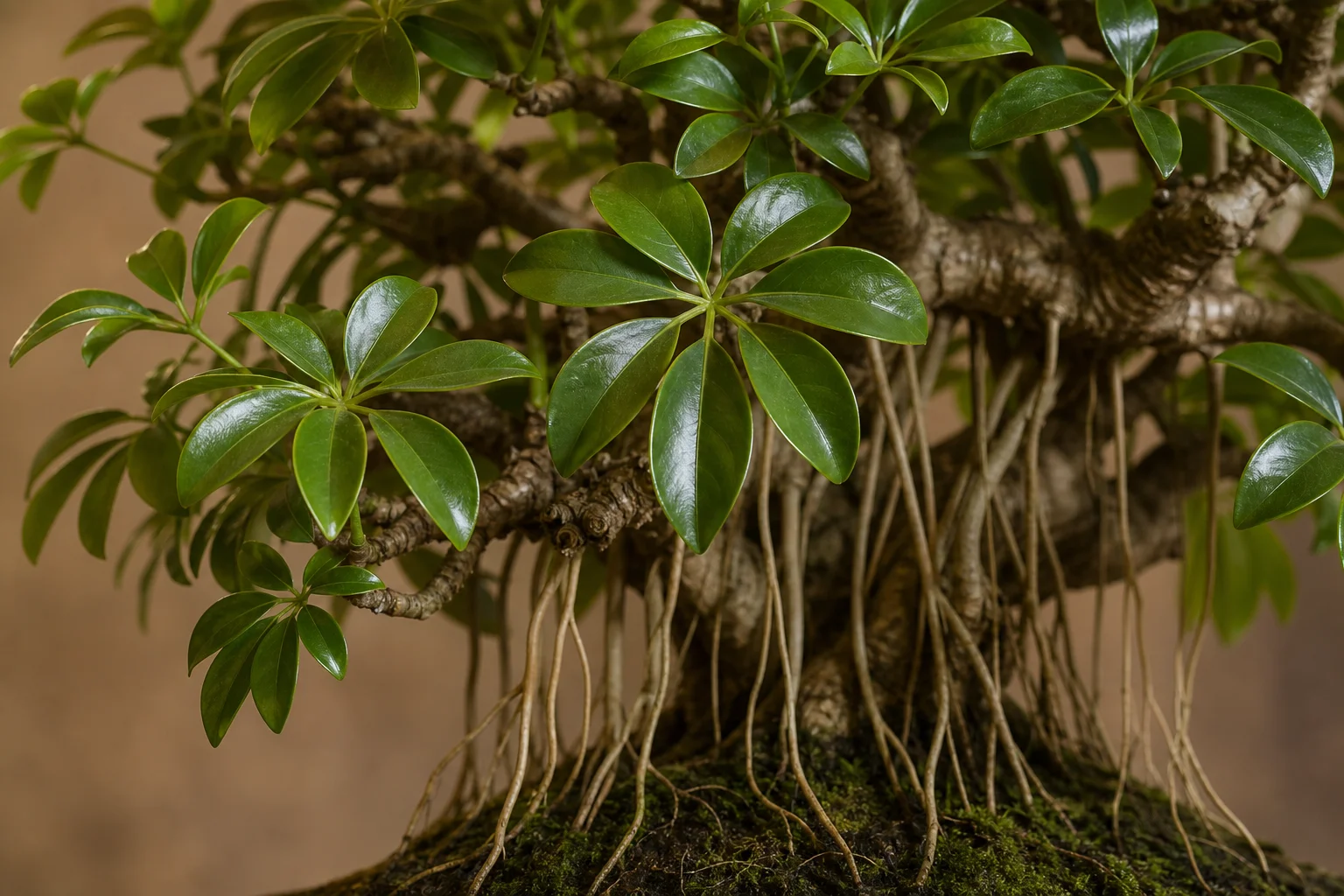
Dwarf umbrella tree
Schefflera arboricolaThe banyan-style indoor bonsai. Aerial roots, compound leaves arranged in umbrella patterns, almost impossible to kill — and one of the few species that genuinely lives up to its "easy indoor bonsai" marketing.
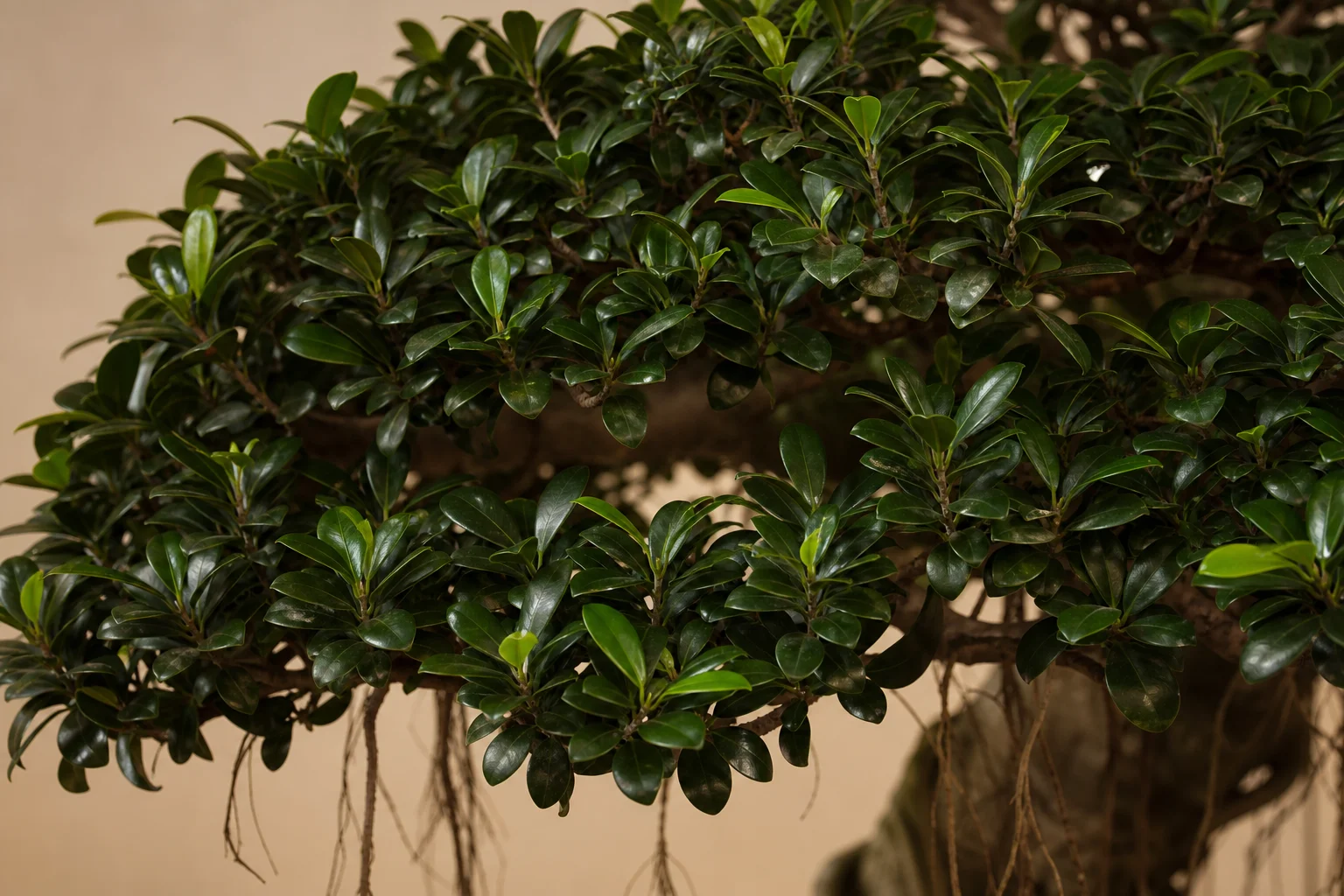
Ficus retusa
Ficus microcarpaThe best indoor bonsai. Tolerant of household conditions, fast-growing, and the only common bonsai species that truly thrives without a winter dormancy.
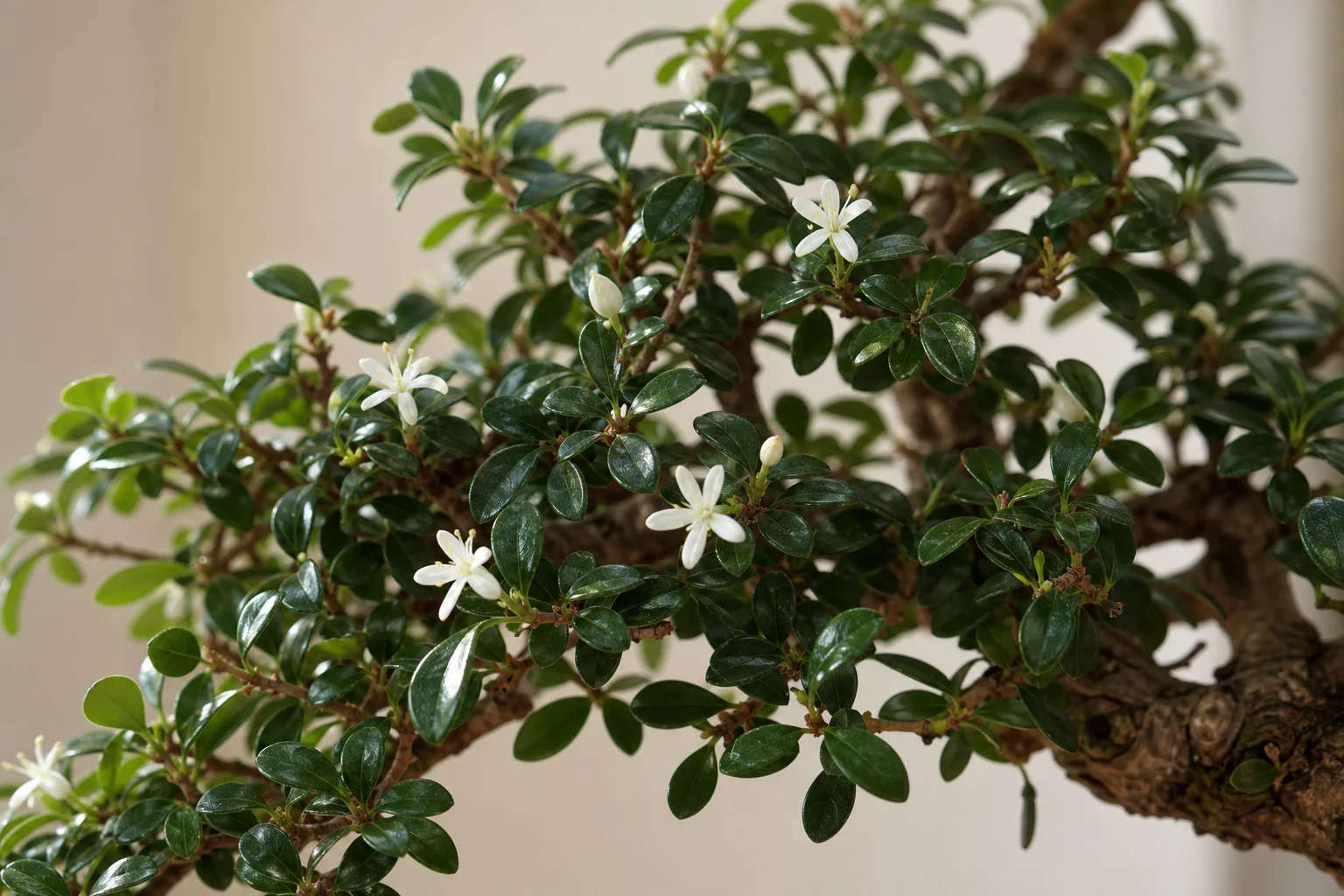
Fukien tea
Carmona retusaSmall dark glossy leaves, tiny white flowers year-round, small red berries — the popular indoor bonsai widely sold as starter material despite being one of the more challenging species to maintain.