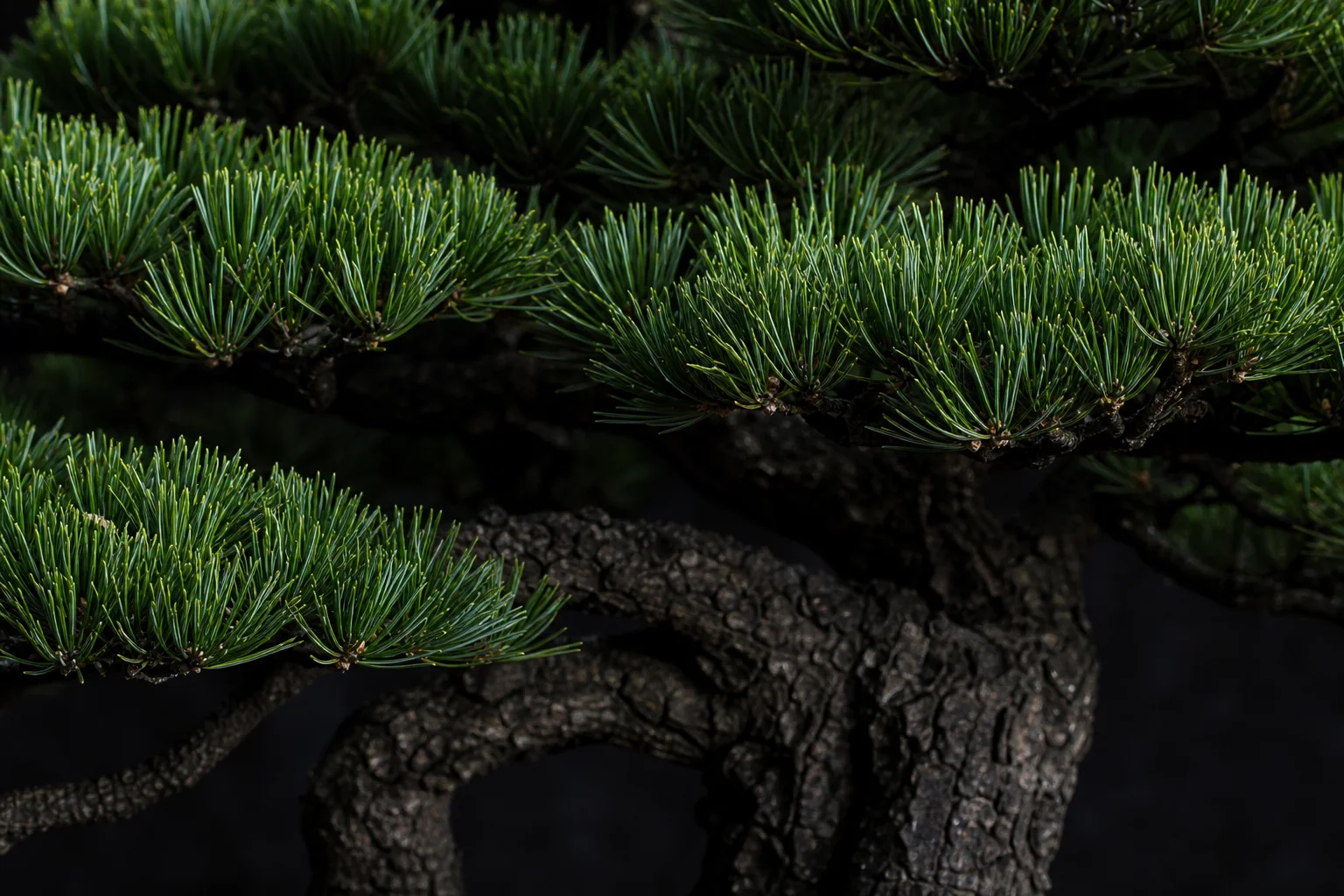
Japanese black pine bonsai care
Pinus thunbergiiThe flagship bonsai pine — dark fissured bark, two-flush technique, and a steeper learning curve than any other common species.
Water
Every 3 days
check daily in summerLiquid feed
Every 14 days
growing seasonSolid feed
Every 21 days
slow releaseRotate
Every 30 days
even canopy growthJapanese black pine is to Japanese bonsai what Cabernet Sauvignon is to French wine — the prestige species, the one with the most developed technique, and the one judged against the highest standard. Mature specimens have nearly black, deeply fissured bark, almost mathematically precise needle pads, and an aesthetic of disciplined power that no other pine quite matches.
It is also the most technique-heavy bonsai you can grow in the UK. The defining practice is decandling — removing the entire spring flush of new shoots in early summer so the tree produces a second, much shorter flush with shorter needles. Done correctly, this is the foundation of refined JBP work. Done incorrectly, it weakens or kills the tree. Done at the wrong time of year — and the correct window in the UK is debated — it produces a mediocre tree.
For UK growers there's also a climate problem worth being honest about. JBP evolved on warm coastal Japan; in the UK it grows slower, decandles less reliably, and is more prone to fungal issues in our wet summers than it would be in Tokyo or California. It can absolutely be grown well here — the UK has several world-class JBP collections — but if you're new to pines, start with Scots pine. Come back to JBP when you've grown a pine for five years.
Native to coastal Japan and South Korea, growing on rocky cliffs and salt-sprayed dunes from Kyushu to Hokkaido. Adapted to lean substrates, full sun, salt-laden wind, and warm, humid summers — a climate the UK does not replicate.
Seasonal calendar
Timing is for South East England. Select your region above to see adjusted guidance.
- Structural pruning and styling
- Heavy wiring
- Continue styling work
- Watch for root activity later in month
- Start feeding lightly if not decandling this year
- Repot if root tips active
- Candles extending — leave undisturbed
- Repotting window for established trees
- Candles fully extended
- Stop feeding if decandling planned
- Last chance to abort decandling plans
- Final preparation
UK decandling window opens very late month at earliest.
- Decandling on healthy refined trees (first week)
- Resume heavy feeding immediately after decandling
- Second flush emerges
- Continue heavy feeding
- Needle plucking — balance energy
- Stop feeding end of month
- Wiring window opens
- Continue needle thinning
- Heavy wiring and structural work
- Carve deadwood
- Continue styling on dormant trees
- Minimal watering
Watering
Water carefully — overwatering is the most common cause of death. Wait for the surface of the substrate to dry before watering, then water thoroughly. In a UK summer this typically means every 2–4 days; in spring and autumn every 4–7 days; in winter every 7–14 days or less.
JBP roots want oxygen and demand wet-dry cycling. A pot kept constantly damp will rot, slowly at first then suddenly. A pot allowed to dry between waterings will produce a healthier tree than one tended too attentively.
Tap water is fine. Avoid wetting the foliage in evening watering during damp UK weather — it encourages needle cast fungi.
Feeding
Feeding strategy for JBP is more developed than for any other bonsai species, and the details vary by what you're trying to achieve.
For trees in development pushing for trunk thickness: heavy feeding all season. Slow-release pellets on the surface from March through September, plus weekly full-strength liquid feed. The tree will produce coarse foliage and long internodes that you'll later refine away.
For trees being refined: a complete pause in spring (no feeding from late March until after decandling in late June or early July), then heavy feeding from mid-July through September to drive the second flush. This pattern produces shorter needles in the second flush.
In all cases stop feeding by end of September. UK autumns are wet enough that continued nitrogen will produce soft growth that won't harden before winter.
Soil & Repotting
Very free-draining, acidic to neutral. JBP needs maximum oxygen at the roots.
70% pumice, 20% akadama, 10% lava — coarser grade than for deciduous species (3–6mm). Some growers go to pure pumice for collected or weak material. Avoid akadama-dominant mixes; they hold too much water for UK conditions.
Repot every 4–6 years on refined trees; every 2–3 on younger material being developed. Window is late March to early May — wait for active root tips.
JBP tolerates root work poorly and keeping mycorrhizae intact is critical — these fungi are partly responsible for the tree's vigour. Don't bare-root. Remove no more than a quarter of the root mass on established trees and considerably less on older specimens. The standard advice is to repot only when root-bound, not on a fixed schedule.
Pruning
JBP pruning is the most developed in bonsai. There are entire books on it. The summary below covers the basics; deeper learning requires years of practice and ideally a teacher.
Spring (April–May): Let candles extend fully. Do nothing.
Decandling (late June to early July in the UK): On healthy refined trees, cut all new candles back to short stubs at the base. The tree will produce a second flush from latent buds — these second-flush shoots will have much shorter needles than the first flush would have had. This is the technique that produces the dense, short-needled foliage pads characteristic of show-quality JBP.
Critical caveats: only decandle healthy, well-fed, vigorous trees. Never decandle weak trees, recently repotted trees, recently collected trees, or trees you're still developing. Don't decandle every branch — leave weaker branches alone so they get a head start. UK timing is later than Japan's — late June at earliest, more usually first week of July.
Needle plucking (September–October): Thin old needles to balance energy across the tree. Leave more on weak branches, fewer on strong ones.
Structural pruning (winter, November–February): Remove unwanted branches while dormant.
Wiring & Styling
Wire from October through to early February on dormant trees. Use copper for structural work and aluminium for finer branches. JBP bark is robust but check wires every few months; thicker bark sections may mark less but can hold wire impressions for years.
Major bends usually require raffia wrapping or guy-wiring; the species' wood is strong but inflexible compared to junipers.
Informal upright with substantial taper is the classic JBP styling. Twin-trunk, cascade, semi-cascade, literati, and windswept all work. The species lends itself to dramatic deadwood — jin from dead branches, shari running the length of the trunk on collected material. Aim for an aesthetic of disciplined age rather than weathering — JBP reads as ordered and refined rather than wild.
Forest plantings are uncommon for the species; the strong individual character of mature JBP suits solo specimens.
Winter care
Hardier than its origin suggests — down to -10°C with no protection. Below that, shelter from wind. The bigger UK winter concerns are damp rather than cold: prolonged wet winters cause root issues more often than freezes do. A position with good air movement and shelter from prevailing rain helps.
Don't bring indoors. JBP needs its cold rest. Don't fertilise in winter even if the weather is mild; the tree is supposed to be dormant.
Propagation
Almost exclusively from seed (autumn-sown, cold-stratified) for nursery production. Cuttings rarely succeed. Air layering is possible but slow. Most JBP bonsai in the UK come from imported Japanese material, specialist UK nurseries, or seed sown and grown on for 10–20 years.
Grafting is widely used in Japan to put refined JBP foliage onto rootstock with better roots — beyond the scope of most home growers but worth knowing exists when assessing nursery trees.
Common problems
More fungal-prone than Scots pine in UK conditions, and more sensitive to overwatering. Most problems trace back to substrate that holds too much water, watering too frequently, or attempting refinement techniques on a weakened tree.
Phytophthora root rot
Symptoms: Tree weakens, needles dull and grey, eventual collapse.
Cause: Saturated substrate. The most common cause of JBP death in the UK.
Solution: Usually fatal. Prevention via free-draining substrate, careful watering, and not repotting unnecessarily. If caught very early, emergency repot into bone-dry pumice can occasionally save the tree.
Needle cast (Lophodermium)
Symptoms: Old needles develop yellow then brown bands in spring; whole needles drop early.
Cause: Fungal, worsened by damp UK springs.
Solution: Improve airflow. Remove and bin affected needles and fallen debris. Copper fungicide preventatively in early spring. Avoid evening overhead watering.
Failure to produce second flush after decandling
Symptoms: Tree decandled in summer fails to push a strong second flush, or pushes weakly.
Cause: Tree wasn't healthy enough for decandling, was decandled too early or too late, or wasn't fed heavily enough afterwards.
Solution: Don't decandle again until the tree has been recovering for two full seasons with heavy feeding. Most trees recover. Check that your decandling timing matches UK conditions — too early is the common error.
Long needles
Symptoms: Second flush produces needles nearly as long as first flush would have.
Cause: Decandling too late, decandling weak trees, or too much feeding before decandling.
Solution: Adjust timing earlier next year if the tree is strong. Stop feeding 6-8 weeks before planned decandling date. The technique is more art than science and takes years to calibrate to your specific conditions.
Scale insects
Symptoms: Small brown bumps on needles and twigs; sticky honeydew; sooty mould.
Cause: Sap-sucking pests common on imported material.
Solution: Manual removal where possible. Systemic insecticide if severe. Inspect new acquisitions carefully — JBP imported from warmer climates often arrives with scale.
Branch dieback
Symptoms: Individual branches die back over a season.
Cause: Often unbalanced energy distribution — strong branches dominate and steal vigour from weaker ones, which weaken further and die.
Solution: Maintain energy balance with selective decandling (don't decandle weak branches) and needle thinning (leave more needles on weak branches). This is the single most important ongoing technique for JBP refinement.
Popular cultivars
The wild type. Most quality JBP bonsai are seedling-grown wild type with no cultivar name.
A regional Japanese strain particularly prized for its rough corky bark from a young age. Sought-after.
Dwarf cultivars from various Japanese strains. Useful for shohin and mame work.
Compact form with short needles and slow growth. Less corky bark than Mikawa but excellent ramification potential.
Track your Japanese black pine with Kentai.
Collection tracking, care logs and photo history are free — no card, no time limit.
More care guides
Other Pinus guides: Japanese white pine · Mugo pine · Scots pine
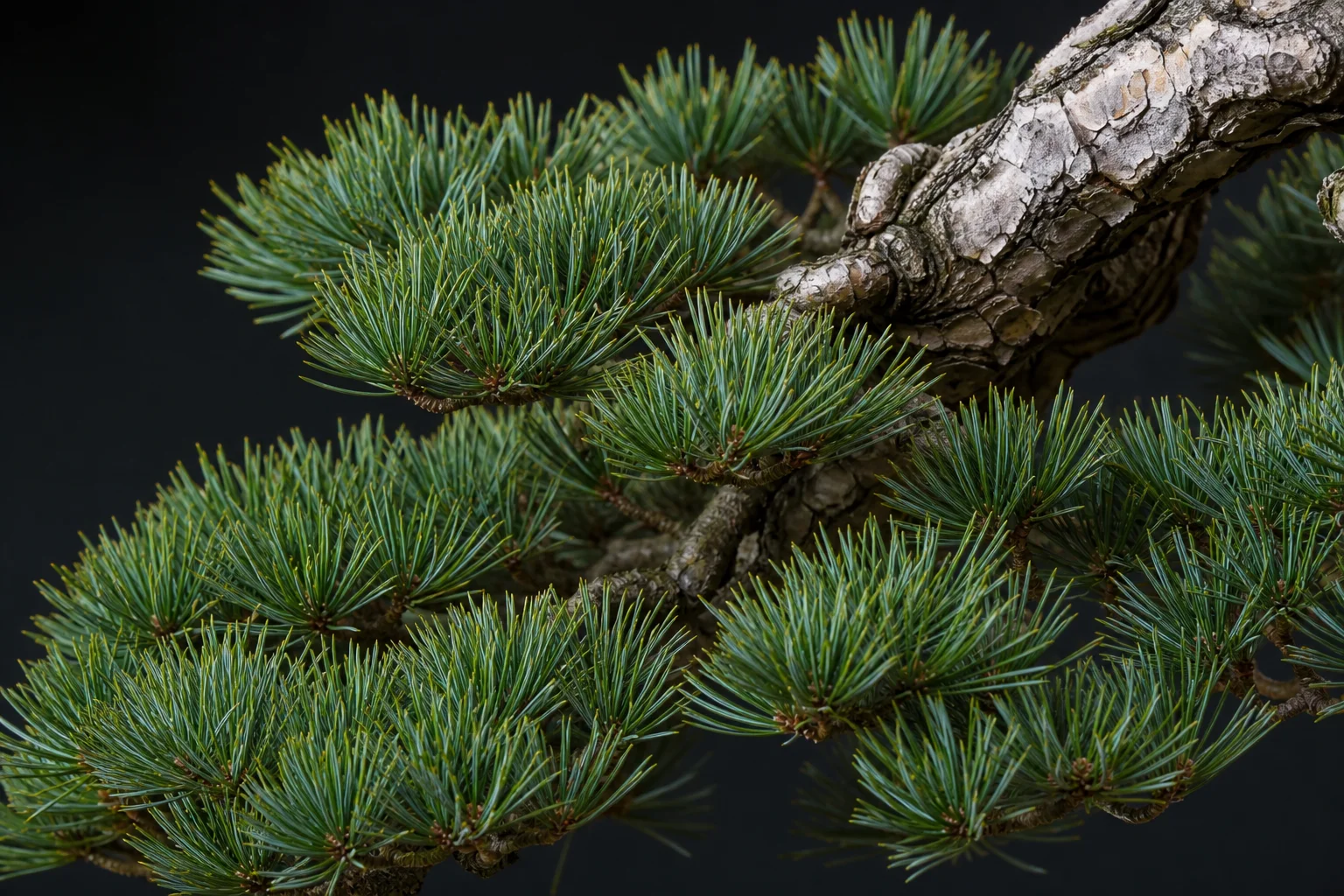
Japanese white pine
Pinus parvifloraThe other classic Japanese pine. Five blue-green needles per bundle, single-flush growth, and a refined elegance that no other pine quite matches.
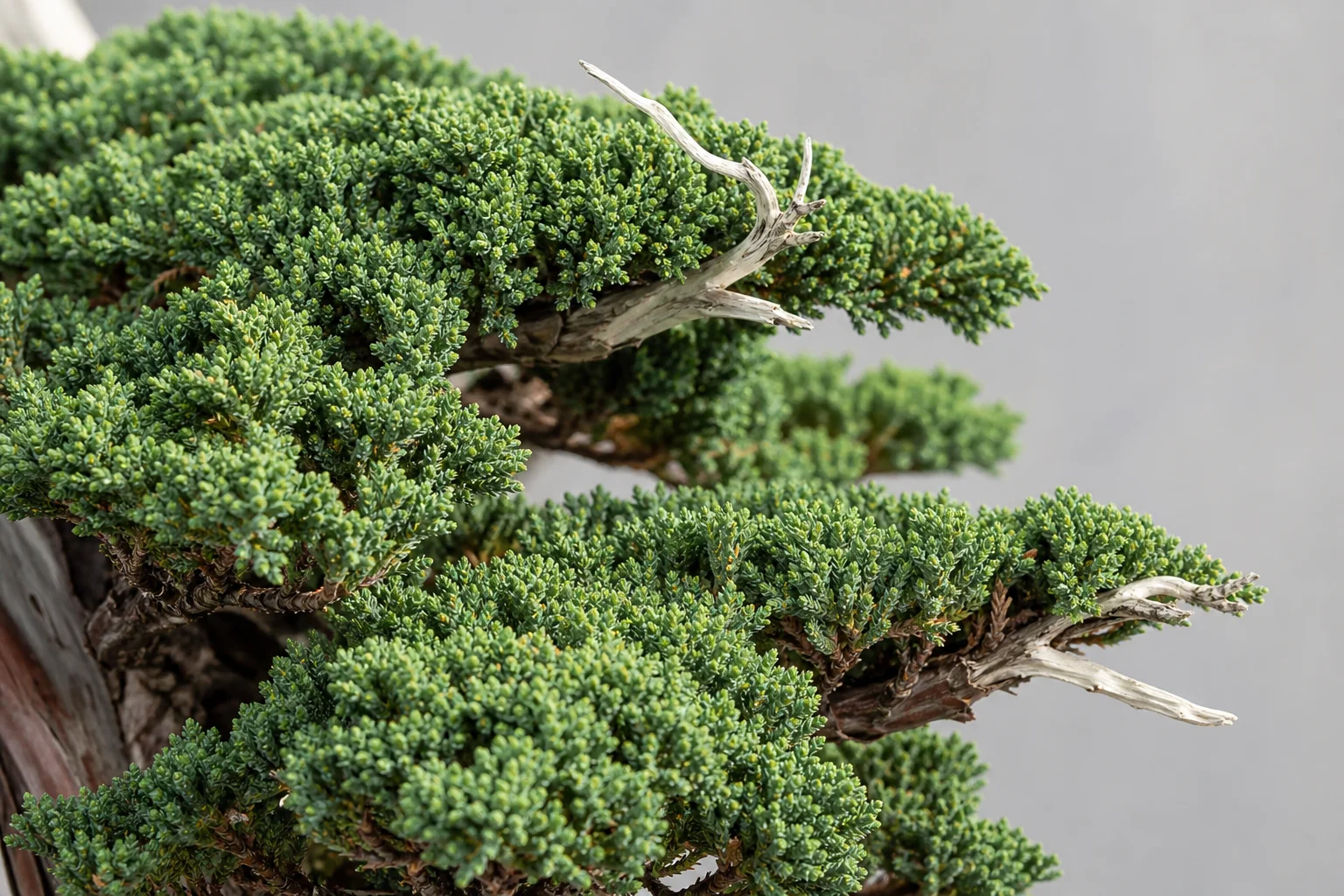
Juniper procumbens 'Nana'
Juniperus procumbens 'Nana'The classic mall bonsai, often the first tree people own — and often killed by being kept indoors. Outside, hardy, sun-loving and beautiful.
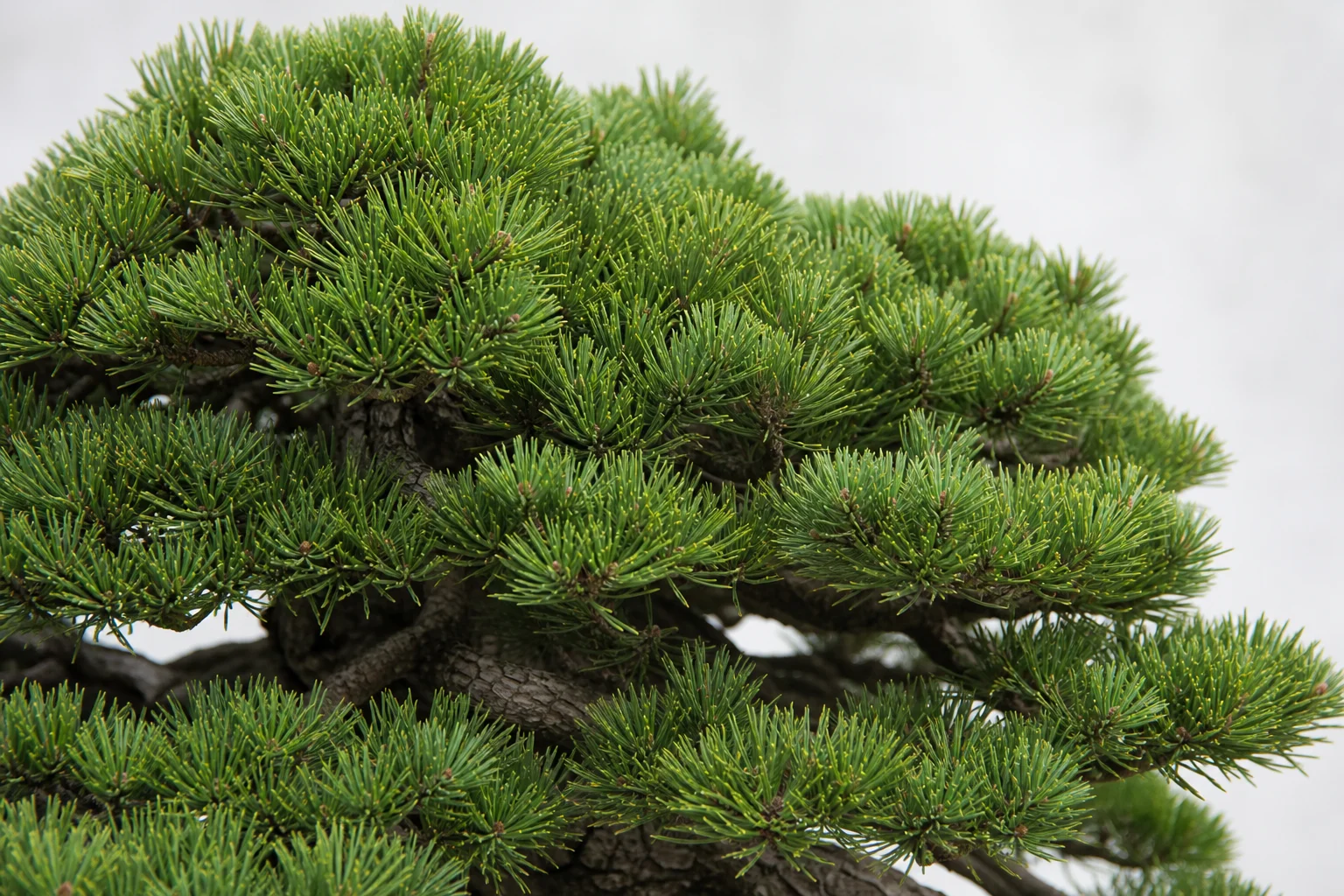
Mugo pine
Pinus mugoThe easy pine. Bulletproof, widely available, and the best beginner conifer in the UK.