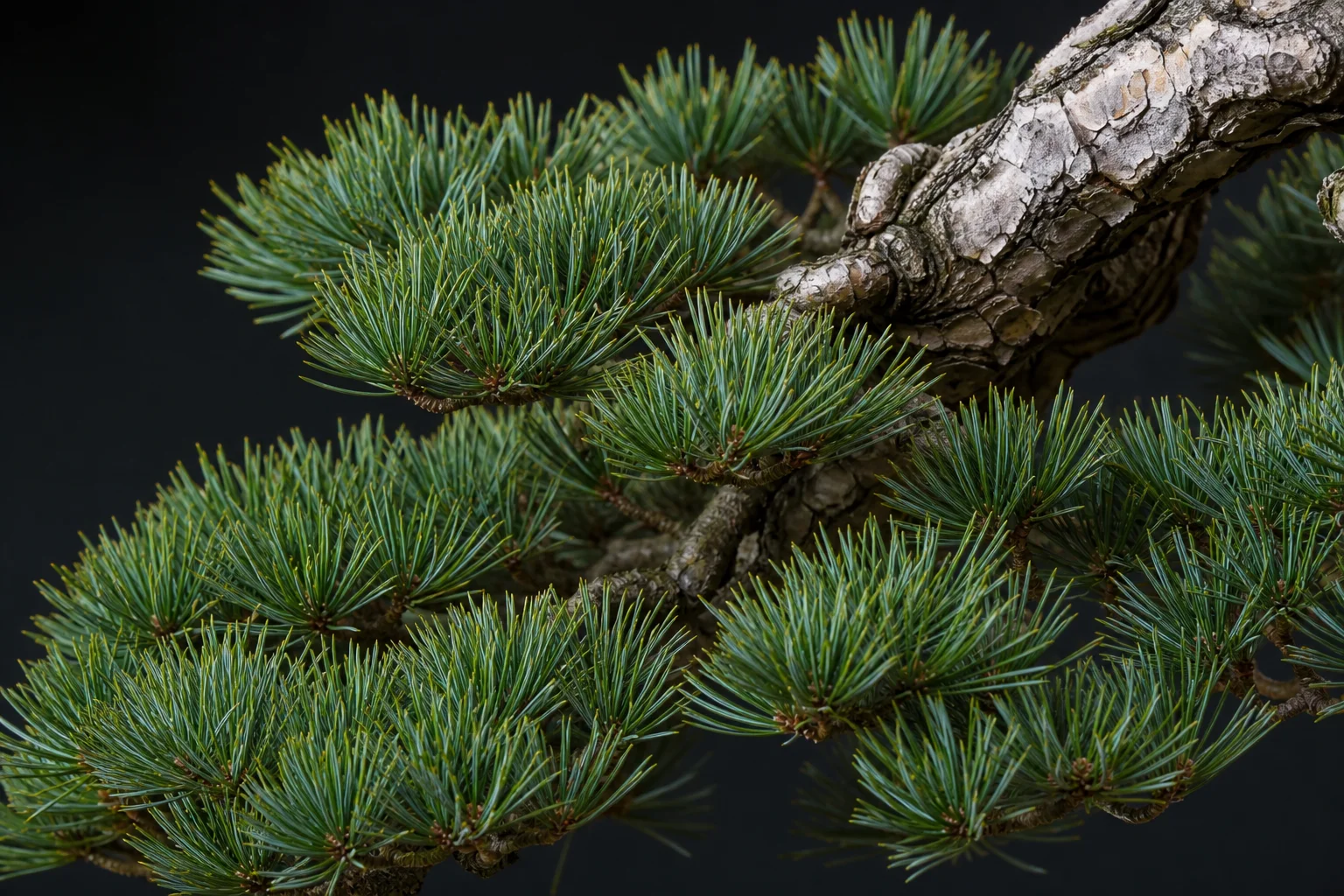
Japanese white pine bonsai care
Pinus parvifloraThe other classic Japanese pine. Five blue-green needles per bundle, single-flush growth, and a refined elegance that no other pine quite matches.
Water
Every 4 days
check daily in summerLiquid feed
Every 14 days
growing seasonSolid feed
Every 28 days
slow releaseRotate
Every 30 days
even canopy growthJapanese white pine is the third leg of the classic Japanese bonsai triad — alongside Japanese black pine and Japanese maple. Where black pine is dramatic and disciplined, white pine is quieter and more elegant: shorter blue-green needles in bundles of five (rather than the two-per-bundle of black pine), a softer texture, and a more upright graceful habit in maturity.
The species' big technical difference from JBP is that it's single-flush — it doesn't reliably produce a second growth flush when decandled, so the two-flush decandling technique that defines JBP doesn't apply. Refinement instead relies on careful candle adjustment in spring, needle thinning in autumn, and the slow accumulation of dense compact growth over many years.
Most quality Japanese white pine bonsai in the UK are imported from Japan and have been grafted onto Japanese black pine rootstock — the JBP roots are more vigorous and tolerant than the species' own. The graft union (visible as a slight line above the soil) is a feature of the genus rather than a flaw, but it does mean the species has effectively two parts with slightly different care needs.
For UK growers: JWP is hardier than JBP in our climate but more sensitive to overwatering. It's an excellent species for someone with pine experience who wants more refinement, but probably not the first pine you should buy.
Native to mountainous Japan and southern Korea. Grows on rocky exposed slopes at high altitude — the natural habitat of mature specimens with the famous flat-topped wind-shaped crowns. The bonsai cultivars derive from selected mountain stock plus centuries of further selection in Japan; some named cultivars (Zuisho, Kokonoe) trace back to specific famous mother trees.
Seasonal calendar
Timing is for South East England. Select your region above to see adjusted guidance.
- Structural pruning and styling on dormant trees
- Heavy wiring
- Continue winter work
- Watch for late-month root activity
- Wait for root activity before repot
- Final winter styling
- Repot if root tips active
- Candles begin extending
- Candle adjustment — pinch strong, leave weak
- Begin light feeding
- Continue light feeding
- Leave tree undisturbed
- Maintain dry/wet watering cycle
- No pinching or pruning
- Last feed early month
- Begin assessing needle distribution
- Needle thinning begins
- Stop feeding
- Complete needle thinning
- Wiring window opens
- Heavy wiring season
- Deadwood work
- Continue winter styling
- Minimal watering
Watering
Water carefully — overwatering is the most common cause of death. Wait for the surface of the substrate to dry before watering, then water thoroughly. In a UK summer this typically means every 3–5 days; in spring and autumn every 5–7 days; in winter every 10–14 days or less.
White pine roots want oxygen and demand strong wet-dry cycling. The species is more sensitive to saturated substrate than JBP.
Tap water is fine. Avoid heavy overhead watering in damp UK evenings — encourages needle cast fungi.
Feeding
Feed lightly. Half-strength liquid feed every two weeks from May through August. Slow-release organic pellets in spring and again in early summer. Stop feeding by end of August.
Heavy feeding produces long needles and undermines refinement. The famous short-needled compact look of refined white pine bonsai comes from years of restrained feeding, not from any technique applied in one season.
Soil & Repotting
Very free-draining, slightly acidic to neutral. Maximum oxygen at the roots is the priority.
70% pumice, 20% akadama, 10% lava in 3–6mm grade. Some growers go to pure pumice or pumice/lava mixes for older specimens. Avoid akadama-dominant mixes; they hold too much water for UK conditions.
Repot every 5–7 years on established trees. The window is late March to early May — wait for visible root activity. White pine tolerates root work poorly and rarely needs disturbing on a fixed schedule. Repot only when truly root-bound.
Remove no more than a quarter of the root mass on established trees, considerably less on older specimens. Don't bare-root. Preserve the mycorrhizal fungi — they're partly responsible for the species' health.
If the tree is grafted (most are), the graft union should remain above the soil. The visible line is part of the tree's structure now.
Pruning
White pine pruning is fundamentally different from JBP. Decandling does not work on white pine — the species rarely produces a strong second flush and attempting JBP decandling techniques on a JWP weakens or kills the tree.
The correct seasonal pattern for refinement is:
Spring (April): Candles emerge. Let them extend.
Candle adjustment (May): Once candles have extended but before needles fully harden, pinch back stronger candles by a third to half — leaving weaker candles alone. This balances energy across the tree. Don't remove candles entirely; partial pinching is the technique.
Summer: Leave the tree alone. No pinching or pruning through summer.
Needle thinning (September–October): Remove old needles (last year's growth) to let light into the interior. Thin more aggressively on strong branches, less on weak ones. This is how energy is rebalanced for the following year.
Structural pruning (winter): Major cuts on dormant trees. Cuts heal slowly; seal large wounds.
Over many years of consistent technique, white pine produces extraordinarily refined ramification with very short needles. It's slow work — measurable progress takes years rather than seasons.
Wiring & Styling
Wire from October through to early February on dormant trees. White pine branches are flexible enough but slow to set — wire usually needs to stay on for 12–18 months. Use copper for structural work, aluminium for finer branches.
Bark thickens with age and develops the species' characteristic plates and fissures. Wire marks remain visible for years; apply carefully and check regularly.
Major bends benefit from raffia-wrapping.
Informal upright with substantial deadwood is the most common style — references the wild mountain form. Cascade and semi-cascade work on suitable material. Literati (bunjin) suits the species particularly well; many of the most celebrated JWP bonsai in Japan are bunjin specimens.
Formal upright is occasionally used but uncommon. Broom is alien to the genus.
Deadwood reads as ancient mountain weathering on white pine and is a strong feature of refined specimens.
Winter care
Hardier than JBP in UK conditions — down to -15°C with no protection. Below that, shelter from wind. The species evolved at altitude and handles cold without complaint.
The bigger UK winter concern is damp rather than cold. Position with good air movement and shelter from prevailing rain. A position with morning sun rather than afternoon sun reduces sudden thaw-freeze damage.
Never bring indoors.
Propagation
Almost exclusively from seed for true-species material — autumn-sown, cold-stratified. Cuttings rarely succeed. The vast majority of bonsai-quality white pine material is grafted onto JBP rootstock in Japan and imported. Specialist UK nurseries (Lodder, Greenwood) occasionally have UK-grafted material; this is the best route for home growers.
Common problems
Generally healthy in UK conditions when grown correctly. Most problems trace back to overwatering, substrate that holds too much water, or attempts to apply JBP techniques.
Phytophthora root rot
Symptoms: Tree weakens, needles dull and grey, eventual collapse.
Cause: Saturated substrate.
Solution: Usually fatal. Prevention via very free-draining substrate and careful watering. White pine is more sensitive to overwatering than other common bonsai pines.
Needle cast (Lophodermium)
Symptoms: Old needles develop yellow then brown bands in spring, drop early.
Cause: Fungal, worsened by damp UK conditions.
Solution: Improve airflow. Remove and bin affected needles. Copper fungicide as preventative in early spring. Avoid evening overhead watering.
Graft incompatibility issues
Symptoms: Slow decline, weak growth, or visible swelling at the graft union years after grafting.
Cause: Some JWP-on-JBP grafts develop compatibility problems over decades.
Solution: Difficult to address. Maintain consistent care and accept that occasional grafted material may decline. When buying, look for trees with well-healed graft unions and check provenance.
Long needles
Symptoms: Year's needles grow longer than wanted, undermining refinement.
Cause: Overfeeding, or insufficient candle adjustment.
Solution: Reduce feeding. Pinch candles harder in May. Needle length reduces gradually over 2–3 years of consistent restrained technique.
Scale insects
Symptoms: Small brown bumps on needles and twigs, sticky honeydew.
Cause: Common on imported Japanese material.
Solution: Inspect new acquisitions before adding to collection. Manual removal. Systemic insecticide for severe infestations.
Branch dieback
Symptoms: Individual branches die back over a season.
Cause: Often energy imbalance — strong branches dominating weaker ones.
Solution: Balance via selective candle adjustment (leave weak branches alone) and needle thinning (leave more needles on weak, thin more aggressively on strong). The fundamental ongoing technique for JWP refinement.
Popular cultivars
The wild type. Variable seedlings, sometimes used for development.
Short-needled, compact cultivar widely used for refined bonsai. Among the most popular JWP cultivars.
Compact cultivar with short blue-green needles. Very popular for refined work.
Cultivar from Miyajima island in Japan. Distinctive bark plating and refined habit.
Very short-needled form. Excellent for refined and shohin work.
Dwarf cultivars of various origins, useful for shohin and mame.
Track your Japanese white pine with Kentai.
Collection tracking, care logs and photo history are free — no card, no time limit.
More care guides
Other Pinus guides: Japanese black pine · Mugo pine · Scots pine
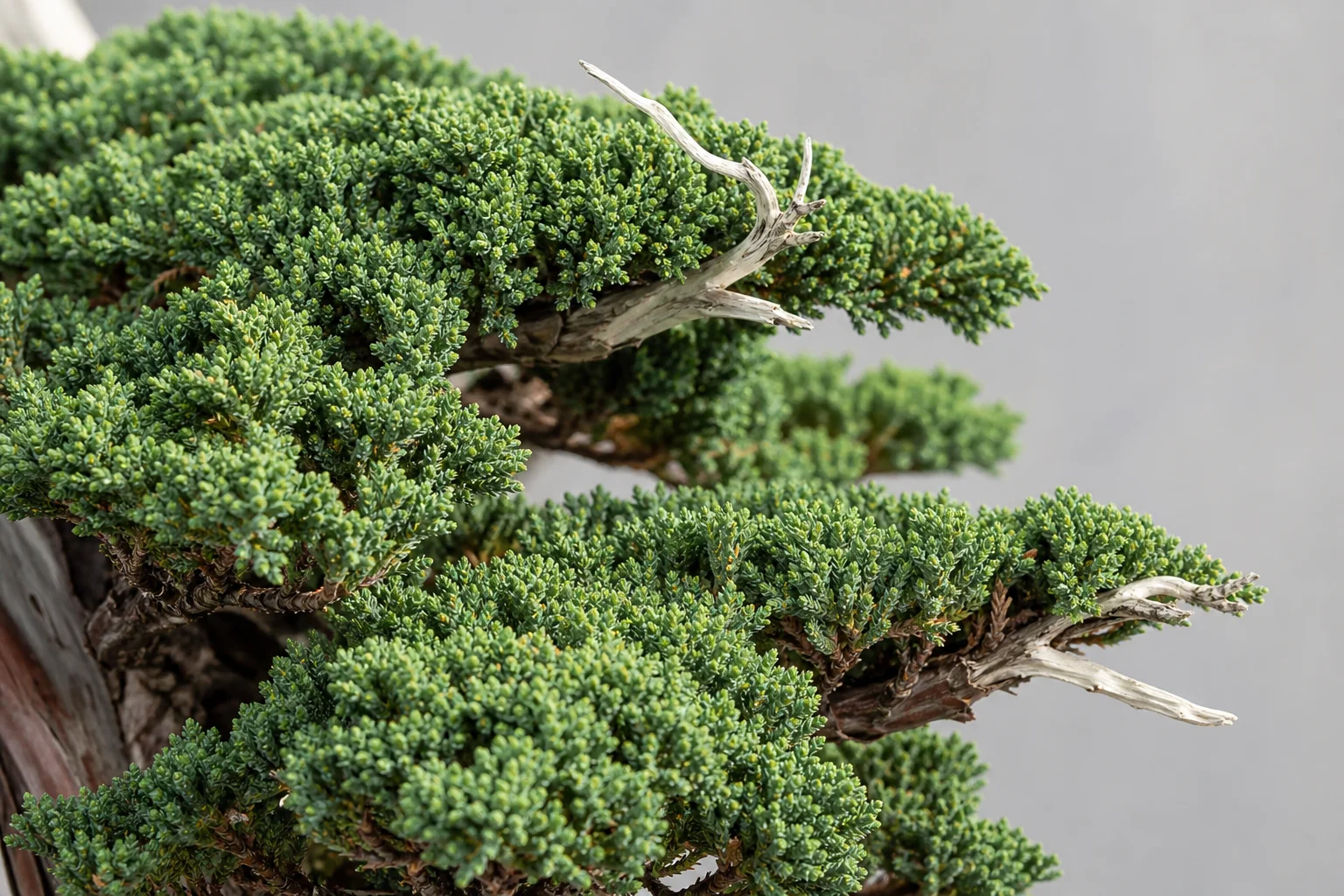
Juniper procumbens 'Nana'
Juniperus procumbens 'Nana'The classic mall bonsai, often the first tree people own — and often killed by being kept indoors. Outside, hardy, sun-loving and beautiful.
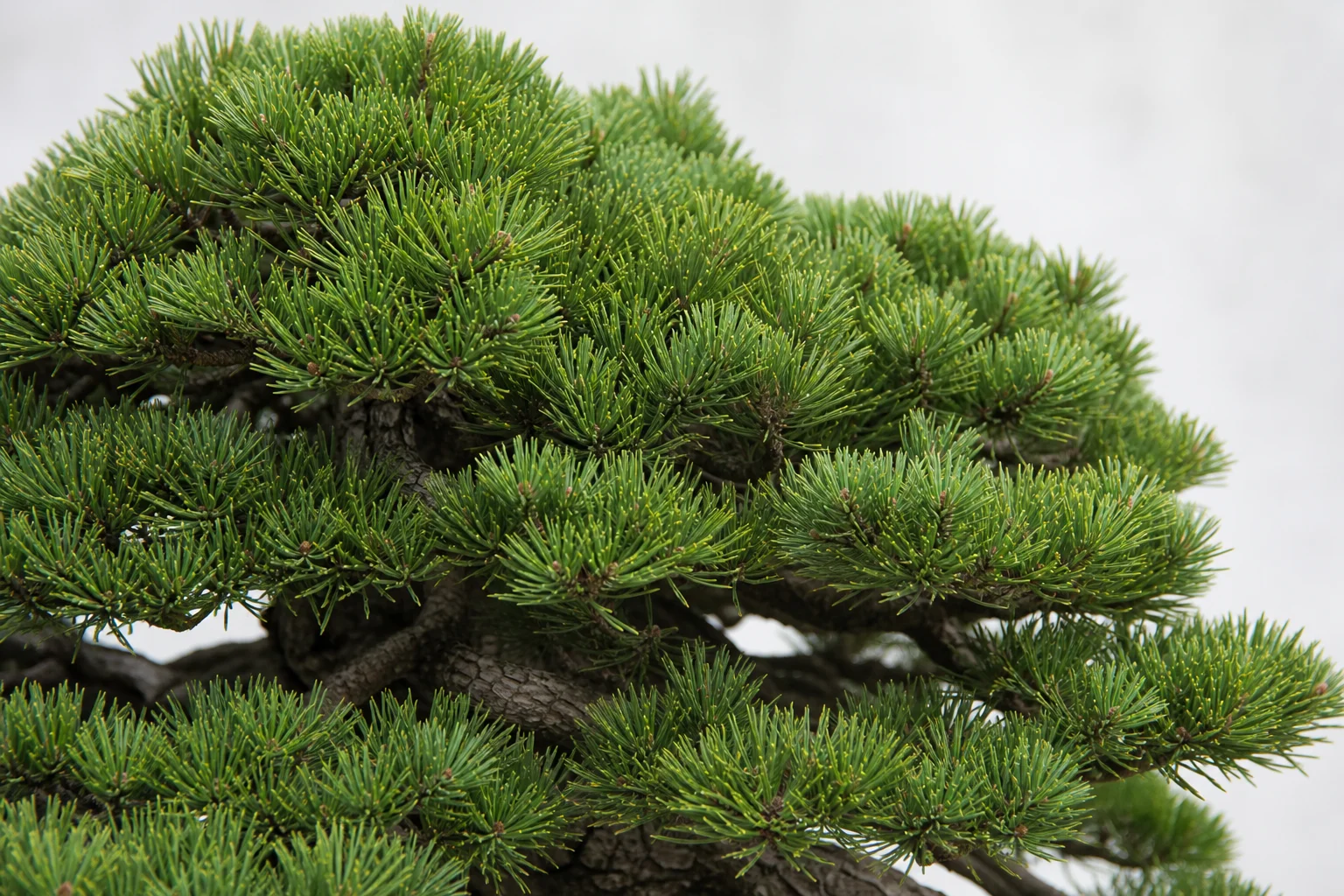
Mugo pine
Pinus mugoThe easy pine. Bulletproof, widely available, and the best beginner conifer in the UK.
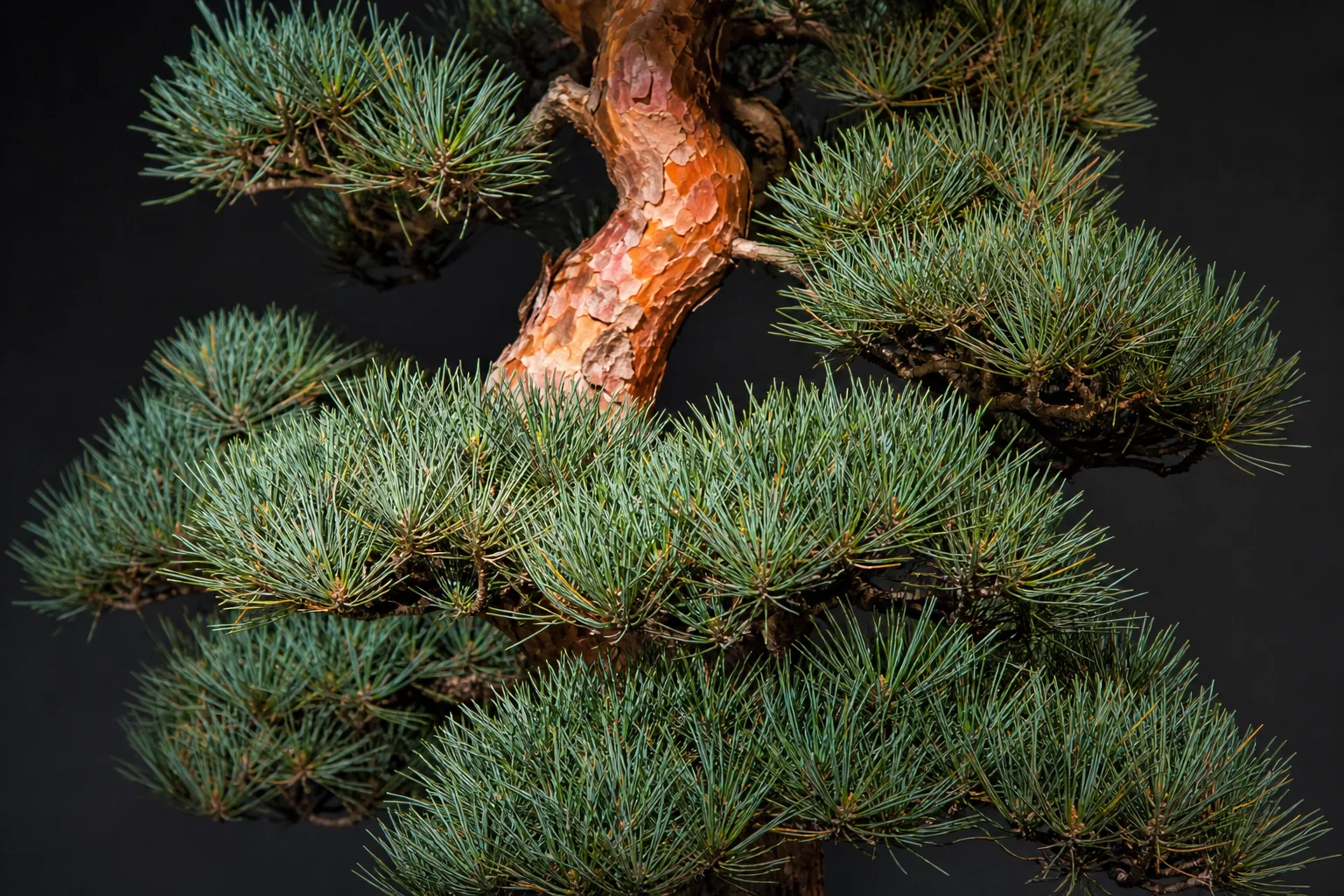
Scots pine
Pinus sylvestrisThe UK's native pine — orange-flaked bark, blue-green needles, and a natural affinity with rocky, windswept styling.