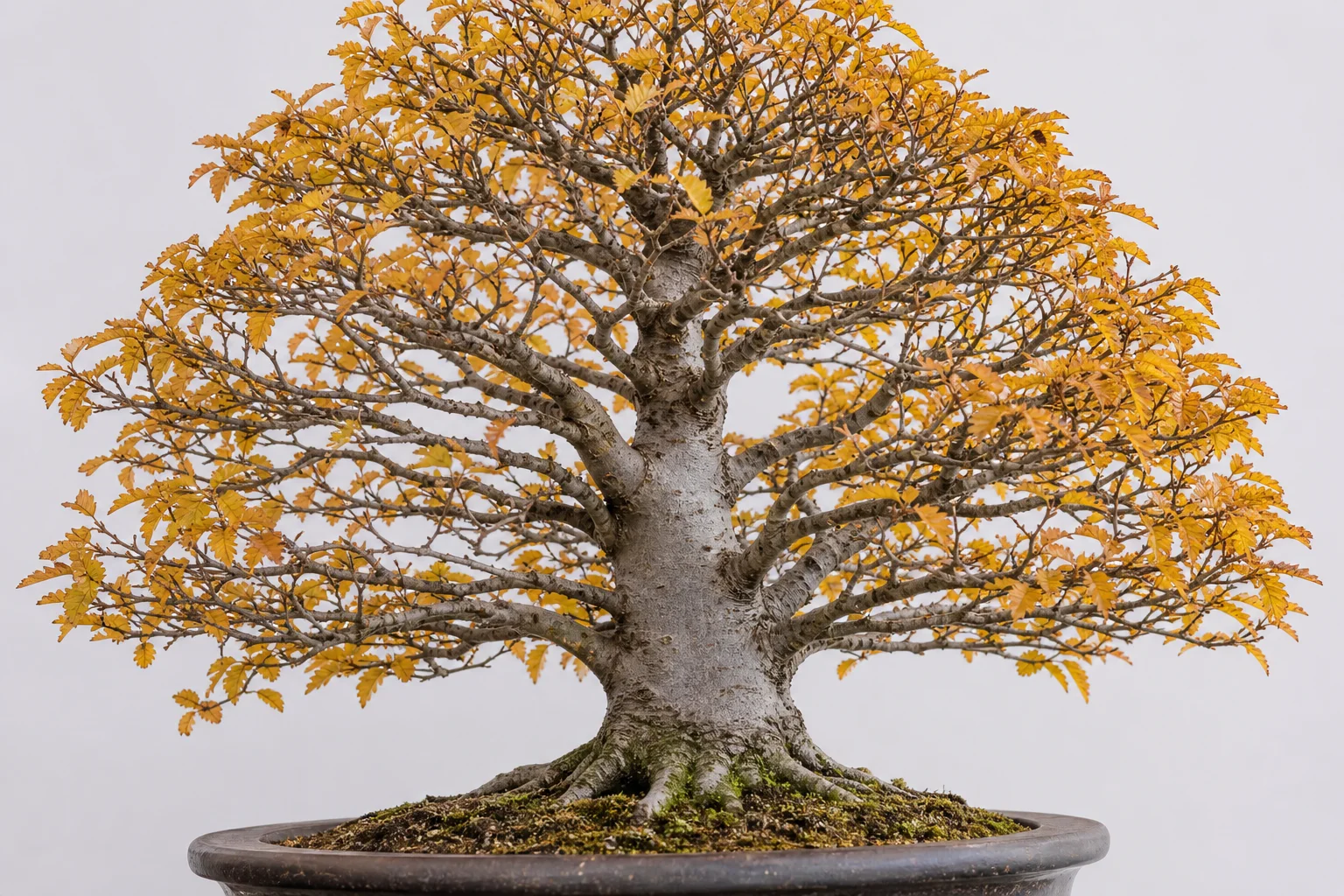
Japanese zelkova bonsai care
Zelkova serrataThe broom-style classic. Natural vase-shaped habit, smooth grey bark, small serrated leaves, and an ease of cultivation that makes it among the best deciduous bonsai species for UK growers.
Water
Every 1 day
check daily in summerLiquid feed
Every 7 days
growing seasonSolid feed
Every 28 days
slow releaseRotate
Every 14 days
even canopy growthJapanese zelkova is the species that the broom style was invented for. The natural growth habit produces a single straight trunk with branches radiating outward and slightly upward from the apex, creating a vase shape that becomes a near-perfect representation of an idealised deciduous tree at small scale. Combined with smooth grey bark that develops attractive horizontal lenticels with age, small serrated leaves that reduce easily with refinement, and reliable yellow-bronze-red autumn colour, zelkova produces some of the most refined deciduous bonsai available.
For UK growers, the species offers an attractive combination of qualities: it's nearly as easy as Chinese elm but produces more refined bark and a more elegant winter silhouette; it's hardier than most cultivars of Japanese maple; it back-buds reliably on old wood; and it tolerates the kind of work — defoliation, hard pruning, root reduction — that builds refined bonsai.
The trade-off compared to Chinese elm is that quality zelkova material can be more expensive — most refined specimens are imported from Japanese or Korean nurseries — and the species develops trunk character slightly more slowly. UK-grown zelkova from seed or nursery stock is widely available but takes 15–20 years to develop the bark character that distinguishes refined specimens.
Closely related American hornbeam (Carpinus caroliniana) shares some habit but isn't a true zelkova; "Chinese zelkova" (Zelkova sinica) and "Caucasian zelkova" (Zelkova carpinifolia) are valid related species but less commonly used for bonsai.
Native to Japan, Korea, eastern China, and Taiwan. Long planted in Japan as a temple and shrine tree (the name "keyaki" refers to the species in Japanese), with some individuals verified to be over 1,000 years old. The species has been a foundational bonsai subject for centuries, particularly in broom-style work.
Seasonal calendar
Timing is for South East England. Select your region above to see adjusted guidance.
- Structural pruning while dormant
- Plan year's work
- Begin repotting late month
- Final winter pruning
- Main repotting window
- Continue repotting in cooler regions
- Leaves emerge
- Begin daily watering
- First slow-release feed
- Start weekly liquid feed
- Begin pinching new shoots
- Wiring window opens once leaves harden
- Defoliate refined healthy trees late month
- Twice-daily watering in heat
- Continue pinching
- Reduce nitrogen mid-month
- Watch for wire biting in
- Switch to low-N autumn feed
- Reduce watering
- Yellow-bronze-red autumn colour
- Stop feeding
- Leaf drop
- Sweep fallen leaves
- Structural pruning
- Winter silhouette at its finest
Watering
Daily through the growing season. Zelkova is similar to Chinese elm in water needs — vigorous and thirsty when in active growth but reasonably forgiving of brief inconsistency.
In hot summer weather, twice daily for trees in shallow pots. The species tolerates dryness somewhat better than Japanese maple but consistent dryness produces leaf scorch and reduced autumn colour.
In winter, regular but reduced watering. Tap water of any hardness is fine.
Feeding
Weekly liquid feed from late April through to mid-September. Slow-release organic pellets in spring and early summer.
Zelkova responds well to consistent moderate feeding. The species is more tolerant of standard feeding regimes than some refined deciduous bonsai — heavy feeding produces larger leaves but doesn't damage the tree the way it does with refined maples.
Reduce nitrogen from late August.
Soil & Repotting
Free-draining and tolerant. Zelkova accepts a wide range of substrates.
60% akadama, 30% pumice, 10% lava is reliable. The species performs well in cheaper development mixes — useful for trees being grown on for trunk thickness.
Repot every 2–3 years on young trees, every 3–4 on mature specimens. The window is mid-February through to early April — wider than for refined species. Repot as buds swell.
Zelkova tolerates aggressive root work — up to half the root mass on healthy trees. The species recovers quickly and is much more forgiving than Japanese maple.
Pruning
Zelkova pruning is among the easiest and most rewarding in deciduous bonsai. The species back-buds reliably on old wood, tolerates hard cutbacks, and develops fine ramification quickly.
Structural pruning in late winter (February). Through the growing season, allow new shoots to extend to four or five leaves then cut back to two. Pinch every two to three weeks in vigorous growth.
The defining technique for refined zelkova bonsai is the broom-style structure — a single trunk that branches into many secondary branches at one point, then continues to subdivide. Building this structure is done by cutting back young material to develop a single point of branching, then encouraging multiple shoots to emerge from that point.
Defoliation works exceptionally well on healthy trees and is essential for developing refined ramification at the speed the species permits. Late June is the window. The second-flush leaves are dramatically smaller.
Hard cutbacks on old wood produce vigorous back-budding — useful for restyling collected material or correcting structural mistakes.
Wiring & Styling
Wire after leaves harden in early summer or on bare branches in winter. Bark is smooth and marks slightly more visibly than thick-barked species — apply loosely and check fortnightly. Aluminium for almost all work.
The species' natural habit produces upright branches that radiate outward from the trunk — major styling is often less about wire and more about directional pruning. Broom-style zelkova bonsai are mostly built through pruning rather than wiring.
Broom style is the defining zelkova style — the species' habit suits this form ideally and most quality zelkova bonsai are broom-style. Informal upright also works well. Forest plantings are particularly fine; zelkova forests are among the most refined of all bonsai groupings.
The species' smooth bark and elegant winter silhouette suit styles that emphasise the trunk and ramification rather than dense foliage. Cascade, semi-cascade, and literati don't suit the species' habit.
Winter care
Hardy across most of the UK with no protection needed in normal winters. The species takes whatever the British climate produces.
In exposed northern and Scottish positions, some shelter from wind in hard winters is sensible — particularly while trees are still developing thicker bark. The species' main vulnerability is dramatic temperature swings on south-facing benches; a position out of strong winter sun reduces stress on swelling buds.
Never bring indoors.
Propagation
From seed (autumn-sown, cold-stratified — reliable, produces consistent seedlings). From semi-hardwood cuttings in June with rooting hormone (moderate success). From air layering in May (good success on suitable branches). Most UK material starts as nursery stock or imported developed bonsai; UK-grown seedlings are available from specialist tree nurseries.
Common problems
Generally healthy. Zelkova has fewer disease and pest problems than most ornamental species. The main concerns are shared with elms (the species is in the elm family).
Dutch elm disease (Ophiostoma novo-ulmi)
Symptoms: Sudden wilting of branches in summer; brown streaking in cut wood; eventual whole-tree death.
Cause: Fungal disease spread by elm bark beetles, devastating to UK elms. Zelkova has some resistance but isn't immune.
Solution: Largely fatal once symptoms appear. Maintain tree health (stressed trees more susceptible). Inspect bark for beetle damage. The disease is less common on zelkova than true elms but worth knowing about.
Aphids
Symptoms: Curled sticky leaves in spring.
Cause: Standard spring pest pressure.
Solution: Hose off. Neem if persistent.
Elm gall mites
Symptoms: Small pimple-like galls on leaves.
Cause: Microscopic mites.
Solution: Cosmetic. Remove affected leaves if unsightly. Healthy trees aren't significantly weakened.
Loss of inner branches
Symptoms: Outer canopy thickens while interior loses ramification.
Cause: Dense outer growth blocks light to interior.
Solution: Annual mid-summer thinning of outer pads. Zelkova back-buds reliably from light penetration.
Failure to develop the broom shape
Symptoms: Tree grows but lacks the radiating branch structure typical of refined zelkova bonsai.
Cause: The broom structure requires deliberate development — natural branching alone doesn't produce it.
Solution: Cut back to a single point and allow multiple new shoots to emerge from that point, then prune to develop the radiating structure. Building a broom-style zelkova from scratch takes 8–12 years of consistent technique.
Coarse leaves on heavily-fed trees
Symptoms: Leaves larger than aesthetically ideal despite refinement.
Cause: Heavy feeding.
Solution: Reduce feeding to half strength for two seasons. Defoliate annually. Leaves will reduce gradually.
Popular cultivars
The standard Japanese zelkova. Most quality bonsai material is the wild type.
Variegated cultivar with cream-pink-green foliage. Less common in bonsai; visually striking but variegation can be unstable.
Selected upright cultivar. Useful for broom-style development from young stock.
Related species from China. Less common in UK bonsai but suitable.
Hornbeam-like leaves; more compact habit than Z. serrata. Uncommon in bonsai but worth seeking out.
Track your Japanese zelkova with Kentai.
Collection tracking, care logs and photo history are free — no card, no time limit.
More care guides
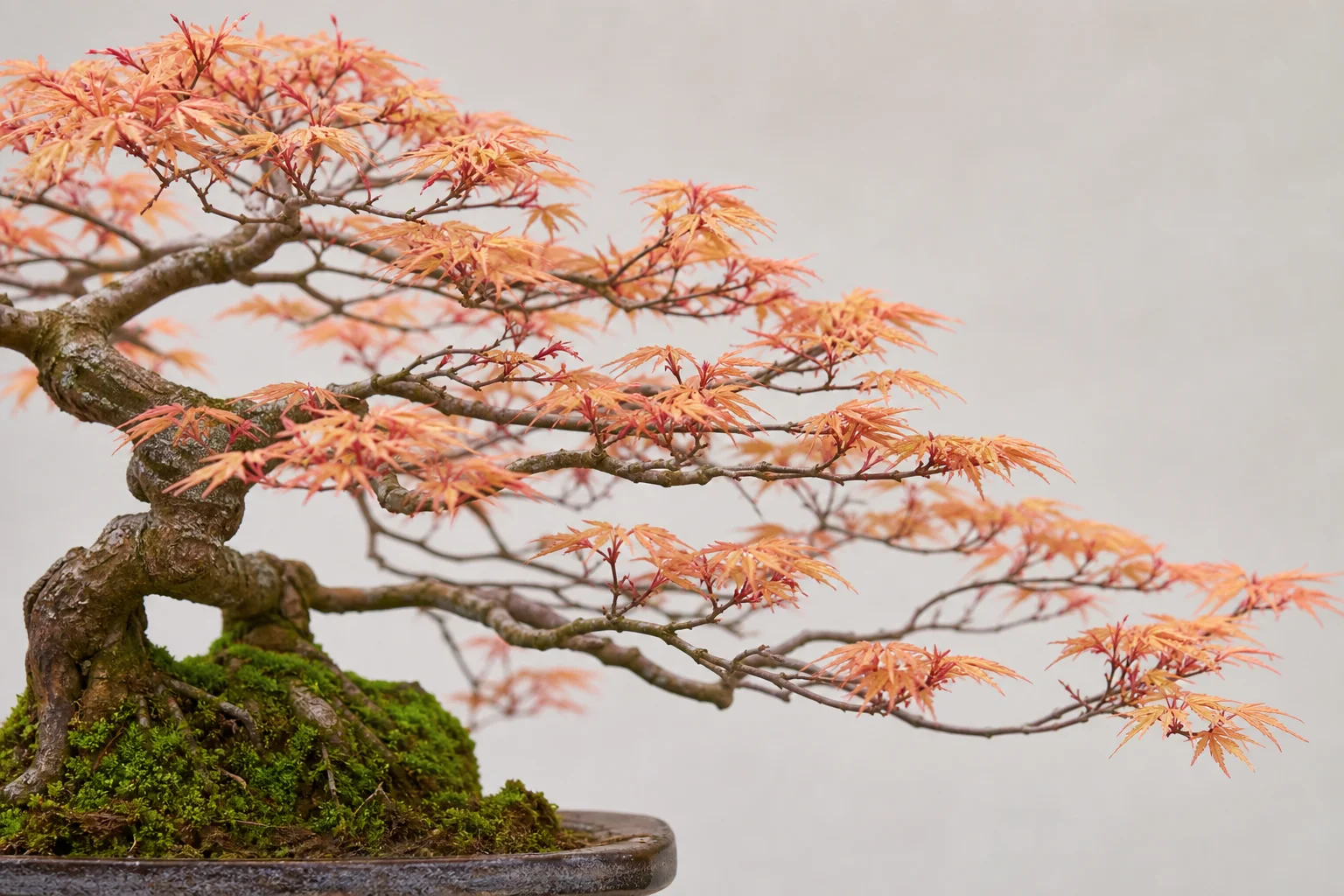
Kiyohime maple
Acer palmatum 'Kiyohime'The dwarf Japanese maple. Tiny leaves, naturally spreading low habit, orange spring colour — and the cultivar that makes shohin bonsai possible without years of refinement.
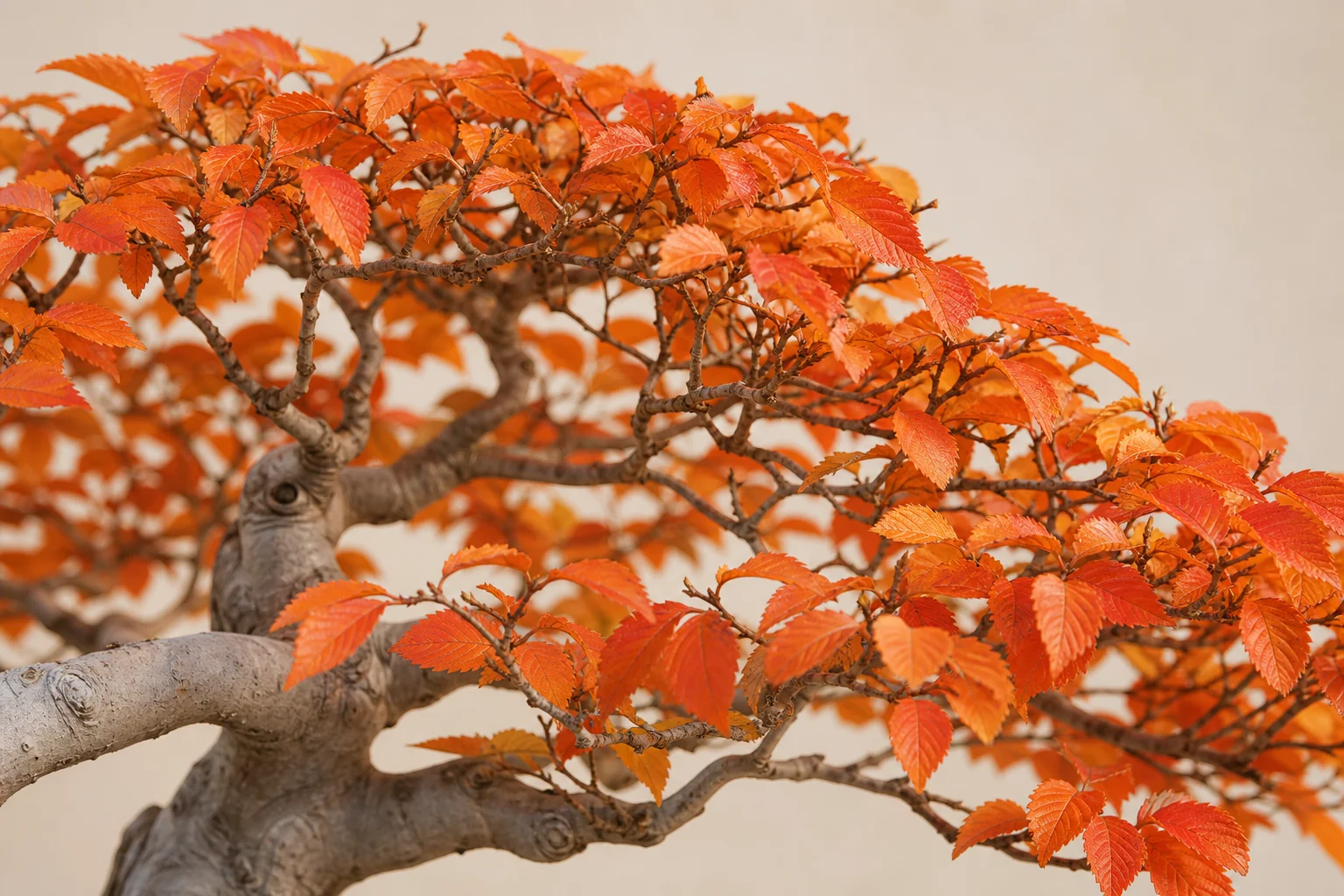
Korean hornbeam
Carpinus turczaninowiiThe Asian hornbeam most commonly imported as refined bonsai. Smaller leaves than European hornbeam, exceptional ramification potential, brilliant autumn colour.
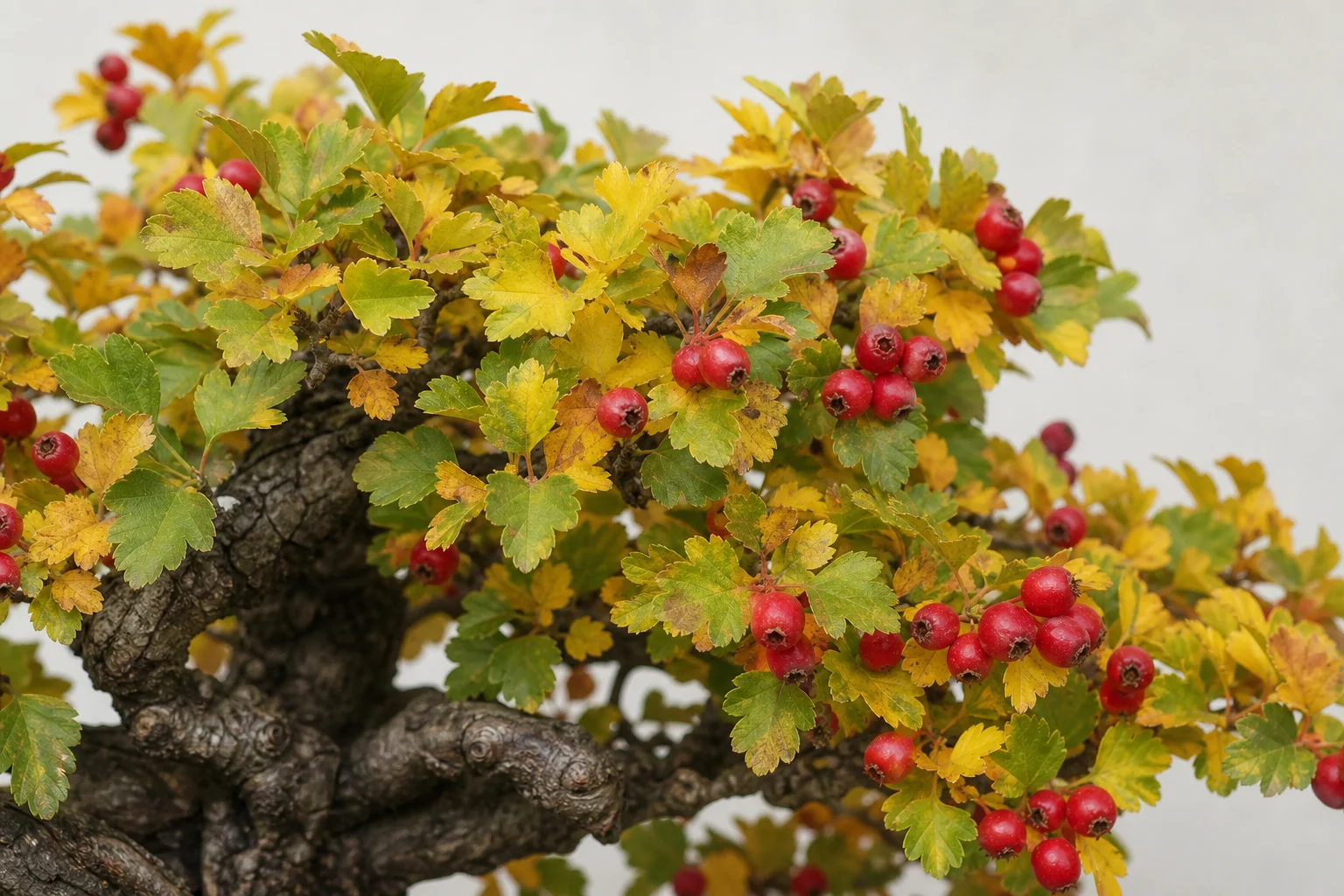
Midland hawthorn
Crataegus laevigataThe second UK native hawthorn. Similar to common hawthorn but with subtle differences worth knowing if you're collecting wild material or growing for ecology — and the parent of 'Paul's Scarlet', the double-flowered cultivar widely planted in UK streets and gardens.