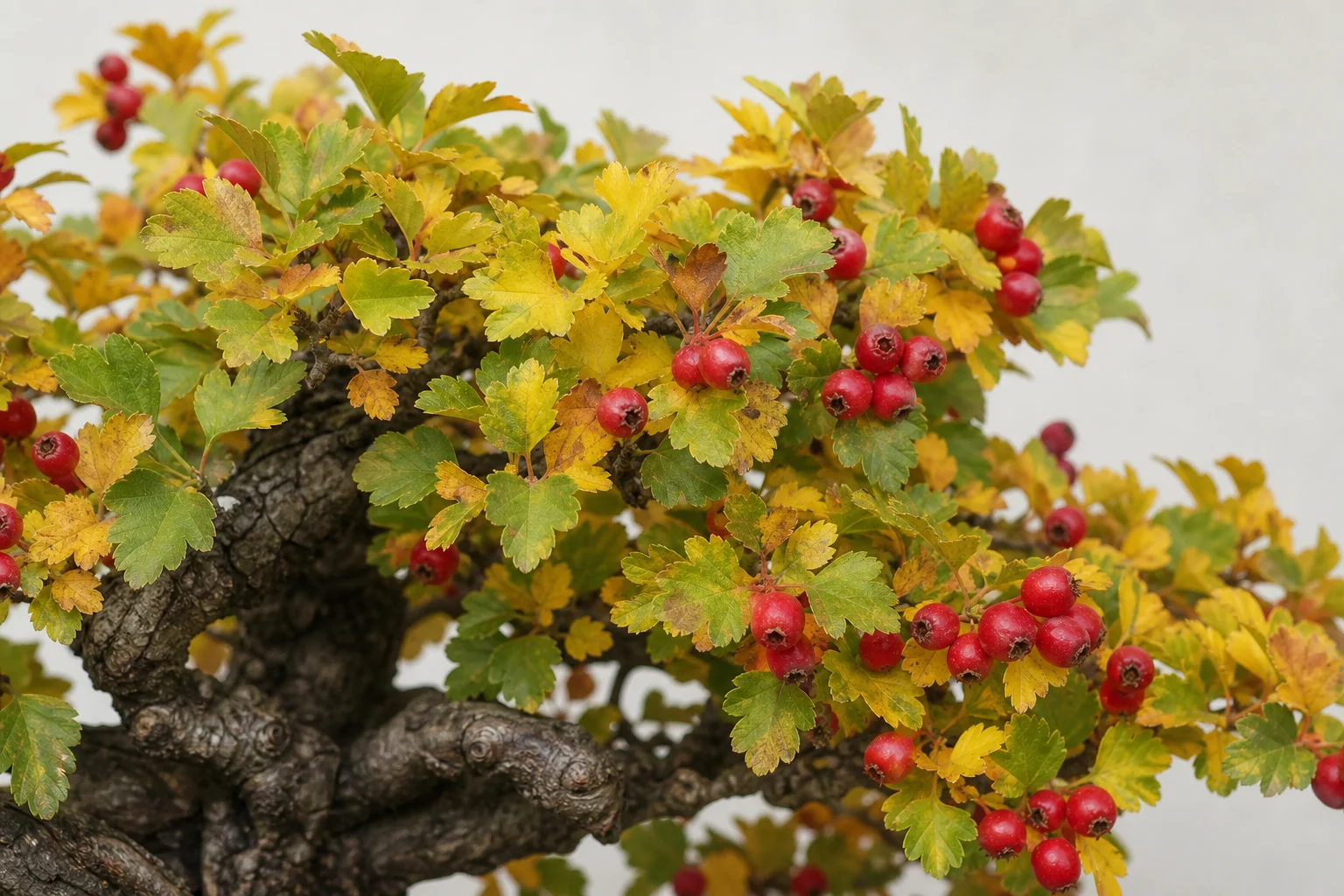
Midland hawthorn bonsai care
Crataegus laevigataThe second UK native hawthorn. Similar to common hawthorn but with subtle differences worth knowing if you're collecting wild material or growing for ecology — and the parent of 'Paul's Scarlet', the double-flowered cultivar widely planted in UK streets and gardens.
Water
Every 1 day
check daily in summerLiquid feed
Every 7 days
growing seasonSolid feed
Every 28 days
slow releaseRotate
Every 14 days
even canopy growthTwo hawthorn species are native to the UK and easy to confuse: common hawthorn (Crataegus monogyna, which has its own guide) and Midland hawthorn (Crataegus laevigata, this entry). For bonsai care, the two are essentially interchangeable. For identification and ecological purposes, the differences matter.
Midland hawthorn has slightly less deeply lobed leaves than common hawthorn — leaves that look more rounded and closer to apple or pear leaves. Fruits typically contain two stones rather than one (hence the older name C. oxyacantha, meaning two-stoned). Flowering is slightly later. The species is more associated with ancient woodland than hedgerow, where common hawthorn dominates.
For bonsai growers, the practical reason to know about Midland hawthorn is its cultivar — Crataegus laevigata 'Paul's Scarlet', with double crimson flowers, has been one of the most widely planted small ornamental trees in UK streets and gardens since its introduction in 1858. Old garden specimens being removed are excellent yamadori, and the cultivar produces dramatic flowering bonsai when developed.
Beyond the cultivar, wild C. laevigata is a perfectly good bonsai subject — slightly less common in UK hedgerows than monogyna but available in old woodland edges, especially in the Midlands (hence the name) and southern England.
Care notes throughout this entry that differ from common hawthorn are flagged explicitly. Otherwise, refer to the C. monogyna entry for full context.
Native throughout most of Europe including the UK, where it grows particularly in ancient woodland understorey. The two-stoned fruit characteristic gave rise to the older botanical name C. oxyacantha. Hybridises freely with common hawthorn (C. monogyna) — many intermediate forms exist in UK populations and identification of wild trees can require careful examination.
Seasonal calendar
Timing is for South East England. Select your region above to see adjusted guidance.
- Structural pruning while dormant
- Plan year's collection
- Continue winter pruning
- Begin repotting late month
- Main repotting window
- Pot up collected material
- Leaves emerge
- Begin daily watering
- First slow-release feed
- Begin flowering (slightly later than common hawthorn)
- Start weekly liquid feed
- Post-flowering pruning possible
- Wiring window opens
- Twice-daily watering in heat
- Continue pinching
- Switch to high-K low-N feed mid-month
- Watch for fireblight
- Continue autumn feed
- Reduce watering
- Yellow-orange autumn colour
- Stop feeding
- Leaf drop, haws persist
- Sweep fallen leaves
- Structural pruning
- Haws provide winter interest
Watering
Identical to common hawthorn. Daily through the growing season; twice daily in summer heat for trees in shallow pots. Reduced winter watering. Tap water of any hardness is fine.
Feeding
Identical to common hawthorn. Weekly liquid feed from late April through to mid-September. Slow-release organic pellets in spring and early summer. Reduce nitrogen from late August.
For 'Paul's Scarlet' and other flowering cultivars, switch to a high-K low-N autumn feed from mid-August through September — this supports next year's flower bud development.
Soil & Repotting
Free-draining and tolerant. Identical to common hawthorn — the species accepts a wide range of substrates including chalk.
60% akadama, 30% pumice, 10% lava is reliable. The species tolerates cheaper development mixes well.
Repot every 2–3 years on young trees, every 3–4 on mature specimens. The window is mid-February through to early April — wider than for refined species. Repot as buds swell.
Midland hawthorn tolerates aggressive root work — up to half the root mass on healthy trees. Collected woodland material can be substantially reduced when first lifted. Recovery is reasonably quick.
Pruning
Identical to common hawthorn — easy and forgiving. The species back-buds reliably on old wood and tolerates hard cutbacks.
Structural pruning in late winter or after flowering. Through the growing season, let new shoots extend to four or five leaves then cut back to two. Pinch every two to three weeks.
The species flowers on previous year's wood — preserve some shoots through summer to provide flowering display the following year. The trade-off between refined ramification and floral display is the same as for common hawthorn.
The species has thorns — wear gloves.
Wiring & Styling
Identical to common hawthorn. Wire after leaves harden in early summer or on bare branches in winter. Bark is moderately resistant to marking. Aluminium for almost all work.
Informal upright is the natural fit. Twin-trunk and clump styles work well. The species' habit suits naturalistic, weathered compositions — particularly fine on collected ancient material.
Formal upright doesn't suit the species. Cascade and semi-cascade are uncommon but possible on suitable material.
Winter care
Fully hardy across the UK with no protection needed. Midland hawthorn takes whatever the British climate produces.
Hard late frost on opening flowers can damage the display — shelter trees overnight if -2°C or colder is forecast during the bloom period. The flowering wood and tree itself are not harmed.
Never bring indoors.
Propagation
From seed (autumn-sown, cold-stratified — slow, often 18+ months to germinate). 'Paul's Scarlet' and other cultivars are always grafted onto seedling rootstock. Collected woodland material is excellent and widely available. Air layering works on suitable branches.
Common problems
Identical to common hawthorn. Mostly healthy but susceptible to fireblight and other Rosaceae diseases.
Fireblight (Erwinia amylovora)
Symptoms: Sudden blackening of shoots and flowers; branches die back rapidly.
Cause: Bacterial disease, spreads in warm wet weather during flowering.
Solution: Cut back well below visible damage into clean wood. Disinfect tools between cuts. Severe outbreaks may require destruction. Identical to common hawthorn vulnerability.
Hawthorn rust
Symptoms: Orange-yellow pustules on leaves; affected leaves yellow and drop.
Cause: Fungal disease, requires juniper as alternate host (life cycle similar to apple-cedar rust).
Solution: Improve airflow. Remove affected leaves. Remove nearby Juniperus communis if recurring is severe.
Aphids
Symptoms: Curled sticky leaves in spring.
Cause: Standard spring pest pressure.
Solution: Hose off. Neem if persistent.
Thorn injuries
Symptoms: Painful punctures.
Cause: Sharp thorns on vigorous wood.
Solution: Wear sturdy gloves when handling. Clean any puncture wound.
Spring frost damage on flowers
Symptoms: Open flowers blacken after late frost.
Cause: Hard April frost on open blossoms.
Solution: Move under cover overnight during the bloom period if -2°C or colder is forecast.
Identification confusion with common hawthorn
Symptoms: Not a tree problem — a grower problem. Difficult to identify which species you're working with on hybrid populations.
Cause: C. monogyna and C. laevigata hybridise freely in the UK; many wild trees are intermediate.
Solution: Practical answer: care is essentially identical, so identification doesn't change how you grow the tree. For ecological or collection purposes, examine leaf lobing depth (deeper on monogyna), fruit stone count, and flowering timing. Many trees won't fit cleanly into either category.
Popular cultivars
Wild Midland hawthorn. The standard for bonsai work using this species.
The famous double-flowered cultivar with crimson blooms. Introduced 1858. Widely planted in UK and excellent for bonsai when collected from old garden specimens.
Double pink-flowered cultivar. Less common than Paul's Scarlet but striking.
Double white-flowered cultivar.
The other UK native hawthorn — see entry for that species. The two hybridise freely; wild trees often intermediate.
Older botanical name for C. laevigata, still occasionally encountered on plant labels and in older literature. Same plant.
Track your Midland hawthorn with Kentai.
Collection tracking, care logs and photo history are free — no card, no time limit.
More care guides
Other Crataegus guides: Common hawthorn
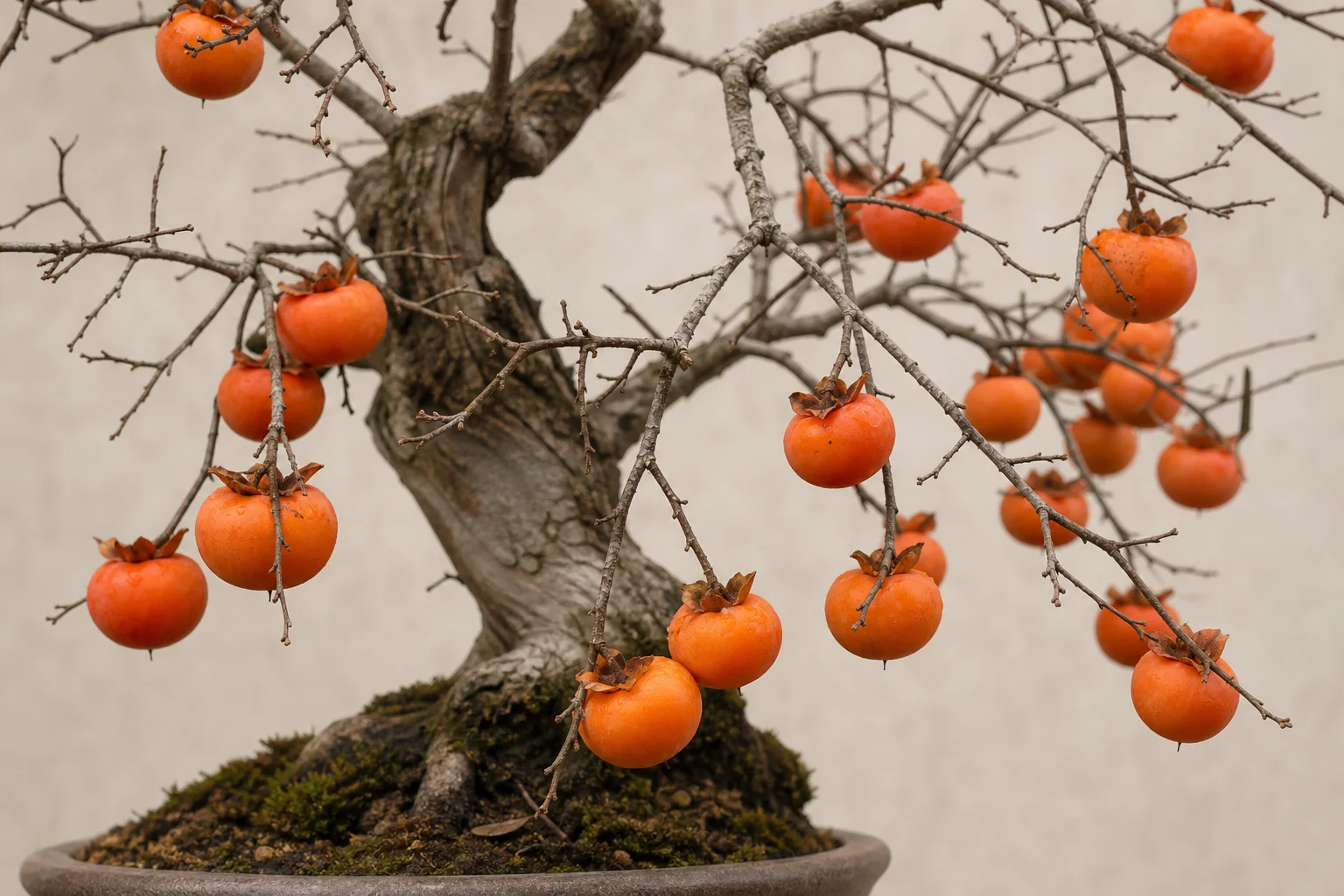
Persimmon
Diospyros kakiBright orange fruit hanging on bare branches into winter, brilliant autumn foliage colour, plated bark on mature trees — and one of the more dramatic seasonal bonsai displays in cultivation.
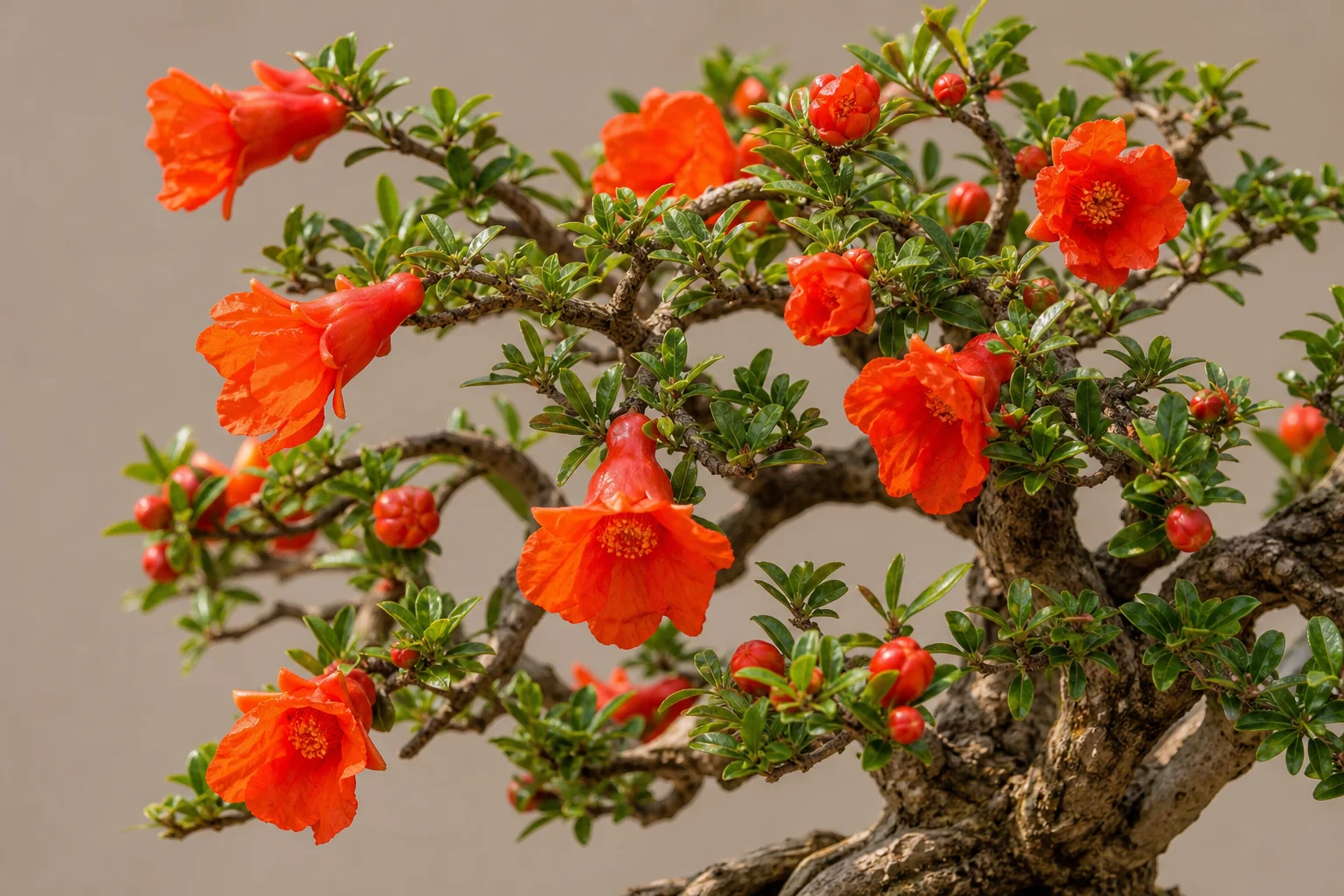
Pomegranate
Punica granatumOrange-red trumpet flowers in summer, miniature pomegranate fruit in autumn, twisted gnarled trunk character on collected ancient material. Borderline-hardy but stunning.
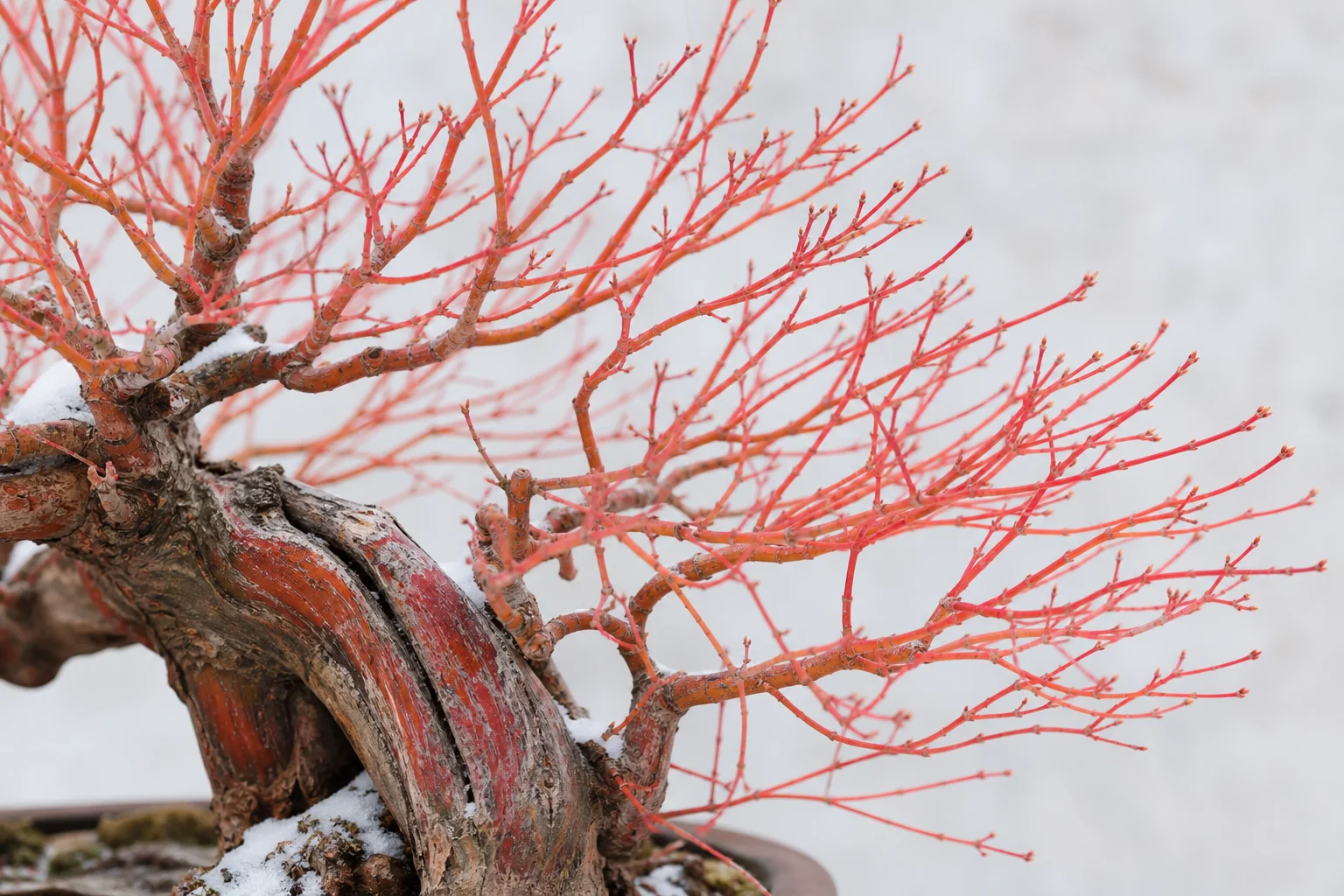
Sango Kaku maple
Acer palmatum 'Sango Kaku'The coral-bark maple. Year-round interest from bright coral-red young bark on the previous year's growth — at its most intense in winter when bare twigs glow against snow.