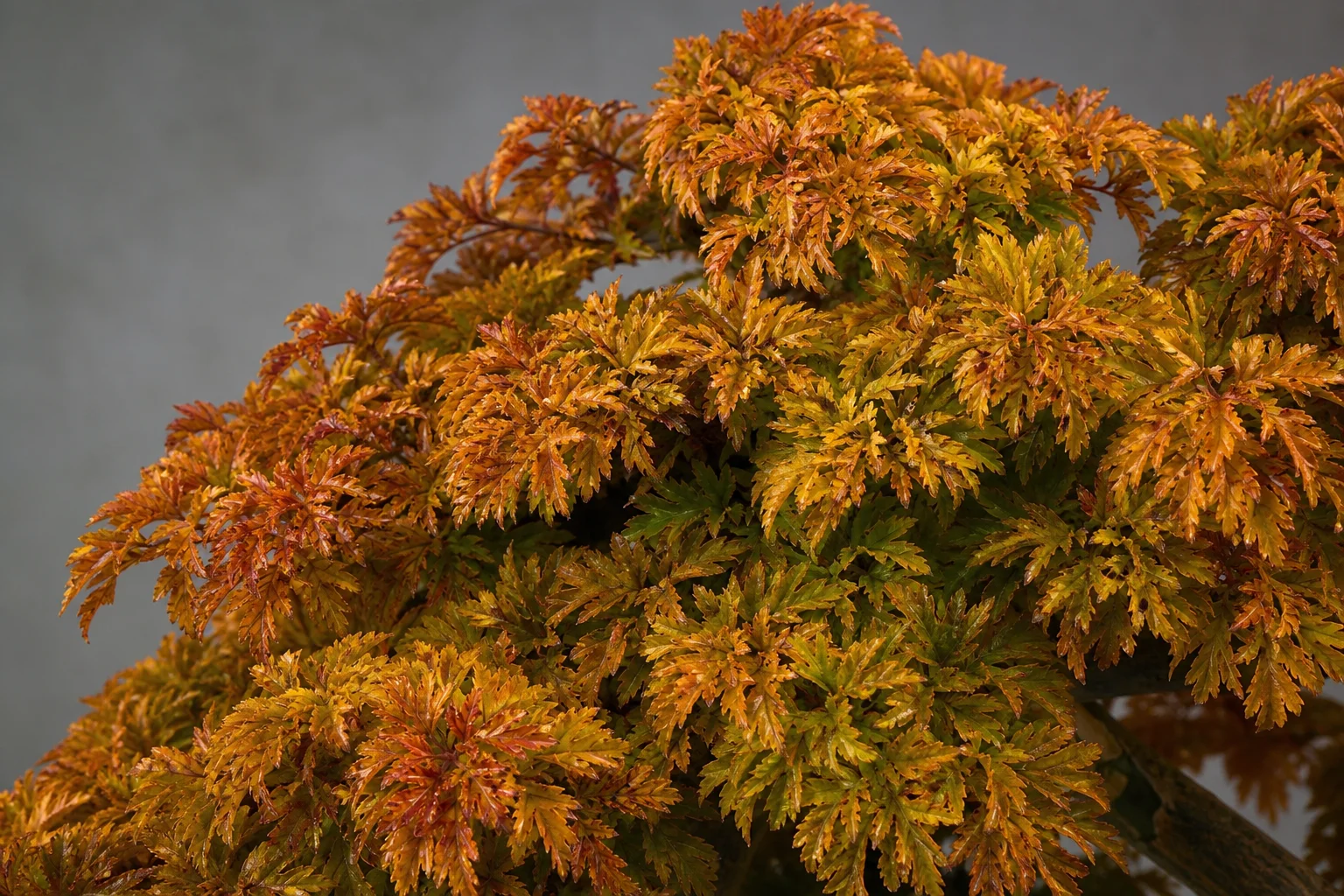
Shishigashira maple bonsai care
Acer palmatum 'Shishigashira'The crinkled-leaf maple. Tightly curled, deeply lobed small leaves clustered densely on short shoots — a cultivar whose habit looks bonsai-trained before any work is done.
Water
Every 1 day
check daily in summerLiquid feed
Every 7 days
growing seasonSolid feed
Every 28 days
slow releaseRotate
Every 14 days
even canopy growthShishigashira (literally "lion's head" or "lion's mane") is one of the most distinctive Japanese maple cultivars and one of the most prized for bonsai. The defining feature is the foliage — leaves are smaller than standard Acer palmatum (typically 3–5cm), deeply divided into five narrow lobes, and characteristically curled and crinkled rather than flat. Combined with a naturally short-internode growth habit that clusters foliage on stubby shoots, the cultivar develops dense rounded foliage pads almost without intervention.
The habit is naturally upright and slow-growing. A 20-year-old Shishigashira will be smaller and more compact than a 20-year-old base palmatum, which makes it ideal for medium and small bonsai. The slow growth is a real consideration when buying — material develops trunk girth more slowly than vigorous cultivars, and "growing on" young Shishigashira to substantial trunk size takes decades. Most quality Shishigashira bonsai material is either imported from Japan as already-developed stock or has been grown by patient UK enthusiasts over many years.
Autumn colour is reliably gold-orange to deep red. The cultivar holds its leaves slightly later than base palmatum and the colour transition is often spectacular.
Origin: Japan, traditional bonsai cultivar known since at least the 19th century. The name combines "shishi" (lion) and "gashira" (head). Closely related crinkled-leaf cultivars include Mikawa yatsubusa (similar habit, even more compact) and Murasaki shishigashira (red-foliage form). All are propagated by grafting.
Seasonal calendar
Timing is for South East England. Select your region above to see adjusted guidance.
- Structural pruning while dormant
- Plan year's work
- Begin repotting late month
- Final winter pruning
- Main repotting window
- Protect emerging buds from late frost
- Curled leaves emerge
- Begin daily watering
- First slow-release feed
- Start half-strength liquid feed
- Begin selective pinching
- Thin interior leaves
- Wiring window opens
- Twice-daily watering in heat
- Continue interior thinning
- Reduce nitrogen mid-month
- Watch for leaf scorch in heatwaves
- Stop feeding mid-month
- Reduce watering
- Peak autumn colour — gold to red
- Continue reducing watering
- Leaf drop slightly later than base palmatum
- Sweep fallen leaves
- Structural pruning
- Plan winter wiring
Watering
Daily through the growing season. Shishigashira shares Japanese maple's sensitivity to drying — the small clustered leaves desiccate quickly in dry conditions and leaf scorch is permanent for the year once it occurs.
In hot summer weather, twice daily for trees in shallow pots. Position in partial shade with morning sun and afternoon protection — full afternoon sun in midsummer scorches the curled leaf edges noticeably.
In winter, regular but reduced watering. Rainwater preferred where available.
Feeding
Weekly half-strength liquid feed from late April through to mid-September. Slow-release organic pellets in spring and early summer.
Shishigashira responds to feeding more conservatively than vigorous cultivars — heavy feeding produces uncharacteristically long internodes and loses the compact habit that makes the cultivar valuable. Restrained feeding suits the cultivar better.
Stop feeding by mid-September.
Soil & Repotting
Free-draining and slightly acidic. Standard Japanese maple substrate.
60% akadama, 30% pumice, 10% lava in 2–6mm grade. Rainwater preferred. The cultivar is slightly less prone to chlorosis on hard tap water than some palmatum cultivars but still benefits from rainwater where possible.
Repot every 2–3 years on young trees, every 3–4 on mature specimens. The window is mid-February through to early April — repot as buds swell.
Shishigashira tolerates moderate root work — up to a third of the root mass on healthy trees. The cultivar's naturally slow growth means it's less forgiving of aggressive root work than vigorous cultivars; be conservative.
Pruning
The cultivar's naturally compact habit reduces but doesn't eliminate pruning work. The challenge is preserving the dense clustered character while preventing the inner growth from becoming congested.
Structural pruning in late winter (February). Through the growing season, allow new shoots to extend to 3–4 leaves then cut back to 2 — slightly less than for base palmatum, reflecting the cultivar's shorter natural extension. Pinch every two to three weeks in vigorous areas.
Thin the dense foliage pads in midsummer by removing some leaves from the interior — Shishigashira's natural density can shade out inner buds and lose interior branching. Selective leaf-thinning maintains air and light penetration.
Defoliation works on healthy trees and produces dramatically refined second-flush foliage. Use every two to three years rather than annually — the cultivar takes longer to recover than vigorous cultivars.
Wiring & Styling
Wire after leaves harden in early summer or on bare branches in winter. The cultivar's short-internode habit makes major bends less necessary than on long-extending cultivars. Aluminium for almost all work.
Wire scars on Shishigashira bark fade slowly but the slow-growing nature means wire can stay on longer without biting in. Check monthly during active growth.
Broom style suits the cultivar's habit. Informal upright is the natural fit. Compact rounded compositions read as natural on Shishigashira because that's essentially how the cultivar wants to grow. Twin-trunk and clump styles work well.
Cascade, semi-cascade, and literati don't suit the upright clustered growth habit. Resist styling against the cultivar's character — Shishigashira styled as cascade looks contrived.
Winter care
Hardy across most of the UK with no protection needed. The cultivar shares base palmatum's mid-range hardiness — fine in most of England and Wales, may benefit from light shelter in Scotland and exposed northern positions during severe winters.
The dense foliage pads can collect leaf litter through autumn — sweep regularly to prevent fungal issues on retained leaves.
Never bring indoors.
Propagation
Always grafted. Cuttings rarely succeed. From seed produces plants that don't resemble the parent. Air layering works on established grafted plants and is a route to own-root specimens that some growers prefer.
Common problems
Generally healthy. The cultivar's slow growth and dense foliage create some specific issues but inherits most of base palmatum's vulnerabilities.
Interior dieback from dense foliage
Symptoms: Inner branches lose leaves and die back over years; outer pads remain healthy.
Cause: The cultivar's dense natural habit shades out inner buds; without intervention, ramification gradually moves outward and the interior becomes empty.
Solution: Annual mid-summer leaf-thinning of dense pads. Remove some leaves from interior positions to maintain light and air penetration. Once interior dieback is established it's slow to reverse.
Leaf scorch on curled edges
Symptoms: Brown crispy margins on the characteristic curled leaves, particularly mid-summer.
Cause: Excess sun, drought, or hard water. The curled leaf shape exposes more edge to evaporation than flat leaves.
Solution: Move to morning-sun afternoon-shade position. Use rainwater. Maintain consistent moisture. The cultivar is more sensitive to scorch than base palmatum.
Verticillium wilt
Symptoms: Individual branches die back over weeks; dark streaking in cut wood.
Cause: Soil-borne fungus.
Solution: No cure. Remove affected branches well below visible damage. Disinfect tools between cuts. Affects all Japanese maple cultivars.
Slow trunk development
Symptoms: Tree grows but trunk thickens very slowly compared to expected progress.
Cause: Normal cultivar behaviour — Shishigashira is genuinely slow.
Solution: Accept it, or develop trunk in a deep growing pot or open ground for 3–5 years before potting up. Don't feed harder to push growth — the cultivar's main aesthetic asset and forcing growth eliminates the dense character.
Aphids
Symptoms: Curled sticky young leaves in spring.
Cause: Standard spring pest pressure.
Solution: Hose off. Neem if persistent.
Chlorosis from alkaline conditions
Symptoms: Pale leaves with green veins; reduced vigour over years.
Cause: Hard tap water gradually shifts substrate pH.
Solution: Use rainwater. Repot into fresh substrate. Sequestered iron helps short-term.
Popular cultivars
The classic lion's head cultivar. Green crinkled leaves, gold-red autumn colour. The cultivar most often sold simply as 'Shishigashira'.
Closely related but more compact, with even shorter internodes and tighter foliage. Excellent for shohin work.
Red-leaved form. Burgundy spring foliage maturing to dark green, then red in autumn. Less commonly available.
Strongly weeping form. Unrelated to Shishigashira directly but sometimes confused. Specialised use for cascade styling only.
Track your Shishigashira maple with Kentai.
Collection tracking, care logs and photo history are free — no card, no time limit.
More care guides
Other Acer guides: Arakawa maple · Deshojo maple · Field maple · Full-moon maple · Japanese maple · Kiyohime maple · Sango Kaku maple · Trident maple
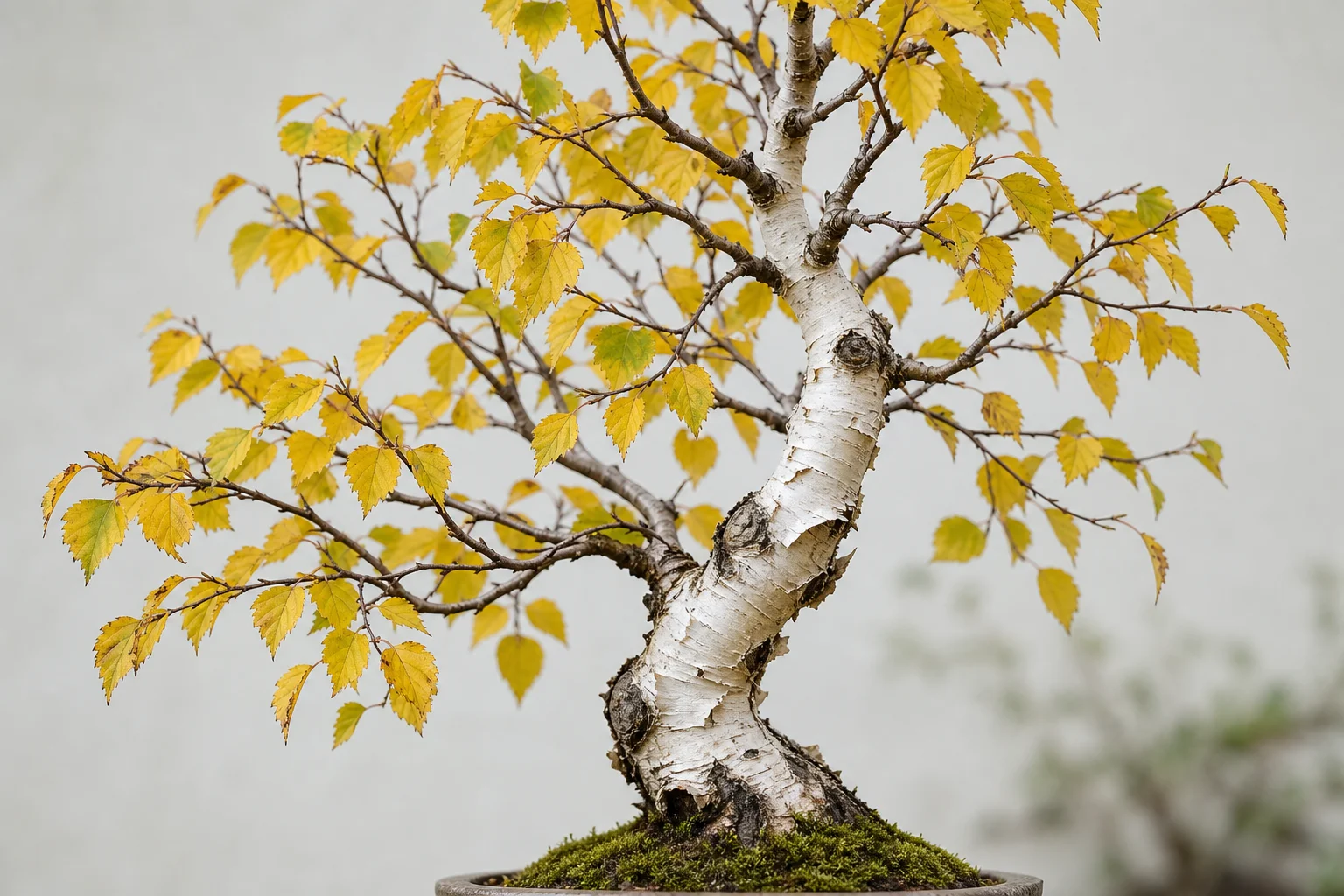
Silver birch
Betula pendulaThe white-bark UK native. Striking visually but genuinely tricky as bonsai — a species more often killed than refined by inexperienced growers.
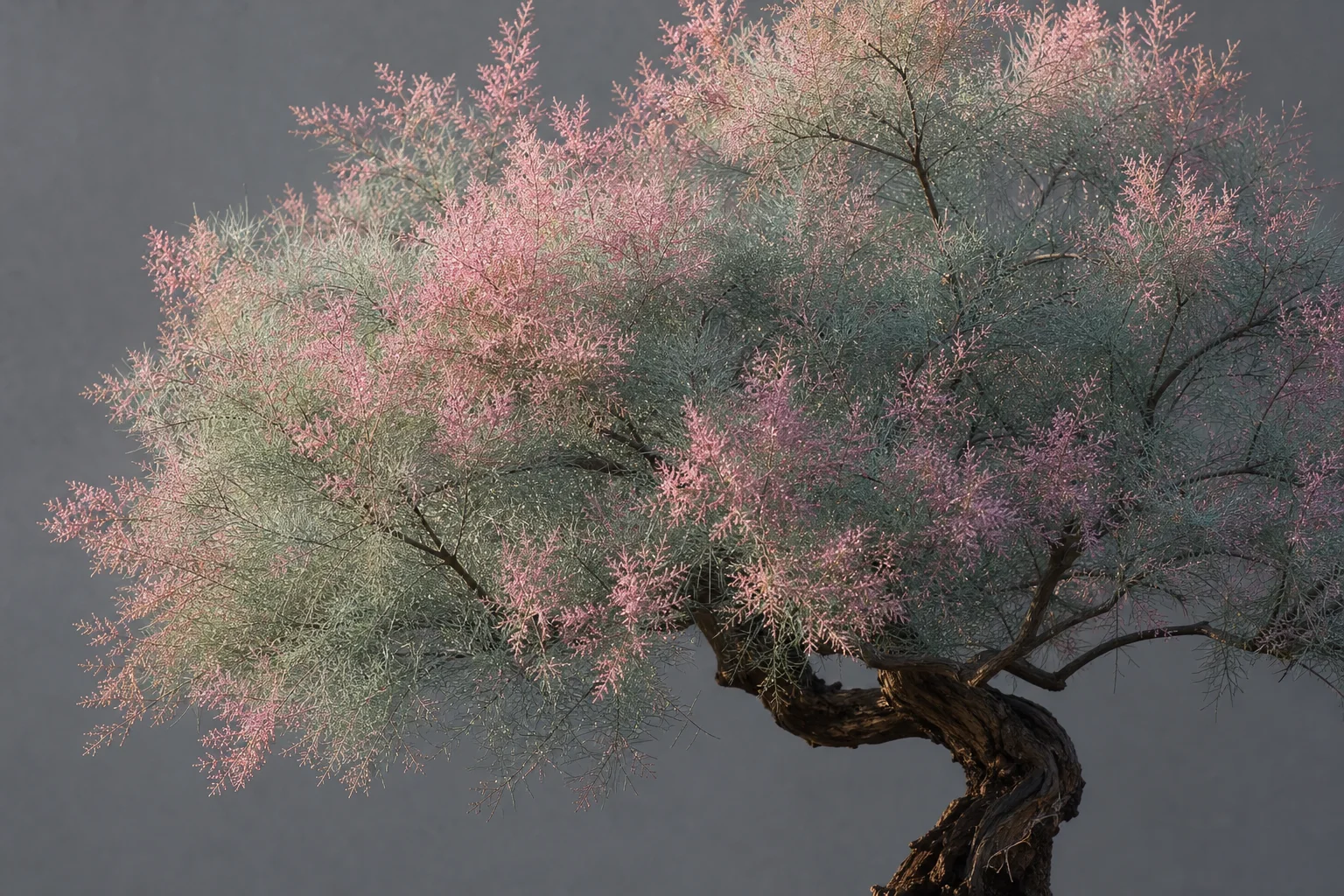
Tamarisk
Tamarix gallicaFeathery scale-like foliage, pink flower plumes in late spring or summer, salt tolerance unmatched among bonsai species — and a distinctive softness that no other tree quite provides.
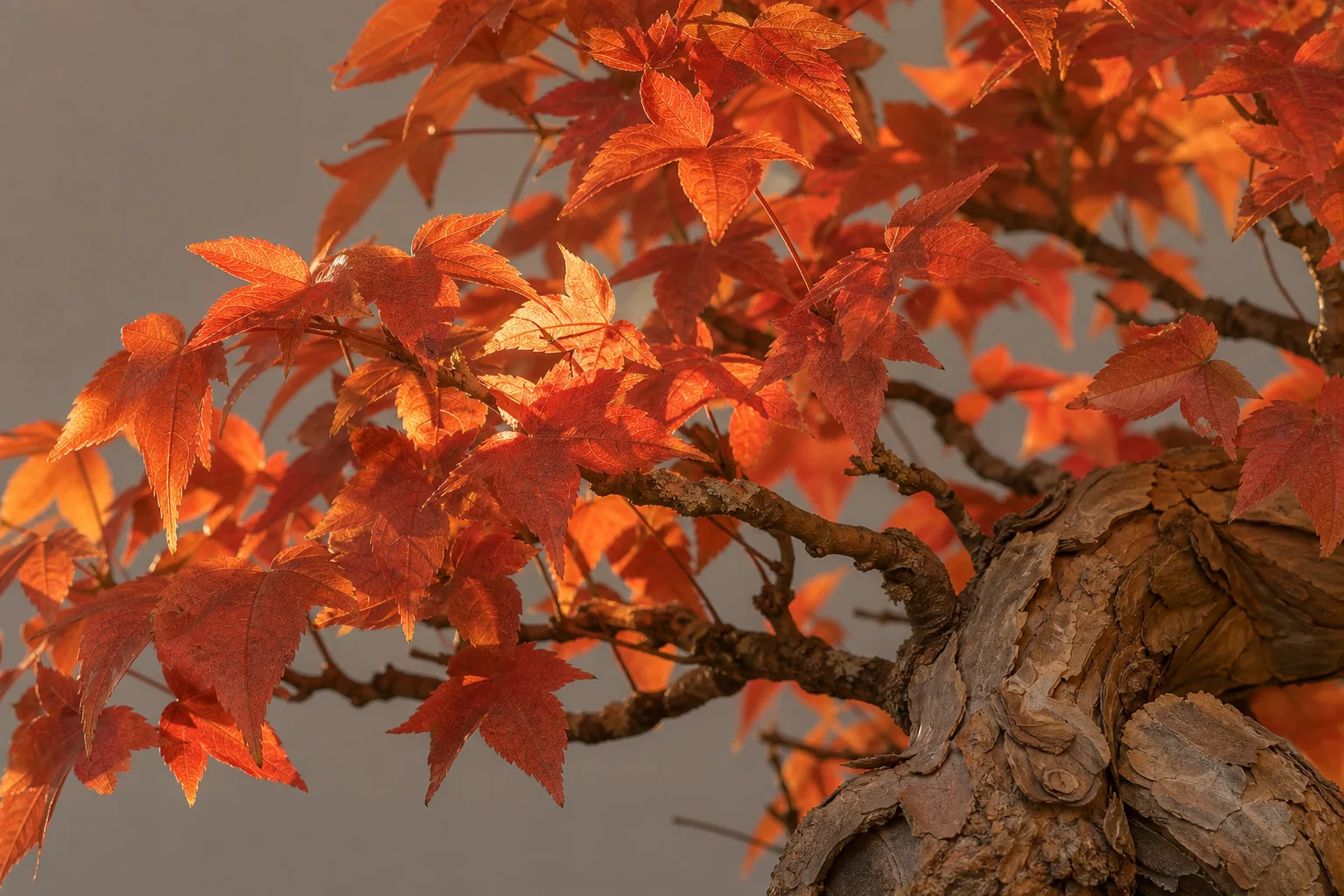
Trident maple
Acer buergerianumThe other classic maple — faster, hardier, more forgiving than its Japanese cousin, and famous for spectacular flaking bark.