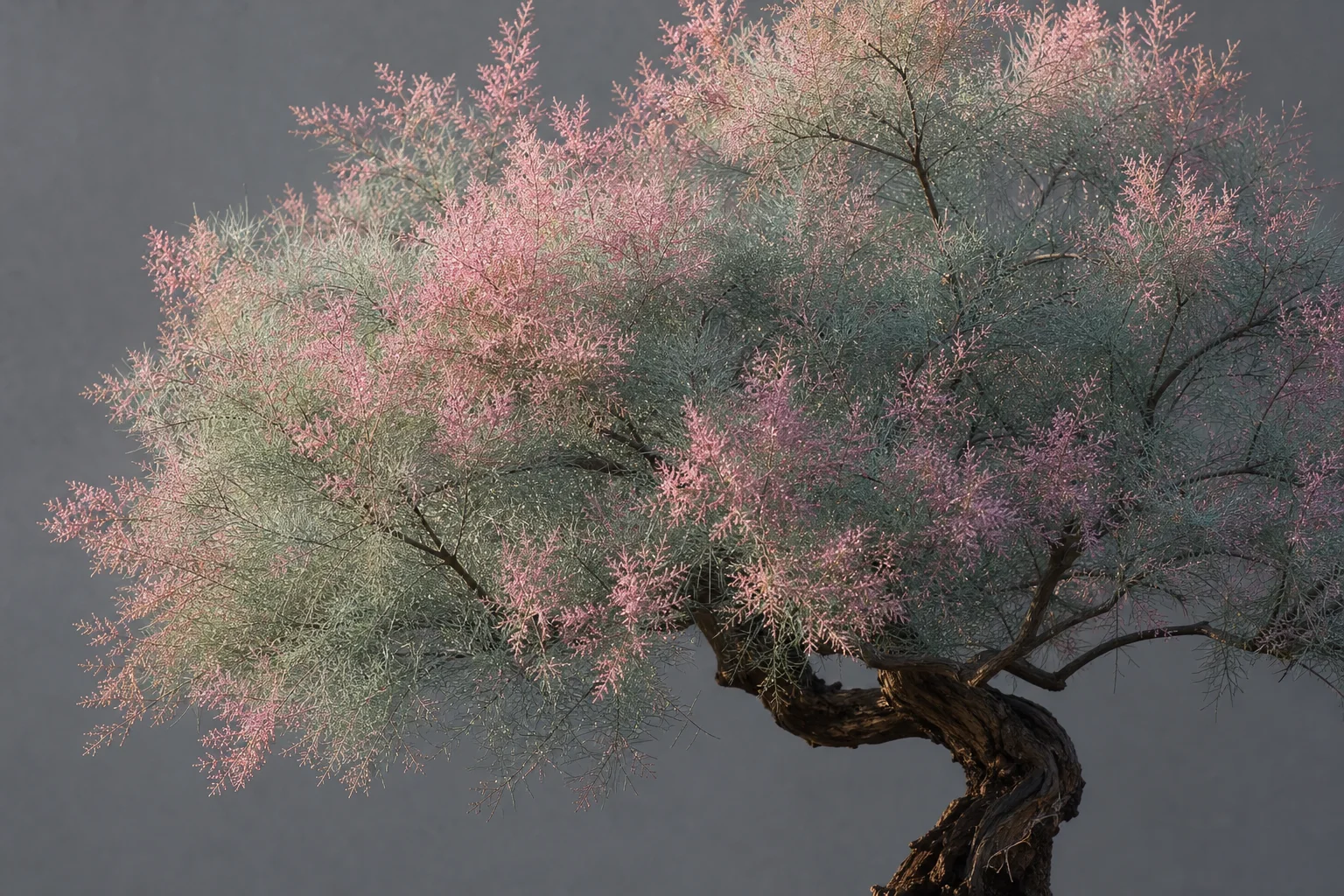
Tamarisk bonsai care
Tamarix gallicaFeathery scale-like foliage, pink flower plumes in late spring or summer, salt tolerance unmatched among bonsai species — and a distinctive softness that no other tree quite provides.
Water
Every 1 day
check daily in summerLiquid feed
Every 7 days
growing seasonSolid feed
Every 28 days
slow releaseRotate
Every 14 days
even canopy growthTamarisk is the bonsai species with feather foliage. Where every other tree species in this catalog has either flat broadleaf foliage, needle-like conifer foliage, or scale-like cypress foliage, tamarisk produces something different — extremely fine scale leaves arranged on slender drooping shoots that give the whole canopy a soft cloud-like appearance. The texture is unmistakable and translates beautifully to bonsai compositions.
The species is also one of the few bonsai-suitable plants genuinely native to UK coastal conditions. Tamarix gallica naturalised on the south coast of England centuries ago and Tamarix anglica is sometimes recognised as a distinct UK form. Wild material is collected from coastal locations where the species grows on cliffs and shingle banks — gnarled, salt-bleached, wind-shaped specimens with substantial age character.
Beyond the foliage, tamarix produces feathery plumes of small pink flowers — Tamarix parviflora flowers in spring (April–May) on previous year's wood, while Tamarix ramosissima and T. gallica flower in summer (June–August) on current year's wood. The flowering display can be spectacular when fully developed.
Care considerations are mostly standard for a Mediterranean-origin species. Tamarix is moderately drought-tolerant once established, prefers full sun, and tolerates almost any substrate including alkaline and saline conditions that would kill other species. The salt tolerance is genuine — tamarisk grows in some of the most challenging coastal positions and accepts saline irrigation that would damage most bonsai.
The species' main pruning challenge is timing relative to flowering — different tamarix species need different pruning timing depending on whether they flower on new or old wood. Identification of which species you have matters more than for many other genera.
Tamarix is a small genus of about 50 species native to dry regions of Europe, Africa, and Asia. T. gallica is widespread across the Mediterranean and naturalised in UK coastal areas. T. parviflora native to southeastern Europe. T. ramosissima native to central Asia. T. anglica is sometimes recognised as a UK-naturalised form derived from T. gallica. The species has been planted globally for windbreaks and erosion control, and unfortunately has become invasive in some North American and Australian environments.
Seasonal calendar
Timing is for South East England. Select your region above to see adjusted guidance.
- Structural pruning on summer-flowering species
- Plan year's work
- Begin repotting late month
- Pruning on summer-flowering species
- Main repotting window
- Last pruning on summer-flowering species before growth
- Spring-flowering tamarix bloom (T. parviflora)
- Begin daily watering
- First feed
- Late spring flowering for T. parviflora
- Start weekly liquid feed
- Post-flowering pruning on spring-flowering species
- Summer flowering begins (T. ramosissima)
- Wiring window opens
- Peak summer flowering for T. gallica and T. ramosissima
- Twice-daily watering in heat
- Continue summer flowering display
- Reduce feeding mid-month
- Stop feeding mid-month
- Reduce watering
- Yellow autumn colour (subtle)
- Continue reducing watering
- Leaf drop
- Position out of strong winter wind
- Structural pruning on summer-flowering species
- Light winter work
Watering
Daily through the growing season. Tamarix is more drought-tolerant than most deciduous bonsai but consistent moisture during active growth produces better flowering and foliage density.
In hot summer weather, twice daily for trees in shallow pots. The species' natural coastal habitat means it tolerates wind and dryness better than typical garden subjects.
In winter, regular but reduced watering. Tap water of any hardness is fine — the species tolerates the hardest UK water without complaint and accepts mild salinity that would damage other species.
Feeding
Weekly liquid feed from late April through to mid-September. Slow-release organic pellets in spring and early summer.
The species responds well to consistent moderate feeding. Heavy feeding produces vigorous foliage at the expense of flowering display.
Stop feeding by mid-September.
Soil & Repotting
Free-draining and tolerant. Tamarix is the most substrate-tolerant species in this catalog — it accepts everything from pure pumice to clay-rich mixes and from acidic to highly alkaline conditions.
60% akadama, 30% pumice, 10% lava is reliable but the species genuinely doesn't mind. Cheaper development mixes work fine.
Repot every 2–3 years on young trees, every 3–4 on mature specimens. The window is mid-February through to early April. Repot as buds swell.
Tamarix tolerates aggressive root work — up to half the root mass on healthy trees. The species recovers quickly. Collected coastal material can be substantially reduced when first lifted.
Pruning
Tamarix pruning timing depends on species — this matters more than for most genera.
For spring-flowering species (T. parviflora): flowers form on previous year's wood, so prune after flowering (June). Aggressive winter pruning eliminates the year's display.
For summer-flowering species (T. gallica, T. ramosissima): flowers form on current year's wood, so prune in late winter or early spring (February–March). This encourages strong new growth that bears the flowers.
If you're uncertain which species you have, observe one full year's flowering cycle before doing significant pruning.
Beyond timing, pruning is forgiving. The species back-buds reliably on old wood and tolerates hard cutbacks. Through the growing season, let new shoots extend to 8–10cm then cut back. Pinch every 3–4 weeks.
Defoliation isn't a useful technique on tamarix — the scale-like leaves are already small and the species responds poorly to full defoliation.
Wiring & Styling
Wire after new growth hardens in early summer or on bare branches in winter. Bark is reasonably forgiving — apply moderately loose and check fortnightly. Aluminium for most work, copper for thicker structural branches.
The species' slender flexible branches are easy to wire on young material. Older wood becomes more brittle — major bends on heavy wood need raffia wrapping.
Informal upright suits the species. The natural windswept growth habit of coastal tamarix suggests windswept and cascade styles — both of which work brilliantly. Twin-trunk and clump styles work well.
The species' soft cloud-like foliage and naturally bent trunk character suit naturalistic compositions referencing coastal or windswept locations. Forest plantings work but are uncommon.
Formal upright doesn't suit the species. Aim for compositions that emphasise the distinctive foliage texture and weather-shaped trunk character.
Winter care
Hardy across most of the UK with no protection needed in normal winters. The species is rated H5 — hardy through southern English winters, may benefit from sheltered position in colder UK regions.
In Scotland and exposed northern positions, light shelter in severe winters is sensible. The species' coastal heritage means it tolerates wind better than most species but extreme cold combined with wet conditions can damage roots.
Never bring indoors.
Propagation
Very easy from hardwood cuttings in late winter or semi-hardwood cuttings in summer. The species' coastal heritage means it's adapted to colonising via vegetative propagation and roots from almost any pruned section pushed into substrate. Air layering also works well. Collected coastal material is the best source for dramatic trunk character.
Common problems
Generally healthy. Tamarix has fewer disease and pest problems than most ornamental species.
Confusion about pruning timing
Symptoms: Tree fails to flower year after year despite otherwise good care.
Cause: Pruning at the wrong time for the species — winter pruning on spring-flowering tamarix removes the next display.
Solution: Identify which species you have. Spring flowerers (T. parviflora): prune after flowering. Summer flowerers (T. gallica, T. ramosissima): prune in late winter. Observe one full year if uncertain.
Aphids on flower spikes
Symptoms: Sticky honeydew on developing flower plumes.
Cause: Standard spring pest pressure.
Solution: Hose off carefully during flowering. Neem oil after flowering.
Brittle wood on older specimens
Symptoms: Branches snap during wiring or styling.
Cause: Older tamarix wood becomes brittle and breaks rather than bending.
Solution: Major bends should be done on young wood. Older specimens are better styled through directional pruning. Raffia wrapping helps for moderate bends on heavier branches.
Root rot from poor drainage
Symptoms: Tree weakens; foliage thins; eventual decline.
Cause: Saturated substrate, particularly in cold conditions.
Solution: Improve drainage. The species tolerates dryness well but resents wet feet, especially in cold weather.
Reduced flowering after collection
Symptoms: Newly collected wild material doesn't flower for several years.
Cause: Normal post-collection response — collected material focuses on root and trunk recovery before flowering.
Solution: Patience. Most collected tamarix flowers within 3–5 years if otherwise healthy. Don't force the issue with aggressive feeding.
Loss of feathery foliage character
Symptoms: Foliage looks coarse or sparse compared to expected feathery texture.
Cause: Insufficient feeding or watering, or wrong pruning timing.
Solution: Ensure consistent moisture and moderate feeding. Healthy tamarix produces the soft feathery foliage that's the species' main aesthetic asset.
Popular cultivars
Widespread Mediterranean species, naturalised in UK coastal areas. Summer flowering. The standard for UK-collected wild material.
Spring-flowering species with abundant small pink flowers on previous year's wood. Cultivated as garden tree in UK.
Central Asian species widely planted as ornamental. Summer flowering with substantial pink plumes. Invasive in some non-native environments but acceptable for bonsai.
UK-naturalised form sometimes treated as distinct species, often considered a form of T. gallica. The plant of UK coastal collected material.
Cultivar of T. ramosissima with particularly intense pink flowers. Excellent for bonsai display.
Cultivar with darker pink flowers.
Track your Tamarisk with Kentai.
Collection tracking, care logs and photo history are free — no card, no time limit.
More care guides
Trident maple
Acer buergerianumThe other classic maple — faster, hardier, more forgiving than its Japanese cousin, and famous for spectacular flaking bark.
Willow
SalixVigorous, water-loving, fast-growing — and challenging for bonsai precisely because of that vigour. The species that breaks every conventional rule about bonsai water management.
Wisteria
Wisteria floribundaPendulous racemes of lavender, white, or pink flowers in May–June — the most spectacular flowering bonsai when it works, and the most frustrating when it doesn't.