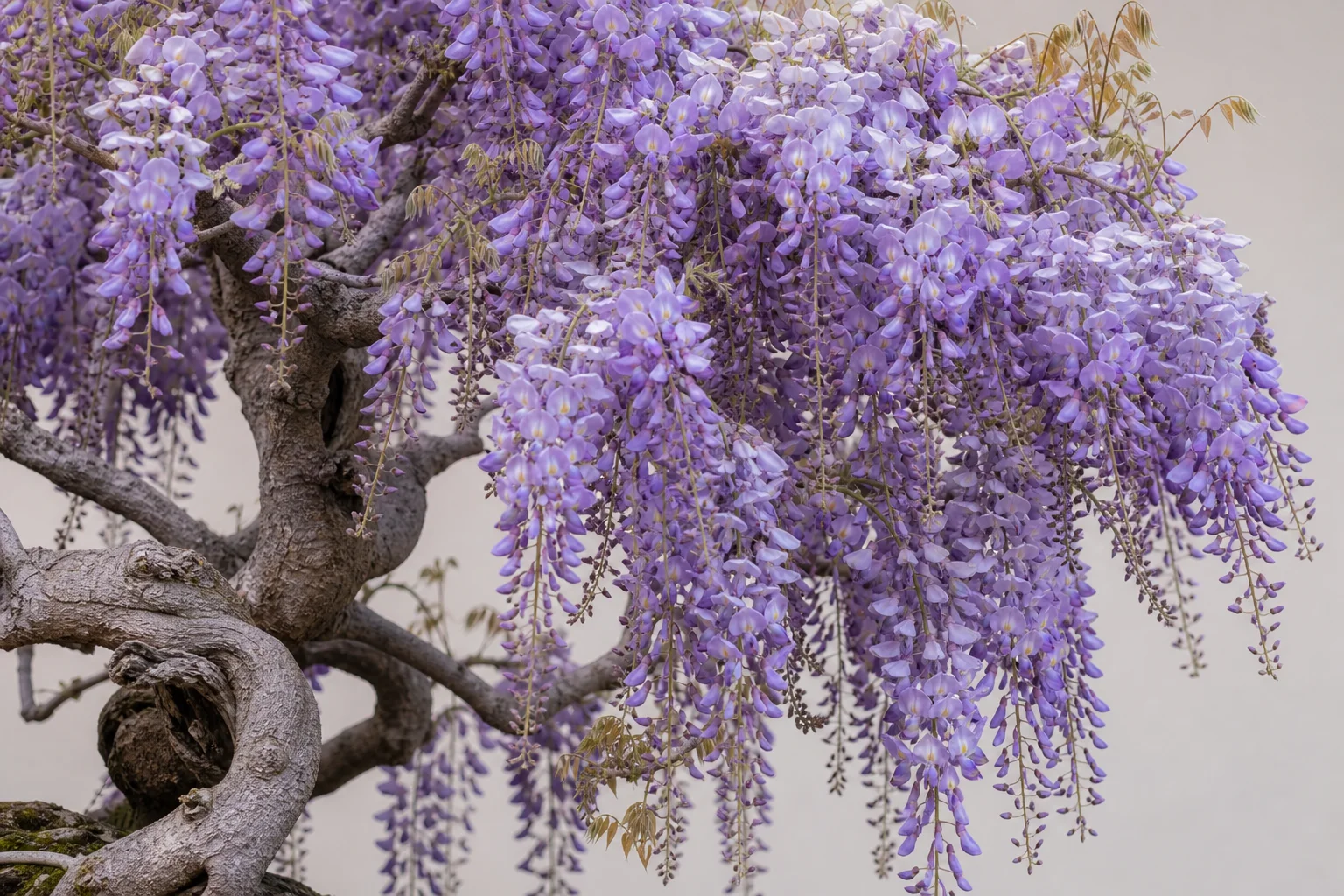
Wisteria bonsai care
Wisteria floribundaPendulous racemes of lavender, white, or pink flowers in May–June — the most spectacular flowering bonsai when it works, and the most frustrating when it doesn't.
Water
Every 1 day
check daily in summerLiquid feed
Every 7 days
growing seasonSolid feed
Every 28 days
slow releaseRotate
Every 14 days
even canopy growthWisteria bonsai is famous for two things: the breathtaking flowering display and the difficulty of producing one. A well-flowered wisteria bonsai in May is one of the most striking sights in horticulture — dense racemes of pendulous flowers hanging beneath the canopy on bare wood, often before leaves have fully extended. The species' natural climbing habit translates into bonsai as gnarled, sinuous trunk lines that suggest serious age within a few decades.
The frustration is that getting flowers reliably is the central challenge of the species, and many wisteria bonsai never flower at all. Five things matter: the right cultivar (seed-grown plants take 7–20 years to flower; grafted nursery plants flower much sooner), the right age (flowering is suppressed in juvenile plants), the right pruning (timing is specific and unforgiving), the right feeding (excess nitrogen produces foliage at the expense of flowers), and adequate light (wisteria flowers poorly in partial shade).
When all five align, the display is unmatched. When any one fails, you have a tree that produces vigorous foliage and no flowers, year after year. This is the bonsai species where buying carefully matters most — always buy a grafted plant from a flowering cultivar that you've seen bloom, never an unflowered seedling.
Two species dominate in cultivation: Wisteria floribunda (Japanese wisteria, longer racemes 30–90cm) and Wisteria sinensis (Chinese wisteria, shorter racemes 15–30cm but often densely packed). Both are excellent for bonsai; care is essentially identical.
Wisteria floribunda native to Japan; W. sinensis native to China. Both species have been cultivated in their native countries for centuries and were introduced to Western gardens in the 19th century. The famous wisteria displays at Ashikaga Flower Park in Japan show the species' potential at full scale. As bonsai, wisteria has been cultivated for at least 400 years in Japan, particularly in shohin and medium sizes where the proportion of flowers to canopy can be made dramatic.
Seasonal calendar
Timing is for South East England. Select your region above to see adjusted guidance.
- Second cut — prune previous summer's shoots to 2-3 buds
- Structural pruning while dormant
- Complete winter pruning
- Plan post-flowering repot
- Watch for flower bud swelling
- Do not feed
- Flower racemes elongate
- Protect from hard late frost
- Peak flowering display
- Do not feed during bloom
- Post-flowering: repot if needed
- Begin feeding with low-N high-PK formula
- First cut — prune long shoots to 5-6 leaves
- Continue feeding
- Switch to high-K tomato-style feed
- Watch for second flush of growth requiring trimming
- Continue high-K feeding for bud formation
- Stop feeding by month-end
- Autumn colour — yellow
- Reduce watering
- Leaf drop
- Begin winter wiring
- Structural pruning while dormant
- Bare-branch styling
Watering
Daily through the growing season — wisteria is genuinely thirsty when in active growth. In hot summer weather, twice-daily watering for trees in shallow pots is normal. The species tolerates more water than most bonsai — far more than pines or junipers — and some growers keep wisteria pots standing in shallow trays of water during peak summer growth.
In winter while dormant, water sparingly but never let pots dry completely. Wisteria roots can desiccate in dry winter weather and the resulting damage often only becomes visible in spring as poor leaf-out.
Tap water of any hardness is fine.
Feeding
Feeding strategy is central to flowering, and this is where most wisteria bonsai fail. The basic principle: lots of phosphorus and potassium, restricted nitrogen.
Through spring (March–May): no feeding. Flower buds are developing and feeding shifts energy to vegetative growth at the expense of flowers.
After flowering (June): begin feeding with a balanced or low-nitrogen, high-PK formulation. Weekly liquid feed at half strength. Continue through summer.
Late summer and autumn (August–September): switch to a high-potassium tomato-style feed. This is when next year's flower buds are forming. The phosphorus and potassium support bud development; excess nitrogen at this stage produces foliage at the expense of flowers.
Stop feeding by late September.
The single most common mistake on wisteria bonsai is feeding with general balanced fertiliser through spring. This eliminates the next year's flowering reliably.
Soil & Repotting
Free-draining and tolerant. Wisteria is unfussy about substrate.
60% akadama, 30% pumice, 10% lava is reliable. The species also performs well in cheaper development mixes. Slightly more moisture-retentive substrates suit wisteria better than the very free-draining mixes used for pines — the species likes moisture.
Repot every 2–3 years on young trees, every 3–4 on mature specimens. The window is immediately after flowering — June. Repotting in early spring like most deciduous species can reduce or eliminate flowering by disturbing roots during a critical period for the tree.
Wisteria tolerates aggressive root work — up to half the root mass on healthy trees. The species recovers fast and the post-flowering window gives plenty of growing season for recovery.
Pruning
Wisteria pruning is the most technical aspect of growing the species and the second-most-common cause of failure to flower (after feeding). The technique is a two-step seasonal cycle.
First cut (mid-summer, July–August): Cut back all new long shoots to 5–6 leaves. This is heavier than most species' pruning. The goal is to redirect energy from vegetative extension into bud formation.
Second cut (late winter, January–February): Cut these shoots back further to 2–3 buds. The buds remaining will produce next year's flowering wood.
This two-step process produces short flowering spurs that bear the racemes. Trees pruned only once a year, or pruned at the wrong times, tend to produce foliage on long extensions without setting flower buds.
Major structural pruning happens in winter while bare. Wisteria tolerates substantial cutbacks on woody material — old vines back-bud reasonably well, though less reliably than yew.
Wiring & Styling
Wire after leaves harden in summer or on bare branches in winter. Wisteria branches are flexible when young and stiffen quickly with age — major bends are best done on young wood. Bark is moderately resistant to marking. Aluminium for most work; copper for thicker structural branches.
The species' natural tendency to climb means heavy branches grow long quickly. Wire often needs checking every two weeks during active growth and may bite in within a season.
Informal upright with a sinuous twisting trunk is the classic wisteria style — referencing the species' natural climbing habit. Cascade and semi-cascade work particularly well because they showcase the pendulous flowering racemes to best effect. Twin-trunk and multi-trunk forms are common.
Formal upright doesn't suit the species. Aim for compositions that emphasise the sculptural trunk and create space below the canopy for the flowers to hang freely. A wisteria styled with a dense canopy at the front blocks its own flowering display.
Winter care
Fully hardy across the UK with no protection needed. Wisteria takes whatever the British climate produces.
Pot vulnerability is the main winter consideration — wisteria roots can suffer in pots during prolonged sub-zero periods. Position out of standing water and exposed wind in late winter. A position with some afternoon sun rather than full exposure helps moderate temperature swings.
Late frost on opening flower racemes is the most disappointing winter weather event. A hard April frost after racemes have started elongating can destroy the season's display. Shelter trees overnight during the bloom period if -2°C or colder is forecast.
Never bring indoors.
Propagation
Almost exclusively grafted in commercial nursery production — flowering cultivars onto seedling rootstock. Seed-grown wisteria takes 7–20 years to flower (sometimes never) and is unsuitable for bonsai. Air layering of an established mature plant can produce a flowering bonsai relatively quickly. The best route to quality wisteria bonsai is buying a grafted plant from a known flowering cultivar and developing it over 5–10 years.
Common problems
Generally healthy. Most problems trace to feeding errors, light levels, or pruning timing rather than pests or diseases.
Failure to flower
Symptoms: Tree produces vigorous foliage but no flowers, year after year.
Cause: Multiple possible causes: ungrafted seedling-grown plant (may take 20+ years to flower or never), wrong feeding regime (too much nitrogen), wrong pruning timing, insufficient light, tree too young.
Solution: Verify the plant is grafted from a flowering cultivar. Switch to low-N high-PK feeding regime from June onwards. Apply the two-step pruning technique. Ensure full sun position. If these are all correct and flowering still doesn't happen, the cultivar may simply be reluctant — try a different plant.
Aphids
Symptoms: Curled sticky young leaves and flower racemes; ants present.
Cause: Standard spring pest pressure, particularly heavy on wisteria.
Solution: Hose off carefully (avoid damaging flowers if in bloom). Neem oil after flowering. Inspect weekly in spring.
Scale insects
Symptoms: Small brown bumps on stems; sticky residue and sooty mould.
Cause: Common pest on woody wisteria.
Solution: Manual removal with alcohol-dipped cotton bud. Horticultural oil in winter on bare branches. Systemic insecticide for severe infestations.
Chlorosis from alkaline conditions
Symptoms: Pale yellow leaves with green veins, particularly on trees watered with hard tap water.
Cause: Iron deficiency from alkaline substrate.
Solution: Use rainwater. Repot into fresh substrate. Sequestered iron supplement helps short-term. Less critical than for satsuki azaleas but still worth attention.
Wire damage to flexible branches
Symptoms: Spiral wire marks visible on bark even after wire removal.
Cause: Wisteria thickens fast and wire bites in quickly during growth season.
Solution: Check wire fortnightly during active growth. Remove and re-apply as needed. Severe wire marks fade slowly but rarely disappear entirely. Future wirings should be looser.
Toxicity warning
Symptoms: No symptoms on the tree, but a safety consideration for the grower.
Cause: All parts of wisteria are toxic to humans and pets if ingested.
Solution: Keep prunings out of reach of pets and small children. Don't use wisteria offcuts in compost that animals access. Wash hands after handling prunings. Not a high-risk plant for most growers but worth noting.
Popular cultivars
Long racemes (30-90cm), generally lavender-purple. Vines twine clockwise. The standard for bonsai. Open flowers progressively from the base of the raceme downward.
Shorter racemes (15-30cm), denser flower clusters, often slightly earlier flowering. Vines twine anticlockwise. Excellent for bonsai. All flowers on a raceme open simultaneously.
Less common species with shorter dense racemes and slightly fuzzy buds. Some excellent named cultivars.
Cultivar with exceptionally long racemes up to 1.5m on garden plants. Spectacular but the raceme length can look out of proportion on smaller bonsai.
White-flowered form of W. floribunda. Refined and striking, particularly against dark bark.
Pink-flowered cultivar of W. floribunda. Less common but available from specialist suppliers.
Track your Wisteria with Kentai.
Collection tracking, care logs and photo history are free — no card, no time limit.
More care guides
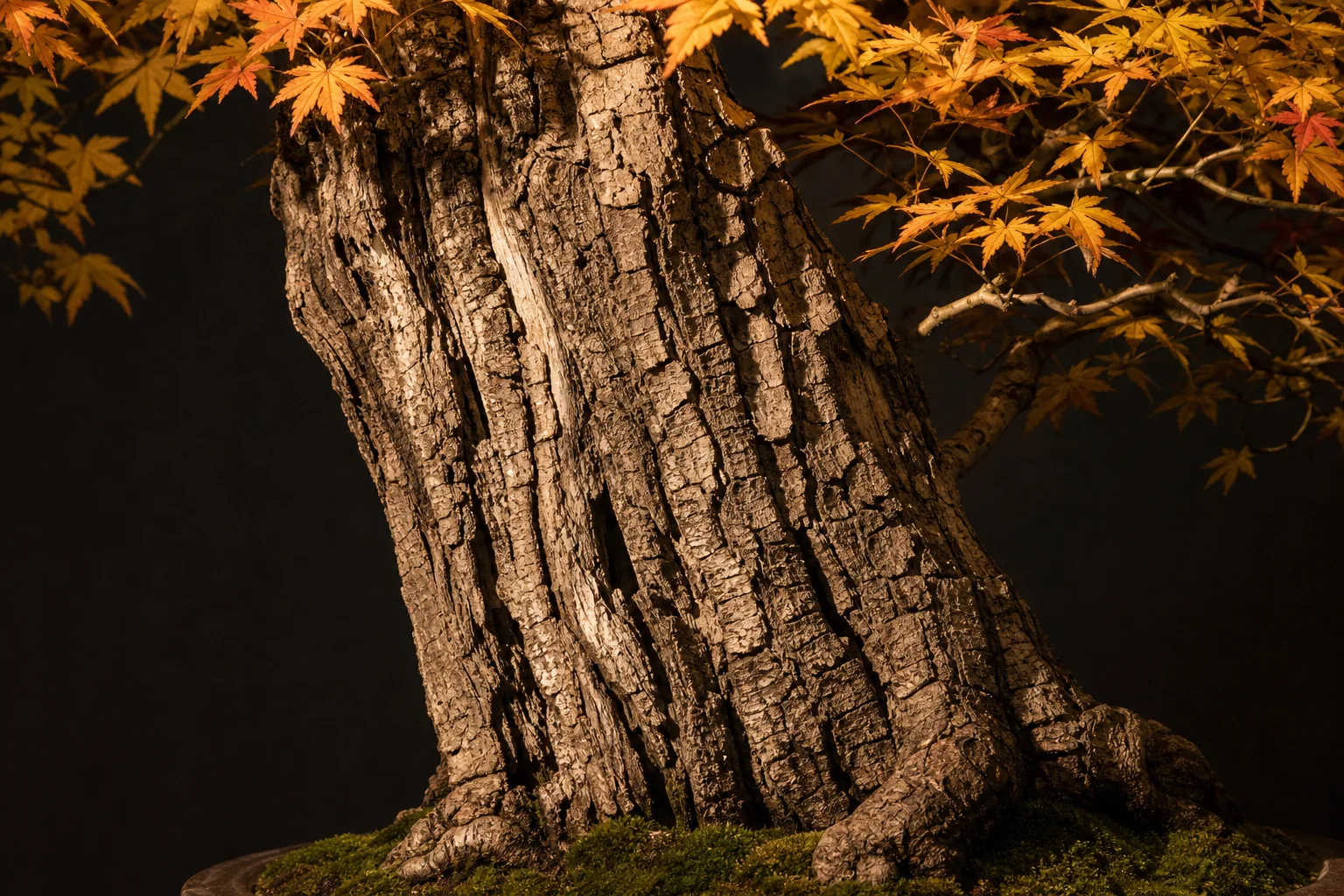
Arakawa maple
Acer palmatum 'Arakawa'The rough-bark Japanese maple. Develops corky deeply fissured bark unique among palmatum cultivars — trunk character that takes other species 50 years to acquire.
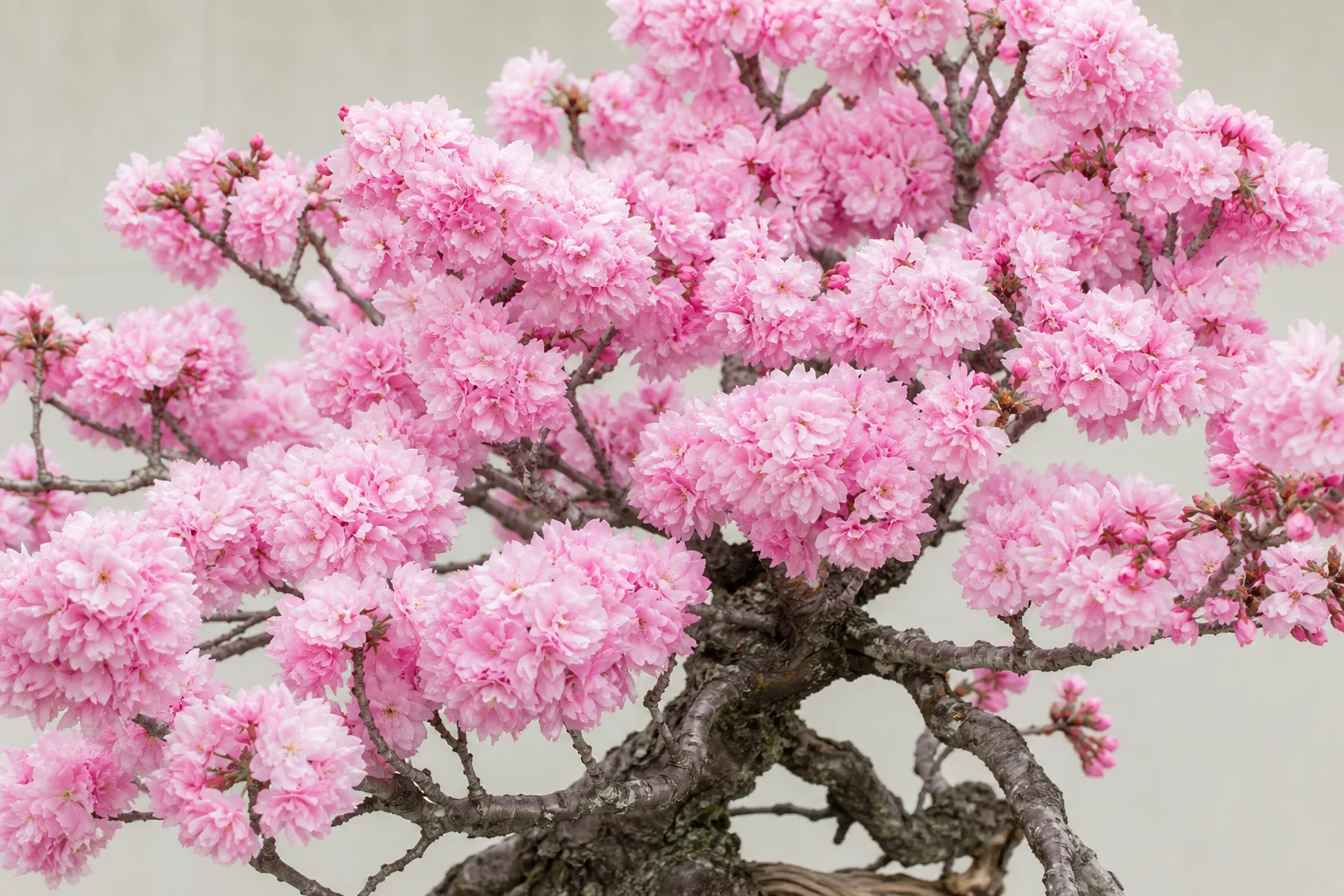
Cherry / Prunus
PrunusThe sakura genus. Includes Japanese flowering cherry, plum, peach, almond, and apricot — and produces some of the most culturally significant flowering bonsai in the tradition. Demanding but unforgettable.
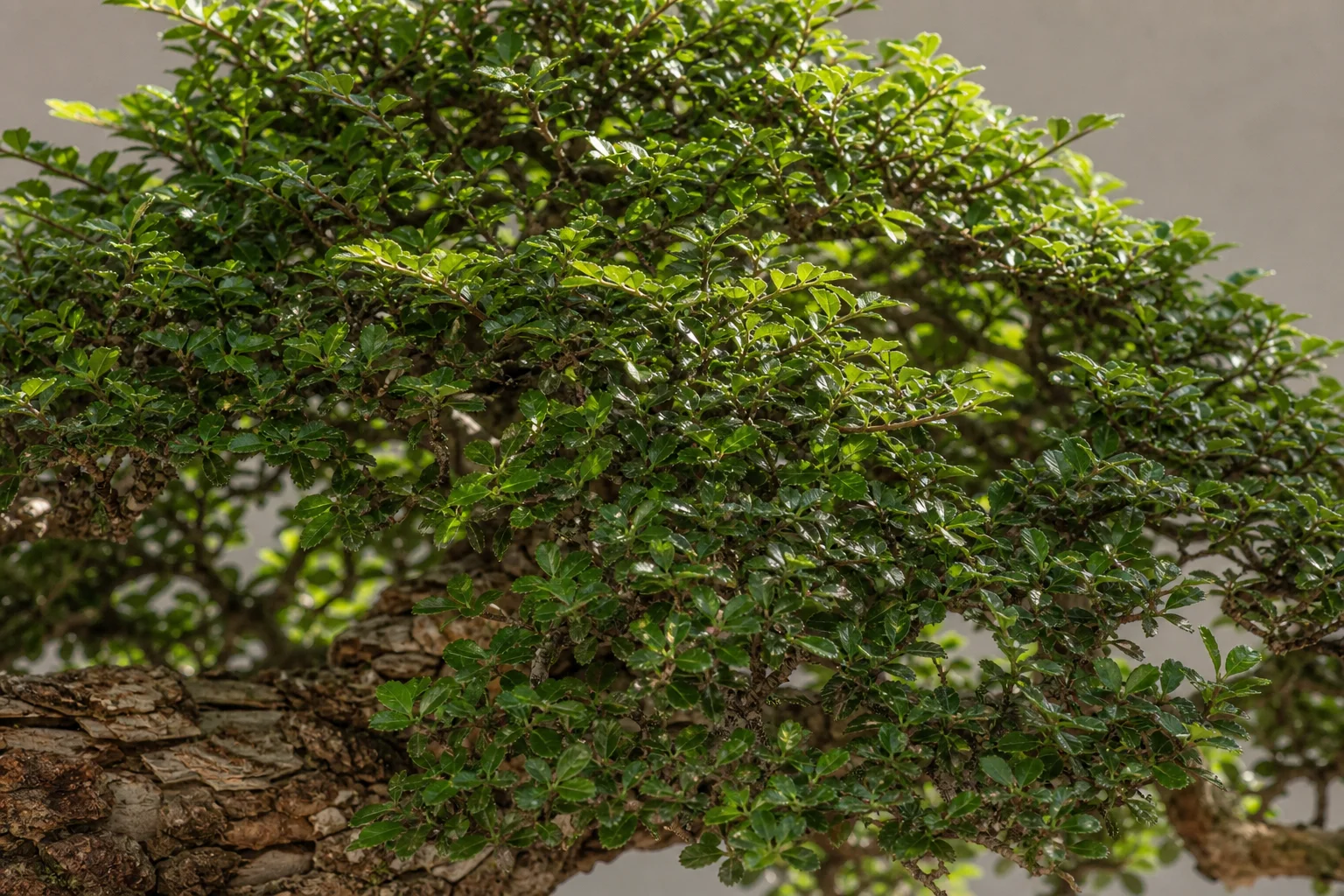
Chinese elm
Ulmus parvifoliaThe most forgiving deciduous bonsai. Fast, vigorous, tolerant of mistakes, and beautiful in every season.